Turning neodymium sludge back into magnets
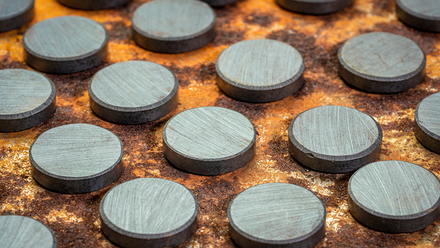
Active grain boundary reconstruction recycles sintered neodymium-iron-boron (Nd-Fe-B) sludge back into high-performance magnets.
The results, from Beijing University of Technology, China, are published in the paper Achieving near-complete recycling of Nd-Fe-B sludge into high-performance magnets via active grain boundary reconstruction in the journal SSRN.
The strategy reportedly achieves near-complete recycling using ~95wt.% regenerated powder.
The paper explains that 'high-value recycling of Nd-Fe-B sludge is often constrained by the environmental impacts of conventional routes' and 'performance degradation of the regenerated powder due to oxidation, contamination and deterioration of particle morphology'.
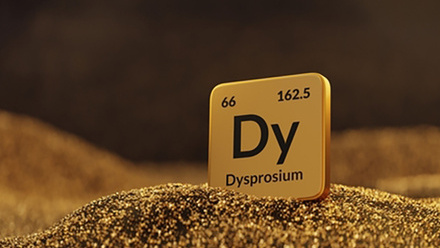
The process begins with 'multi-wire cutting sludge derived from high-performance sintered Nd-Fe-B magnets containing dysprosium (Dy) and terbium (Tb)'. Low-oxygen, quasi-spherical powder is obtained from this sludge through 'deep purification followed by calcium thermal reduction deoxygenation'.
Following this, a ball-milling-assisted surface coating with rare-earth hydrides is used to compensate for compositional losses.
Microstructural analyses are said to show the rare-earth hydrides also act as 'localised liquid-phase sources' that help guide reconstruction of a continuous, non-magnetic, thin grain boundary phase during sintering.
Meanwhile, under optimised processing conditions, 'residual oxides inherent to the regenerated powder are transformed into beneficial magnetic isolation phases'.
The synergistic effects of the hydrides and residual oxides are said to enable the 'exceptional recovery' of remanence (Br) and coercivity (Hcj) exhibited by the team’s optimal regenerated magnet, named RM-1080.
Testing of RM-1080 reports performance values of Br = 1.327T, Hcj ~1.627x10⁶A/m and maximum energy product ((BH)max) ~342.1kJ/m3, similar to the original magnet’s values of Br = 1.383T, Hcj ~1.633x10⁶MA/m and (BH)max ~372.1kJ/m3.
The regenerated magnet is also said to show 'temperature stability superior to that of the original magnet'.
These properties are attributed to three key mechanisms, revealed through microstructural and magnetic domain analyses.
The Nd-rich coating boosts remanence by enhancing densification and grain boundary wettability. Inherent residual oxides in the regenerated powder are transformed into beneficial magnetic isolation phases, contributing to coercivity.
Also, an (Nd,Tb)2Fe14B core-shell structure is formed by precisely replenished Tb, which enables high coercivity and temperature stability.