

Spray coating boosts prospects for multilayer bioplastic packaging
A water-based process holds promise for films that are both high-performing and easier to manufacture.
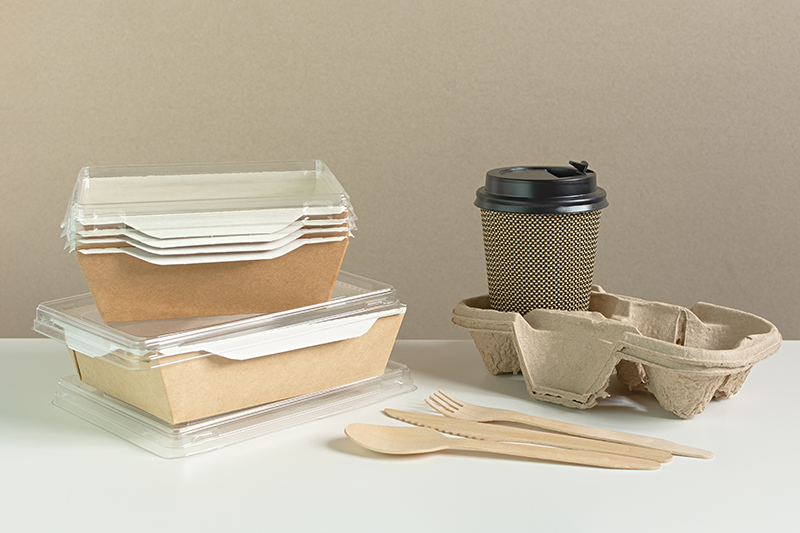
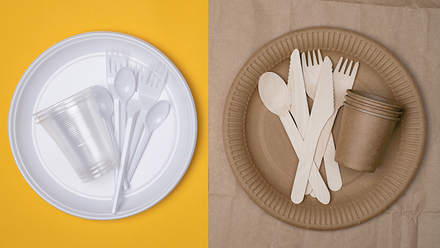
Examples of food containers that a multilayered bioplastic could help replace
© Anna_Zaitzeva/ShutterstockResearchers at Virginia Tech, USA, claim their work represents the first attempt to fabricate bioplastic-based multilayer structures using a water-based polyhydroxyalkanoate (PHA) suspension through spray coating.
The system combines bioplastics PHA with a biopolymer – hydroxypropyl methylcellulose (HPMC).
Wider adoption of bioplastics in packaging depends on their ability to match conventional films in strength, processability, and resistance to oxygen and water vapour.
Professor Young-Teck Kim at the university says HPMC was selected for 'its excellent transparency and oxygen barrier properties derived from cellulose'. However, HPMC’s high hydrophilicity and poor moisture barrier performance limits its direct use in packaging applications. In the multilayer system, PHA plays a critical role in providing water resistance.
'In general, bioplastic layers provide superior mechanical performance, whereas biopolymeric substrates contribute complementary functional properties, such as excellent oxygen barrier performance, cost efficiency and the stiffness required for packaging applications,' explains Kim.
Unlike conventional methods, where polymers are dissolved in organic solvents, the Virginia Tech team disperses the PHA particles in deionised water. The suspension is then spray-coated onto the HPMC substrate. After coating, the structure is dried and hot pressed, using heat and pressure to support multilayer formation and improve integration between the layers.
'Under controlled pressure and temperature conditions, the PHA layer can be directly bonded to various substrates without the need for an additional adhesive or tie layer,' says Kim. 'This behaviour is attributed to the thermoplastic characteristics of PHA, which also enable the material to function as a heat-sealing layer.'
Testing shows that hot pressing is key to improving the multilayer structure. It reduces surface roughness from 5.66 to 0.08µm at 5MPa, lowers the oxygen transmission rate from 120.49±4.63 to 52.24±1.19cm³/m²·day, reduces the water vapour transmission rate from 1,170.31±12.85 to 423.14±7.75g/m²·day, and increases tensile strength from 42.29±2.47 to 70.17±3.11MPa.
Scanning electron microscopy and 3D surface profilometry was used to examine surface morphology and smoothness, and to assess interfacial adhesion and lamination quality between the two layers.
The current work focuses on a bilayer structure, but Kim says the process could be extended to more complex multilayer designs, including trilayer and quadruple-layer structures. This could allow different functional layers to be combined while retaining the water resistance and heat-sealing role of PHA.
Kim says the laboratory has already developed bilayer and triple-layer, PHA-coated paper structures capable of serving as a potential alternative to ethylene vinyl alcohol and as antimicrobial packaging systems. The team is investigating the effects of antimicrobial agents within PHA-based, multilayer packaging systems for a variety of food applications.
The system is reported to be compatible with existing commercial-scale manufacturing, and Kim suggests it may offer advantages over conventional extrusion-based coating technologies.
'Conventional polyethylene coating layers are typically in the range of 20-50µm in thickness, whereas our system can achieve functional coating layers in the range of approximately 5-30µm, depending on the targeted application. As a result, this approach has the potential to significantly reduce overall material consumption while maintaining the desired packaging performance.'
The team is now preparing the technology for commercial translation, with industry engagement already underway.
More like this...

Recent events
- Free
NMG Lunchtime Series: Focus on Bioplastics
Join our Natural Materials Group's monthly virtual event, where we will focus on Bioplastics
- Free
NMG Lunchtime Series: Focus on Bioplastics
Join our Natural Materials Group's monthly virtual event, where we will focus on Bioplastics