Adhesive-free sealing to enhance paper packaging recyclability
A heat-based laser treatment could enable adhesive-free paper packaging to simplify recycling at the end of its life.
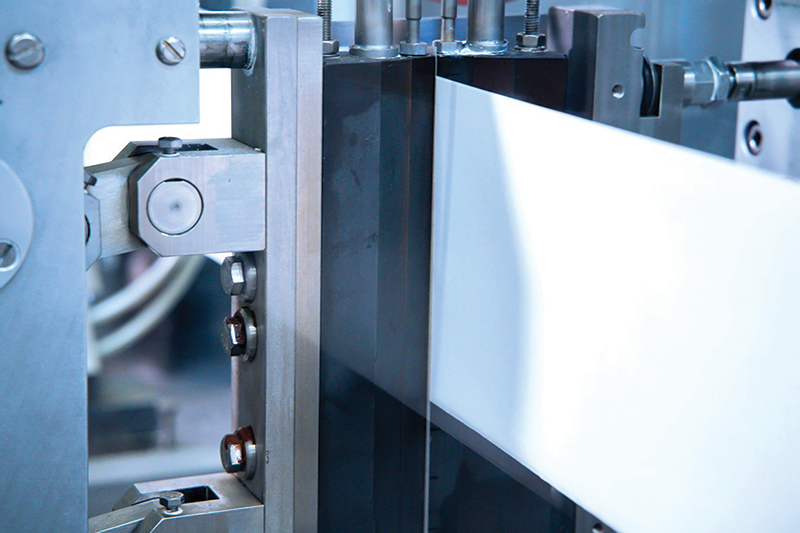
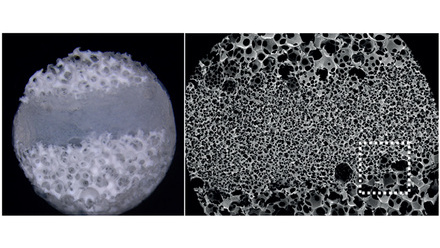
A paper web sealed by the heat contact process
© Fraunhofer IVVIt could also enhance the quality of the recyclate.
Four institutes as part of the Fraunhofer-Gesellschaft research centre in Germany have carried out the work in the Papure project.
They have designed a controlled process for irradiating the paper surface with a carbon monoxide (CO) laser. This rapidly heats the paper and converts hemicellulose, cellulose and lignin into short-chain compounds.
These become fusible cleavage products on the surface, which can be sealed under heat and pressure. Group Manager of Laser Micro Processing at Fraunhofer IWS, Volker Franke, says these are 're-fusible, sugar-like reaction products' in place of the conventional synthetic adhesives.
Paper packaging, while offering a high recycling rate, cannot yet be sealed without adding adhesives or plastic layers. These additives can contaminate the paper, complicate recycling and reduce the recycled material’s quality.
The new laser technology is currently designed for uncoated papers, but the team initially characterised around 36 types – including coated, uncoated, printer papers and cardboard – to determine whether they would be suitable for adhesive-free sealing. They were particularly looking at cellulose, hemicellulose and lignin content.
Robert Protz, Research Scientist at Fraunhofer IAP, explains, 'An excessive proportion of inorganic compounds, such as talc and calcium carbonate, have a negative effect on the adhesive properties and bond strength of the seams.' He adds that thicker standard papers available on the market were found to be 'more suitable for binder-free sealing'.
A 6m-long, 1m-deep, 2m-high, demonstrator manufacturing unit is currently being built at Fraunhofer IWU in Dresden, with a laser and sealing module integrated. This will replicate the roll-to-roll manufacturing process for a flat, four-sided bag – a common packaging design.
A paper web is run continuously through the plant and irradiated with a CO laser. This is followed by a second paper that is joined to the first along four seams to form a bag, using a combined heat-sealing and punching tool. Heat activates the cleavage products, bonding the two paper webs together.
The team is improving bond strength and leak-tightness by adjusting the sealing parameters and tool geometries.
Fabian Kayatz, Project Coordinator at Fraunhofer IVV, explains, 'Bond strength determines how difficult it is to…open packaging. Crucial sealing parameters are time, temperature, pressure and tool geometry. Fibre direction, i.e., the orientation of the material relative to the sealing tool, also plays a role.'
Project Head at Fraunhofer IWU, Marek Hauptmann, says the team is 'striving for a bond strength that is higher than the interply adhesion of the paper layers'. He shares that they are 'already achieving good bonds in the shear tests' and can 'easily lift 20kg with a seal that is only 2cm long and 3mm wide'.
A future seal seam measurement system in the pilot plant will record real-time changes in seal seam quality, enabling rapid adjustments and acting as a quality control.
Christer-Clifford Schenke, Fraunhofer IWU Research Scientist, says that, by the end of the project this autumn, 'our goal is to produce 10 packages per minute on the pilot system', as well as reach Technology Readiness Level 5.
While this is 'below the output of standard packaging machines on the market', the researchers intend to increase it in future.
They believe the water-soluble cleavage products and lack of added adhesives will likely make the technology compatible with paper recycling processes and could reduce production costs, but further work is needed to confirm this.