Recycling aluminium
Exploring patents related to recycling scrap aluminium.
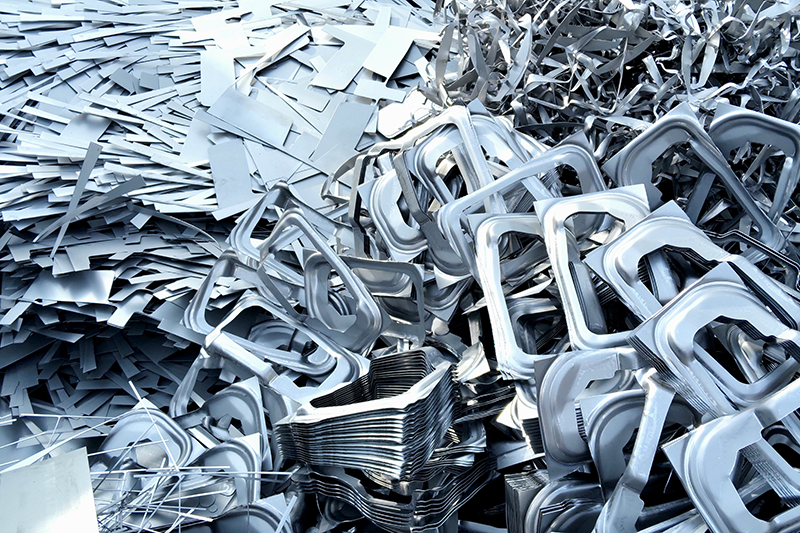
Aluminium alloys are widely used in engineering for their high strength-to-weight ratio and corrosion resistance. Many different alloy systems exist, categorised broadly according to their main alloying elements, with different alloys varying in terms of mechanical properties, density, weldability and so on.
Aluminium can be also formed using various different processes, but one common method to produce hollow components like aerosol cans, bottles, or other pressure vessels is known as impact extrusion. This involves striking a cold metal slug with a punch at high velocity, causing the metal to flow backwards around the punch and into a die to form the desired shape.
Due to the extreme deformation involved, impact extrusion traditionally requires very soft and ductile metals. In the case of aluminium, the process has historically relied on high-purity 1000-series (such as 1070 or 1050) alloys that contain at least 99.5% aluminium.
In contrast, stronger alloys, such as those in the 3000-series with manganese and magnesium, are typically used to produce consumer products like beverage cans. Due to the single-use nature of these products, large volumes of 3000-series scrap material is generated. Unfortunately, the higher strength of this alloy series is also associated with lower ductility, making recycled scrap alloys unsuitable for conventional impact extrusion.
A US patent, US 12,385,112 B2, granted to Ball Corporation in August 2025, seeks to provide a solution. This claims an aluminium alloy slug specifically designed for impact extrusion and defined in terms of physical and chemical characteristics. The claimed slug has a thickness of 3-14mm and is formed by mixing between 20 and 60wt.% of recycled aluminium material with a prime aluminium material.
The final alloy’s composition is precisely defined. The aluminium content ranges from 97.84-99.31wt.%, with limits on the silicon, iron, manganese, magnesium, zinc, chromium and titanium contents. This composition can be produced by blending recycled 3000-series alloys with a 1000-series alloy.
The patent also details the manufacturing process required to produce the slug.
The method starts with melting the pure and recycled materials together, preferably in an indirectly heated furnace to minimise material loss from oxidation. A grain refiner like titanium boride can be included to control the microstructure. The molten alloy is then cast into a continuous slab, which is subsequently hot- and cold-rolled to reduce its thickness, before being punched to create the individual slugs.
Annealing of the punched slugs can be carried out to recrystallise the grain structure, decreasing the material’s strength and increasing its ductility. The patent describes a preference for continuous annealing over batch annealing, as this reduces aluminium oxide formation as well as offering an improved and more uniform metallurgical grain structure.
A finishing step, such as shot blasting or tumbling, can roughen the slug’s surface. This removes surface oxides, increases the surface area and creates small depressions that act as reservoirs for lubricant – beneficial for high-pressure, impact extrusion processes.
According to the patent, containers produced using the claimed slugs offer significant benefits, including high strength at a lower weight. From a sustainability perspective, the invention also provides an effective method for upcycling scrap aluminium, saving valuable natural resources.
The commercial importance of this development to Ball Corporation is highlighted by the number of granted patents in the same patent family. For example, three corresponding patents have been granted in Europe, protecting different aspects of the technology.
European patent EP 3 144 403 B1, for instance, claims a broad method that involves blending 10-60% of a 3105, 3004, 3003, 3103, 3013, or a 3104 aluminium alloy with 40-90% of a 1070 or 1050 alloy. The blended aluminium alloy is used in an impact extrusion process to form a metallic container.
Other family members, EP 2 756 108 B1 and EP 3 141 624 B2, claim specific manufacturing processes in greater detail.
EP 2 756 108 B1 protects the entire manufacturing method for producing a shaped container with a curl adapted to receive an aerosol valve or a crown closure. This includes melting the specific alloys and casting a slab, through to the rolling, punching, annealing, finishing and forming steps.
Similarly, EP 3 141 624 B2 claims a detailed manufacturing process that specifies different alloy blending ratios and includes steps for adding titanium boride, performing continuous annealing, increasing the surface area of the slugs and tumbling them with a lubricant.