Manganese layer protects stainless steel for seawater hydrogen production
A dual-layer protection strategy can reportedly produce a stainless steel strong enough for seawater electrolysis.
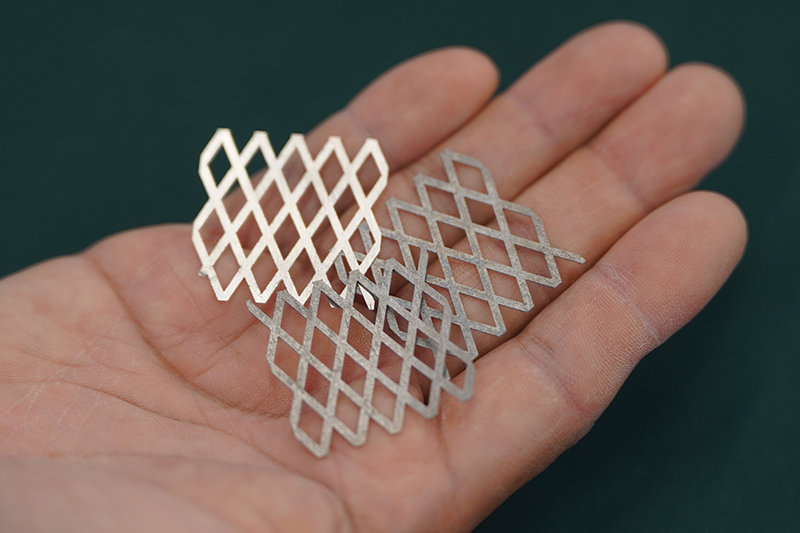
The stainless steel developed for seawater hydrogen production
© The University of Hong KongThis could offer an economical alternative to more costly gold- and platinum-coated titanium (Ti)-based parts.
The unexpected ingredient in this 'sequential dual-passivation' approach is manganese (Mn) – a mineral often viewed as problematic for corrosion resistance.
The team at the University of Hong Kong initially focused on developing low-cost and nickel-free stainless steels. Manganese was explored as an austenite-stabilising element and a potential replacement for nickel. Carrying out electrochemical testing of corrosion resistance, the researchers made a surprising discovery.
'Some Mn-containing stainless steels survived at very high potentials [during oxygen evolution], where ordinary chromium (Cr)-based stainless steels would normally fail,' says Professor Mingxin Huang at the university.
This prompted the team to investigate Mn’s role in providing high-potential passivation. The result is a sequential dual-passivation strategy, in which conventional chromium (III) oxide (Cr₂O₃) provides protection at lower potentials and Mn provides an additional shield when the potential enters the water-oxidation region at ~720mV.
This mechanism allows the alloy to maintain corrosion resistance in chloride-containing environments up to 1,700mV, while still 'offering efficient current transport as a structural material', explains Huang. 'This means that critical components such as bipolar plates and porous transport structures could potentially be made without relying heavily on noble-metal coatings.'
The challenge was 'to control the alloy composition and microstructure so that Mn could contribute to high-potential passivation rather than becoming a weak point', Huang shares. They introduced some silicon 'to suppress oxidation-induced elemental segregation and help stabilise the near-surface chemistry during passivation'.
He describes how the two protective layers are not like ordinary coating layers. 'We do not deposit a Cr layer and then an Mn layer. Instead, they form naturally during electrochemical operation. Chromium first forms the conventional Cr₂O₃/Cr(OH)₃ passive layer at lower potentials. When the potential increases into the water-oxidation region, Mn is activated and forms a MnO₂-based protective layer. This is why we call it sequential dual-passivation – the material builds its own protection step-by-step as the environment becomes more demanding.'
He notes that 'proving this mechanism was technically very difficult because the passive film is only a few nanometres thick and changes with potential. We used atomic-level characterisation to look at the surface and near-surface regions after electrochemical testing'.
Huang adds, 'If structural components can be made from a stainless steel for hydrogen production (SS-H₂) rather than Ti with precious-metal coatings, green hydrogen production could become less expensive and more affordable at large scale.'
The next step is to move from material development to engineering validation. 'For real electrolyser applications, we still need to test the material under more practical operating conditions, including long-term operation, fluctuating potentials from renewable electricity, anodic and cathodic environments, and different electrolyte chemistries,' he explains.
Huang says one direction is to develop different SS-H₂ grades for these varying electrolyser environments and electrochemical conditions. The research has moved from lab-scale samples to projects with industrial partners.
Scaling the technology remains a challenge. They are developing the related forming and manufacturing processes in parallel, so the alloys can be made into practical components.
'When we make thin plates, meshes, foams, or porous transport structures, the forming process can affect the surface chemistry, microstructure, contact resistance and passivation behaviour,' Huang says. Iterating the alloy grades and manufacturing routes together is important, he asserts, so that the material can meet the requirements of practical electrolyser components.
Recent events

EUROCORR 2026
The European Corrosion Conference, the flagship event of the international corrosion calendar, promises investment for the future by addressing the corrosion challenges of green technologies
Dublin
EUROCORR 2026
The European Corrosion Conference, the flagship event of the international corrosion calendar, promises investment for the future by addressing the corrosion challenges of green technologies
Dublin