Industry evolution in steel
As part of the Institute's 150th anniversary, our Iron and Steel Group looked at 150 years of the iron & steel industry, with commentary about the past, the present, and potential future opportunities.
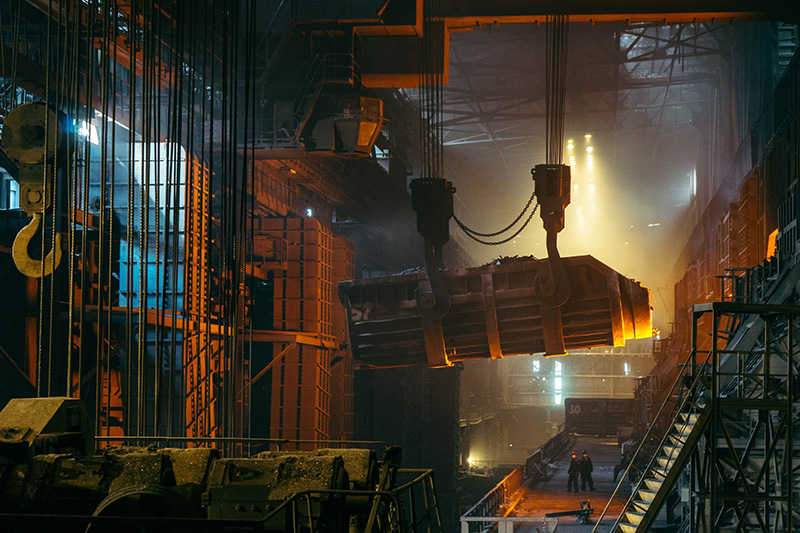
Over the last 150 years, hundreds of engineers, scientists and technicians have cut their teeth taking society forward via developments in the Iron and Steel arena.
This section is a tour around the manufacturing processes over the period.
1869 - 1900: The Bessemer Years - The Bessemer Process
Prior to the Bessemer process developed in 1856, wrought iron was the material of choice for infrastructure, and shipbuilding. The benefits of steel were well known from the manufacture of cutlery small engineering components and armour, due to its improved properties, particularly ductility and ease of shaping, however the existing process was long and laborious and products could only be made in small batches. Bessemer's invention of injection of hot air blasted through liquid Iron to decarburise the iron, meant that steel for the first time could be manufactured in large quantities, at a fraction of the cost and time of the cementitious process. Suddenly steel was available to all enabling the growth of rail transport systems and shipbuilding. While the process was patented in 1860 and the first cast made on the 18th June 1859 it would be another 20 years before the process was widely accepted.
The initial slow implementation of the Bessemer process was due to the high volatility of production (oxygen) and the presense of high phosphorous in the ores. Initially for high quality steels the Bessemer process relied on the procurement of low phosphorus ores from Sweden and South Wales, which limited the production. This was coupled with the slow acceptance for shipbuilding where it wasn’t until a report by Lloyds register in 1869 that steel was certified for use in Shipbuilding. The Lloyds register of ships in 1889 still shows the transition from Iron and wood to Steel ships, though increasingly the introduction of large steam powered ships, would accelerate the transition to steel. By 1900 the UK made 61% of the worlds ships. This had also transformed the industrial map of Britain with the traditional wood based southern yards giving way to the mainly Northern based yards of the 1880s onwards, due to the abundance of ironmaking, and coal resources. By the end of the century steel had also come to displace wrought iron in structural steel, with the building of the Forth Bridge (1890 54KT) and Blackpool Tower (1894 2.5KT).
Despite the enormous step change the Bessemer process brought, some significant developments were needed to enable bulk production.The deoxidation of the steel relied on the invention of Robert Foster Mushet, who in collaboration with the EBBW Vale Company patented the process of the addition of ‘a triple compound of iron, manganese and carbon to deoxidise the bath before teeming the metal into the mould’. Unfortunateley this wasn’t taken up initially and the patent expired in 1859. When commercial production began in the Bessemer Works, Mushet received no royalties, though Bessemer voluntarily paid him a pension for the rest of his life.
The problem of using high phosphorus ores and dephosphorising was finally solved after a series of experiments by various researchers particularly Snelus ( lime based brick lining) and Sydney Gilchrist Thomas, in collaboration with Percy Carlisle Gilchrist, a chemist at Blaenavon Works. Although the lining isssues had been solved the steelmaking performance proved erratic. J.E. Stead, also working at the Blaenavon works, experimented with blowing of lime through the tuyeres. He noted the effective removal of phosphorous during the overblow, reasoning that both basic and strongly oxidising conditions were required for effective removal of phosphorus. The findings of all this work were presented by Sidney Gilchrist Thomas on his seminal paper 'basic steelmaking' at the spring meeting of the Iron and Steel Institute in 1879.
The Bessemer process would remain in operation until 1978 (in the production of forging ingots for which it was well suited), though it was progressively phased out for bulk steelmaking in the period 1900-1920 with the advent of open hearth steelmaking and the introduction of Electric Arc steelmaking.
All steel was cast into ingots or moulds for subsequent forging or rolling into semi products. Forging was carried out by the steam hammer and rolling by the stream driven two-high mills of the time. Much of the forging and rolling processes had been around from antiquity, but enhanced from the dramatic increase in force from steam drives.
Research and development during early industrialisation
Although steel had been researched since the early 1800s the methodology was largely empirical and based on the observed properties, from the use of small test samples. The main driver for research following Bessemer's invention, and the step up in scale was to control the chemistry of the reaction, particularly deoxidising (using Manganese) and dephosphorising using lime, in both Bessemer converters and open hearth. Each steelworks generally had resident chemists, whos main focus was to control the process, and increase productivity.
The technique of using spectroscopy to analyse the metal, had been experimented with in the mid 1800s and was now employed to apply science to process control. The extract opposite is from Bessemer heats in Sheffield, showing the correlation between the observation by eye and the spectroscopic analysis. This gave rise to controlling the C and P and minimising overblow.

Spectroscopic analysis of Bessemer Casts, Sheffield Works
Metallography was in its infancy, but developed rapidly from the 1880s largely as a result of work of a Sheffield geologist Henry Clifton Sorby, with a seminal paper relating changes in microstructure to changes in composition and processing, presented at a meeting of the Iron and Steel Institute in 1884. He named the pearly structure sorbite, but it would later be changed to pearlite, due to its ‘pearly‘ nature under optical microscopy.
Temperature measurement was crude until the platinum–rhodium thermocouple introduced in the latter stages of the century. This allowed for experimentation on actual temperature changes and combined with the metallography of the day would lead to the first edition of the Iron- Iron carbide equilibrium diagram in 1899, which is still researched to this day.
1900-1960: The growth of open hearth and electric arc - early 20th Century process evolution
Shortly after the Bessemer process in 1856, Sir William Siemens invented the open hearth process in 1867, by merging two technologies of regenerative heating with Martins process of diluting pig iron with wrought iron scrap prior to refining. The process, used preheating of the incoming air, combined with heating from regenerative waste gases, enabling much higher temperatures to be achieved. One key advantage over the Bessemer process was the ability to utilise scrap steel and wrought iron, which was abundant and cheap. The process also had a higher flexibility of raw material inputs, and closer control of the process, This led to a massive increase in applications for open hearth steel, and its rapid rise in the last decade of the 19th Century would see it become the dominant steelmaking process until its decline in the 1960s. At the start of the century the acid open hearth process was the dominant process, however the iron ore demand could not be satisfied by sourcing of relatively scare low phosphorous ores, and so the basic process rapidly became the dominant process by 1920 onwards.
The carbon arc was discovered by Sir Humphrey Davy in 1810, and small arc furnaces were patented by Siemens in 1878, however enhancement to bulk steel commercialisation awaited introduction of large scale electrical power and the production of robust carbon electrodes. The first commercial batch of electric arc steel was manufactured in France from the Heroult process in 1900. The EAF has seen steady growth over the 20th Century largely related to higher power densities and efficiencies, and its main advantage of relatively installation cost compared to Integrated works. From the early days Electric Arc has always been the favoured route for the production of alloy steels, due to its ability to melt metals from scrap or ingots. This differentiation exists to the day with the bulk ‘low alloy’ steels generally made via BOS Integrated plants and alloy steels such as stainless, and tungsten tool steels made via EAF.
In the first half of the 20th Century, the driver in alloys steels was to develop armour steels for gun barrels and armour plating. Experiments in the 19th Century had shown chrome and nickel improving hardness and toughness, but the process was difficult to control, until the advantages of low carbon were later understood. It was while experimenting with armour plate steels that one Harry Brearley ‘discovered’ the corrosion effects, and produced the first stainless steel in 1913.
Early 20th century technological developments in steel
The main hot working processes of rolling, forging tube making and wire drawing had been established practise in the 19th Century. In the first half of the 20th Century these would be significantly enhanced, with the development of the electric motor, increasing the power, and introducing process control. The electric motor also paved the way for continuous mills, initially for bar and rod but then quickly for the production of strip around 1920.
Up until the 1920s the main joining method for steel had been riveting which was time consuming and wasteful due to the material overlap needed. Gas welding had been invented in the late 19th century, and though adopted for some tube applications, was not widely used. The driver for adoption of the technology was the time leading up to and during WW1, where productivity was key in supporting the war effort with tanks, aircraft and ships. Although this was a great success, there were problems emphasised by the Liberty ships where some broke in half due to brittle fracture. This however spurned the new science area of fatigue and fracture, leading to the drive for low sulphur, low phosphorous steels, and the the derivation of the Carbon equivalent formula to avoid preheating, which drove carnon levels down.
The Iron and Steel Institute formed in 1869 had fostered collaboration between the steel companies, however up until the 1930s the main research was carried out in works laboratories. The 1930s heralded the introduction of ‘big science’, and the steel industry saw opportunities to benefit from large scale research, graduating from the existing committees of the Iron and Steel Industrial Research Council (formed in 1929), to the British Iron and Steel Research Association formed in 1944. The group also undertook foreign sponsored projects through associations with such bodies as the International Flame Research Foundation in he Netherlands and Belgium, now superceded by RFCS. The laboratories included Battersea in London, Sketty Hall in South Wales, Imperial College London (fundamental Ironmaking) , Normanby in Middlesborough, and Hoyle Street in Sheffield. Later the laboratories of United Steels in Rotherham ( STC), a new centre in Grangetown (now MPI) and Scottish labs in Motherwell would be added to the mix. Some of the pioneering work in these labs, paved the way to the step change in productivity and quality that occurred from the 1960s.
1960-present: evolutions in productivity and quality growth of large scale continuous processing
Since the early days of the Bessemer process, and patented by Bessemer himself, the availability of large quantities of pure oxygen, would potentially dramatic reduce the conversion time, and increase the refinability of the process. In the '40s and '50s a low cost method of producing large quantities of oxygen was developed, and coupled with extensive research in converter technology, in both the UK and particularly in Austria, Basic Oxygen Steelmaking was born. The stirring and mixing capabilities of large quantities of oxygen, also improved slag metal reactions and provided the means for step change cleanliness of the steel. This led to a dramatic increase in economies of scale, with 350T converters now commonplace. The pure oxygen could also be blown into the EAF, increasing its capacity and operational cost, with 100T plus EAF’s now commonplace.
The significant increase in productivity drove the R&D on continuous processing. BISRA had demonstrated a continuous casting machine at its Sheffield Group Laboratories in 1962, though it wasn’t until the late 1970s before the first commercial slab caster was introduced to the UK.
Both BOS and EAF were efficient melters, but further refining was necessary to meet the increasing demands of the market, particularly the drive for steel cleanliness, (low nmi), low SPOON (sulphur phosphorous oxygen and nitrogen), ultra low carbon steels, micro alloyed and alloyed steels. Extensive R&D in the 60s. 70s and 80s had delivered various secondary steelmaking options, CAS-OB, LA/ LD, VAD, VAR, ESR etc, in order to tailor heats to customer specifications.
Downstream processes were also driven by productivity with enhanced continuous rolling mills, run out table cooling (ROTC), Continuous annealing, roller quenching and accelerated cooling.
Late 20th Century steelmaking technological improvements
Up until the 1950s the only technique for microscopy was optical. With the invention of the electron microscopes (both scanning and transmission), came an explosion in research particularly into the effects of microalloying in steels. Large scale projects across Europe ULSAB (ultralight steel automotive body) driven by the desire for lower car emissions, drove the development of ultra high strength steels, and spurned offshoots into other market sectors.
Welding and joining, and now the established science of fatigue and fracture and structural integrity, pushed steelmaking to lower C levels and higher levels of cleanness. The introduction of laser welding with its narrow gap and high dilution rates pushed phosphorous levels down, and focussed researchers on thermodynamic understanding and optimising secondary steelmaking.
Richard Hewitt, Public domain, via Wikimedia Commons
Environmental emissions driven by the EU and globally would lead to a large scale research programme ULCOS (ultra low CO2 steelmaking), and research into capturing offgases and demonstration of new Ironmaking processes, such as HISARNA and Finex.
Future evolution of the uk iron and steel industry
Since its inception in the mid-19th Century up until the 1980s, steel has been largely driven by productivity. The abundance of electricity leading to electric arc and the abundance of low-cost pure oxygen leading to BOS gave us the two main steelmaking processing in use today. However since the 1980s environmental drivers and increasing customer demands have continued to shape the steel industry of today and into the future.
Environmental targets have led to large scale research projects such as HISARNA and Finex which reduces the CO2 byproduct of ironmaking significantly. Other projects such as Carbon Capture and Utilisation(CCU) are still in their infancy though there are some encouraging projects in this area.
Just as the abundance of low-cost oxygen becoming available changed the industry, could the hydrogen economy provide the basis for another step change? We know from earlier work that hydrogen is an effective reductant with water as its main by product. HYBRIT, was developed by SSAB in Sweden as a potential methodology to develop ‘Green Steel’.
The casting process also continues to develop with the 25KT belt caster installed at Salzgitter plant, with the driver to cast higher alloys, and near net shape casting.
Powder metallurgy is increasing due to the drive for additive layer manufacturing (ALM) and other forms of 3D printing to reduce waste during manufacturing of components and enabling rapid prototyping reducing the capital cost of expensive dies for forming operations. BISRA experimented in the 50s with powder formed strip but this was abandoned due to economics of the process of that time.
Could looking to the past, provide solutions for the future? Time will tell.
Next Guide: Steel heroes