Designing the way to circularity
How can industry get a grip on the narrative around plastics and change its course?
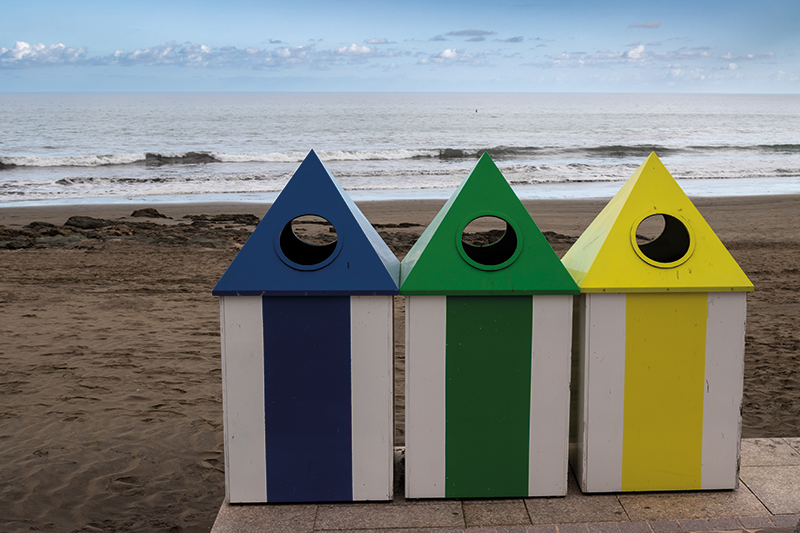
Colour-coded recycling bins for separating waste
© Yassmin Photo/ShutterstockThe demand for plastics is forecast to triple to about 1.5Mt a year by 2050, revealed Geoff Isaac, author of Rethinking Plastics in Product Design. This statistic lays bare the challenge for industry and consumers alike – how do we balance our growing demand for materials that offer innumerable benefits to a broad range of applications, while turning the tide on a burgeoning waste problem.
The magnitude of the challenge was at the heart of a three-day Innovate UK conference on ‘Global Research and Innovation in Plastics Sustainability (GRIPS)’ held earlier this year.
Isaac’s panel session tackled this head on, focusing on the actions needed to create a circular economy. Brian Lodge, Director of Packaging at the British Plastics Federation (BPF), warned that unless packaging is designed for circularity at the outset, it stood 'no chance of getting through the whole chain and then into recycled material to be put back into packaging'.
Lodge demonstrated a free-to-use PackScore tool, informed by RECOUP’s Recyclability by Design guidance. It allows plastics packaging designers to grade how recyclable their designs will be when they reach end-of-life. The tool was originally developed by RPC Group (now Berry Global). It has been published by the BPF with support from RECOUP.
Although targeting rigid plastics for now, flexibles are planned. Lodge explained how A-C graded designs can be recycled through kerbside collections and how the system also incorporates considerations like lightweighting, bio-based materials and post-consumer recycled plastics.
He cautioned that small, seemingly irrelevant, considerations – such as ink selection – can make a package impossible to recycle.
The significance of these design decisions was revisited in another panel session that debated behavioural change to drive plastics sustainability.
Katherine Fleet, Director at RECOUP, explained how a consumer’s decision to recycle or reuse is shaped by many factors, including what bins are available to them, what the recycling rules are and, importantly, their reaction to what the packaging looks like.
'If we can change those things [at the product’s design stage]…some of the most impactful behaviour can occur upstream without us even asking for different behaviour by the consumer,' she explained.
To illustrate her point, she gave the example of a recyclable plastic bottle contained within a shrink sleeve with instructions for the consumer to remove it before recycling.
Fleet explained how consumers are being asked to undertake six behavioural steps to reach the desired outcome. These include noticing the instruction in the first place, peeling off the sleeve and then putting the two materials in the correct bins.
When this instruction is ignored, the infrared detectors at materials recycling facilities (MRFs) detect the sleeve material rather than the bottle material and incorrectly sort the item. This results in the loss of a valuable material destined for closed-loop recycling. Where brands have moved to simpler designs with smaller sleeves, recycling potential has increased, she added.
Enforcing a change
On the subject of legislative developments that will determine a product’s design, Aimée Campanella, Development Director, Textiles EPR at Reconomy, discussed the EU’s Ecodesign for Sustainable Products Regulation (ESPR).
Designed to make products more durable, repairable and recyclable across their lifecycles, she explained how textiles were first in line for product-specific rules from 2027 after the regulation came into force in July 2024.
She shared that 9% of textiles placed on the EU market 'are destroyed [and] unused – that’s about 594,000t, or the same weight as 59 Eiffel towers every year'.
Eco-design, she continued, connects directly with Extended Producer Responsibility (EPR) through eco-modulation, meaning that product design will soon affect a manufacturer’s end-of-life compliance fees.
Digital product passports, one of the regulation’s four pillars, will 'act as a digital ID for every product, tracking materials, repairability, carbon impact and recyclability – in that [the] data won’t just help regulators, it’ll help you build consumer trust and also demonstrate accountability'.
She added that ESPR isn’t just about preventing waste, 'it’s about sustainable design, transparency and reducing overproduction. Together, ESPR’s pillars move us towards a circular and traceable textile system'.
Turning to global action and progress on reaching a Global Plastics Treaty, Dr Geoff Mackey, UK Head at Plastics Europe, said industry is 'incredibly disappointed' that no agreement has been reached by the International Negotiating Committee (INC).
Professor Steve Fletcher, Director of the Revolution Plastics Institute at the University of Portsmouth, UK, described the treaty as a 'game-changer for the plastics industry', if and when it is signed.
Although it would 'establish a legally binding international framework for action', he clarified the 'real action happens to a large extent at the national level. When those national actions are combined, they can amount to significant collective change'.
Samuel Winton, a Postgraduate Researcher at the University of Portsmouth's Global Plastics Policy Centre, identified some of the main sticking points as being sustainable production targets; regulation of chemicals and polymers of concern; voluntary versus binding measures; financial support; and definitions and decision-making around plastics.
Professor Rosalind Malcolm, Co-Director of the Surrey Centre for International and Environmental Law at the University of Surrey, UK, added that the treaty’s ambitious approach partly explains why progress has stalled, pointing out that as many as 16,000 different chemicals are used as plastics additives.
Until substantiative discussions resume at the INC later this year, Winton recommends focusing on strong national action in the UK – for example, EPR, the Deposit Return Scheme (DRS) and bans on single-use items.
From land to sea
Stalled progress on the treaty reared its head in another session when Jack Lidgley, Co-Founder and Head of Engineering at Plastic-i – an Oxford, UK-based start-up – cited its absence as the biggest barrier to preventing plastic pollution of the oceans.
He reflected that once plastic enters the marine environment, everyone cares about it, but without robust regulation 'no one is obligated to do anything about it'.
This discussion explored different innovations, technologies and projects mapping plastics globally.
Plastic-i draws on multi-sensor satellite imagery and artificial intelligence to create metrics that map plastic debris from river to ocean, with published data on international case studies.
'If we look at existing methods, they tend to be manual or vessel-based surveys, or fixed stations, and all have their limitations,' Lidgley explained. 'They don’t scale well geographically, are intermittent and expensive monitoring solutions, and can be dangerous.'
Deploying satellite data means the firm can draw on historical archives and track evolving patterns over time. Plastic-i uses this data to create heatmaps that identify where plastic accumulates, so it can be removed from rivers before it reaches the wider ocean.
Another modelling approach was shared by Dr Ed Cook at Imperial College London, UK. Comprising two research strands, he shared findings from the first phase, published in a paper on A local-to-global emissions inventory of macroplastic pollution in Nature.
He ran through the model’s methodology, including its six stages, starting with waste management data obtained from the municipal level, which he said is 'closest to the point at which waste is being measured'. The gleaned data trains a machine learning model to predict solid waste management data across 50,000 municipalities worldwide. This is then fed into a probabilistic, material-flow analysis model to quantify around 80 waste flows for each one.
Where data isn’t available, Cook says the Imperial researchers use sub-models to describe the mechanisms through which plastic waste is emitted. By modelling 5,000 iterations for each municipality, they can quantify uncertainty, before aggregating the municipal-scale data to country, regional and global level.
Cook said the findings can be updated periodically, so the model 'is designed to be compatible with new data as it becomes available'.
He also explained the concept of emission boundary. 'What we’re trying to do is find out how much material moves from [the] managed and mismanaged systems and into the unmanaged system,' he explained. 'Once material’s gone into the unmanaged system, it’s hard to recover and remediate it.'
Modelling calculations found that around 52Mt of plastic waste had been emitted into the environment in 2020 – most of which was burned in open uncontrolled fires by the 1.5 billion people worldwide who have no formal waste collection system.
Cracking the conundrum
The infrastructure and logistical issues that prevent many low-income countries and small island states from operating formal waste collection systems was a theme of several sessions. This environmental crisis in the making is often compounded by dependence on non-recyclable and low-cost plastic packaging.
At the other end of the spectrum, speakers highlighted examples of reuse and refill solutions in countries like India and South Africa, as well as local and regional initiatives in the small island states in the Caribbean and the Pacific.
Surf’s up for discarded fishing gear

Alexandra Vasquez, Founder and CEO of Helen of the Sea, shared the start-up’s work in tackling some of the 640,000t of fishing gear discarded in the sea every year.
The business deploys 3D printing and injection moulding technologies to transform such waste from the Galapagos Islands into surfing gear.
She explained how the salvaged nylon and polypropylene-based materials are shredded, compounded and moulded using portable and low-tech equipment. The rescued materials are reinforced with recycled additives, primarily recycled glass fibre and carbon fibre.
Vasquez’s aim is to build a viable flagship model that can be replicated across island communities.
'Research shows that for isolated areas like islands, decentralised recycling systems are much more energetically and economically effective than large, centralised systems,' she said.
Partnering with Michigan Technological University, USA, to conduct a Life Cycle Assessment, she reports their approach reduces carbon emissions by 70% compared to current surf gear manufacturing.
Presenting in a session on small island plastic waste challenges, Sian Young, CEO and Founder of Siel Environmental Services Ltd in Trinidad & Tobago, talked about the island nations’ high import dependence on plastic packaged goods. She noted that their waste systems aren’t designed for the volume produced with limited land space for large recycling facilities. This results in overflowing landfill sites and plastic leakage.
'Our recycling options have focused on beverage recycling, so water bottles, juice bottles and soft drinks, as opposed to including food-grade plastics,' she said, adding that more than 75% of items landfilled in Trinidad & Tobago are recyclable.
'Infrastructure is often expensive, centralised and scale-dependent [and] we don’t get the ability to have clean feedstock.'
Dr Charlotte Davies, Managing Director at UK-based not-for-profit Common Seas, added the high cost to ship plastic waste elsewhere to the list of issues for these countries. She stressed that policies and solutions need to reflect local realities if they are to succeed. She echoed Young’s reference to community micro-hubs for sorting and processing to build plastics upcycling and recycling capacity.
'If the policies aren’t designed for the small scale and the remoteness, then they won’t be able to be implemented or won’t be able to last,' she advised.
Davies mentioned Common Seas’ partnership with small island states in the Caribbean, the Pacific and West Africa, and its work on co-designing policy plans. She highlighted joint action with the Government of Barbados to target single-use items, improve separation and expand refill infrastructure, with an aim to slash plastic pollution by 75%.
She also referenced the high transaction costs that island states face and noted that, 'introducing an effective system like EPR in a country with a few thousand people runs the risk of collecting fees that are too small to be meaningful in financing services and creates a disproportionate administrative burden'.
Instead, regional approaches can fundamentally alter the maths – in pooling national resources, small island nations can collectively create a larger producer base as well as harmonise fees and standards across a region.
A separate panel session explored the work of four of the 13 national Plastic Pacts. Jeremy Kaburu, Circular Economy Specialist of the Kenya Plastics Pact (KPP), part of the Kenya Private Sector Alliance, revealed that the African nation does not have advanced recycling infrastructure. Waste service collections mix segregated waste in trucks and deposit everything into open landfill.
Kaburu said the KPP was exploring options with the national transport regulator to see if collection trucks could accommodate individual compartments that store segregated waste separately, or collect dry and wet waste on different days.
He also highlighted the measured outcomes from phase one of KPP’s Let’s Be Clear challenge. This involved encouraging 12 brands to commit to clear PET bottles so that the plastic can be recycled.
A similar picture emerges in South Africa. Dr Kirsten Barnes, from the African Circular Economy Network, revealed that around 34% of consumers dispose of waste in communal (illegal) dumps. She added that South Africa could not redirect its plastics from landfill without reuse initiatives.
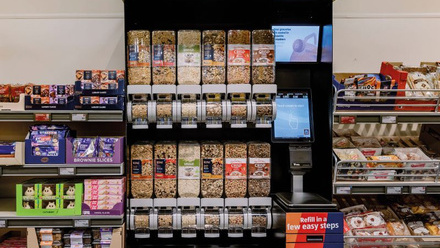
Eben de Jongh, Founder of Sonke Retail in Johannesburg, which designs, manufactures and manages automated refill stations, discussed the challenges in a country where 34 million people live below the poverty line.
He explained that these consumers can generate up to 200% more plastic waste than those on higher incomes, as they can’t afford to purchase the bulk pack sizes for fast-moving consumer goods. The refill machines are designed to offer an alternative, with reportedly more than 99% fill accuracy and fully integrated with retailers’ point-of-sale systems.
Shoppers bring their own packaging to the store, load cash onto a card, scan it and refill the packaging, which he claims works out 60% cheaper than what’s on the shelves. It is this 'commercial viability that really drives the behaviour', he suggested, adding they are currently achieving more than 10,000 transactions a month. 'I believe this is the biggest in the world in terms of automated refill at this point.
'Every machine is linked to the internet so we know what sales have gone through the machine… how much stock is left…which batch is where.'
Grassroots innovations were also shared in the world’s most populous country – India, with its own specific pinch points.
Shourjomay Chattopadhyay, from the Confederation of Indian Industry, revealed that 70-80% of India’s plastic packaging is flexibles, acknowledging 'this is probably just the branded packaging that can be tracked'.
He also underscored the challenge of communicating the most simple waste collection messages in a country of 1.45 billion, with more than 120 languages and across a subcontinent with many different sorting systems.
In a session on tracking, measuring and collecting information on global plastic flows, Akshay Gunteti, Co-Founder of India-based firm Green Worms, revealed that most of the 2.6 million households his social business supports purchase plastic satchets that are complex, multi-layered and non-recyclable because it’s all they can afford.
John Marchant, Director at UK start-up LESS and CEO of the REUSE Foundation, went on to share that one trillion sachets are used worldwide annually, a figure expected to double by 2030. 'They wash down drains and get into waterways [where] they exacerbate flooding,' he said. 'Sachets alone are a primary cause of ocean microplastic.'
Marchant described the company’s Beat the Sachet! project, which worked with Indian companies and NGOs to design and launch a refill bottle system in an 18-month trial. This reportedly prevented about 5,000 sachets from being used every month.
Next up is a larger pilot launching later this year across five product categories in up to 30 villages.
It aims to eliminate over a million single-use plastic packaging items each year and show reuse is viable at scale.
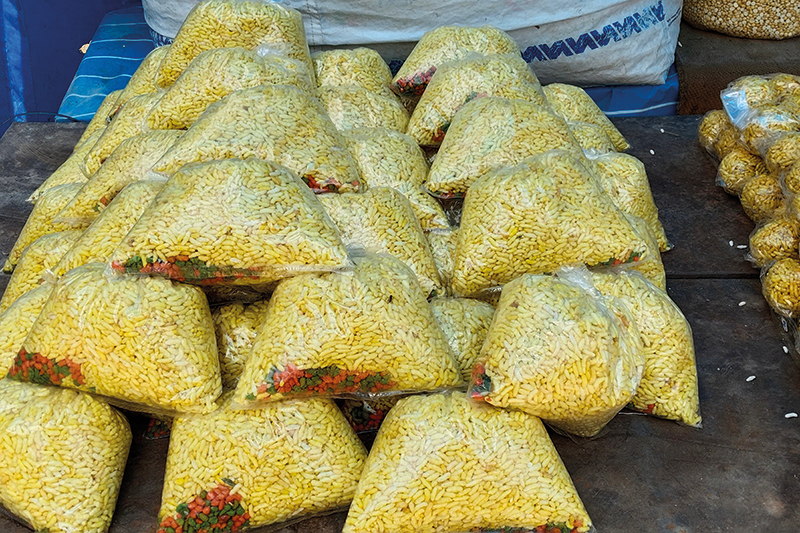
Food and snack shop in Ariyalur, Tamil Nadu, India. The majority of plastic packaging in India is flexibles
© Yogesh KTR/ShutterstockSimpler times?
Shining the spotlight on the UK, Professor Aleksandra Cavoski, at the University of Birmingham, discussed the government’s Simpler Recycling reforms. These are designed to standardise waste collection across England, with the goal of achieving a 65% recycling rate by 2035.
The university’s report on Simpler Recycling: Hidden Impacts for Circular Plastics Systems warns of unintended consequences if infrastructure and market systems are not adequately prepared. Key findings include:
- Infrastructure shortfalls – England faces a projected 3Mt shortfall in recycling capacity by 2035, with many MRFs outdated and ill-equipped to handle new waste streams like flexible plastic films and compostables.
- Market gaps – councils will be collecting more low-value plastics, but lack viable end markets to sell them. Without demand, these materials risk being incinerated or exported, undermining public trust.
- Policy overlap – Simpler Recycling interacts with other major policies, namely EPR, DRS, the Plastic Packaging Tax (PPT) and the Emissions Trading Scheme (ETS). These interactions can create strategic uncertainty and financial strain for local authorities.
- Public awareness crisis – a staggering 70% of the public is unaware of the upcoming changes. Confusion around terms like ‘compostable’ and ‘biodegradable’ is also widespread, contributing to contamination and greenwashing concerns.
The report outlines a series of policy recommendations to ensure Simpler Recycling delivers on its promise:
- Invest in infrastructure – upgrade MRFs, anaerobic digestion and in-vessel composting facilities, especially in rural and low-income areas.
- Stimulate markets – use EPR and PPT to create demand for hard-to-recycle materials and incentivise innovation.
- Improve communication – launch a national awareness campaign with unified branding and clear messaging, including standardised labelling, supported by digital tools and local authority engagement.
- Coordinate policies – align Simpler Recycling with DRS, EPR and ETS through a systems-level review to avoid conflicting incentives and unintended costs.
Cavoski referenced a change in PPT from 1 April 2027. There will be a mass balance approach to account for chemically recycled plastic used to make packaging. This is intended to increase demand for such material by enabling businesses to claim an exemption from PPT when their packaging contains 30% or more chemically recycled plastic. She noted that the legislation does not differentiate between materials that are technically recyclable and those that can be recycled with the UK’s current infrastructure.
In a session on strategies for building advanced recycling capacity, Dr Geoff Brighty, Head of Sustainability and R&D at Mura Technology, detailed the company’s hydrothermal process – Hydro-PRT. This cracks waste flexible plastic to produce oils that are sold as a feedstock to European petrochemicals. The oils are used in steam cracking operations to create virgin-grade plastics.
Once non-target contaminants and chloride- or nitrogen-containing materials are removed in pre-treatment, he said the waste plastic is put through an extruder, heated to more than 450°C and pressurised at more than 280bar to create a melt flow that is mixed with supercritical water.
'Further heat is applied to get it to reaction conditions and that gaseous melt flow is put through our Hydro-PRT conversion unit. There’s about half an hour residence time where the cracking process is enabled to happen,' he explained.
'Our ambition is to become the global leader in scaled productions of advanced recycling of waste plastics, particularly in Europe where we know that there’s a regulated market [and] a demand for packaging alone of around half a million tonnes of recycled polymer.'
Vikki Chesterman, NGO WRAP’s Programme Lead for Plastics and Packaging, underscored the impact of infrastructure constraints prevalent across the three-day event.
She warned the UK was 'facing a bit of a [plastic] film and flexibles storm', because despite plans to roll out kerbside collections for the materials in England in 2027 – and the huge tonnage expected – the infrastructure to sort, manage, recycle and process it didn’t exist. Once again, green shoots of solutions need to be paired with investment in infrastructure across the board.