Fashioning a closed-loop system
Accelerating polyester textiles recycling.
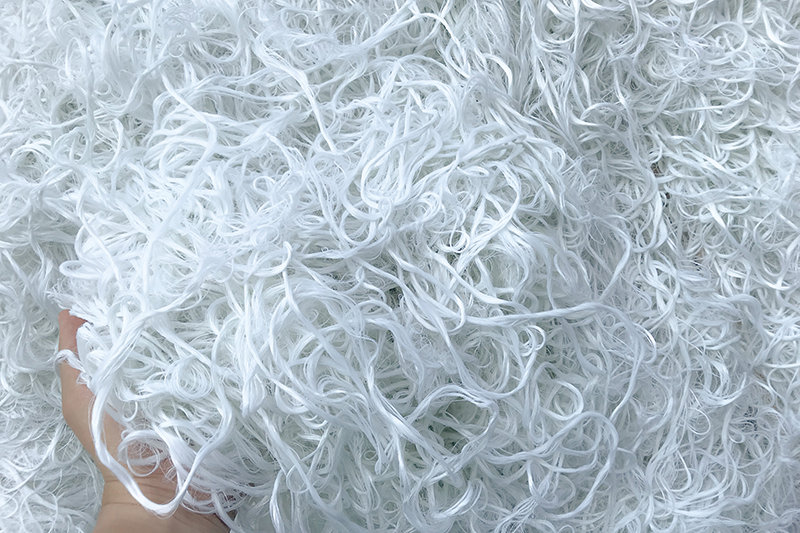
White polyester filament yarn
© RecycleMan/ShutterstockPolyester continues to be the world’s most widely produced fibre, making up 59% of total global fibre output in 2024, reveals Textile Exchange’s Materials Market Report.
But around 88% of this production is fossil-fuel-based. And less than 1% of the global fibre market comes from recycled pre- or post-consumer textiles, highlighting the need for more circular practices that feed waste polyester textiles back into the apparel industry.
A webinar held by PETCORE EUROPE on ‘Unlocking Polyester (PET) Textiles Circularity in Europe: Regulation, Infrastructure and Investments’, brought together stakeholders to discuss barriers and developments towards accelerating circularity.
While collection, sorting, mechanical and chemical recycling technologies exist for polyester textiles, speakers agreed that efficiency improvements across the processing chain are needed.
Silke Einschuetz, Circular Economy Consultant at Calidris Circular and Associate Consultant for AMI, laid out the current landscape. 'Europe is leading the way in terms of available input capacity for textiles closed-loop recycling, with just over 500,000t expected to be available by 2033, and this is closely followed by China and North America. It is [also] leading in terms of plastic waste management and recycling, thanks to largely supportive consumer attitudes and a strong legislative framework.'
Yet 'of the 124Mt of fibres produced in 2023, less than 1% was recycled back into new textile applications globally. Currently, the majority of end-of-life clothing goes to incineration'.
Blended approach
The speakers revealed that one of the factors hindering polyester circularity is the focus on waste bottle recycling into textiles. It remains the primary feedstock for producing rPET textiles. Although this makes use of an abundant waste stream, this is not a closed loop of recycling. Reducing textile waste and increasing the volume of end-of-life textiles collected for recycling is the missing factor.
Other barriers are the stringent requirements, yet variability, around the input and output of mixed textile feedstock, and that recycled feedstock remains more expensive than virgin material.
Einschuetz shared, 'Mechanical recycling of fibres, while possible, shortens fibre lengths, and so the output is often not of a quality suitable for new textiles, unless mixed with virgin materials. It seems that closed-loop recycling back to textile applications can only be achieved with alternative technologies such as chemical recycling.'
Here, Einschuetz is referring to depolymerisation, 'where the polymers are broken down into their constituent monomers. This includes hydrolysis, glycolysis, meta-analysis and ammonolysis, as these are suitable for PET and polyamide (PA) applications, which make up 62% of global fibre production'.
She added that gasification technologies can handle textile waste, but this outputs fuels rather than new textiles, while pyrolysis isn’t suitable for processing PET and PA due to their oxygen content.
Einschuetz reported that 94% of 'operating or depolymerisation plants can take textile waste as part of their input feedstock', which shows 'the potential for closed-loop textile recycling in Europe is really strong'.
Dr Maurizio Crippa, CEO of GR3N SA, continued, 'Textile feedstock is very differentiated and that’s why chemical recycling plays a role. I have brands [coming to me] every week…saying ‘how can I make mono-material clothes?’ Mono-material clothes don’t exist…and if you don’t have mono-material, forget doing mechanical recycling…it is evident that chemical recycling will provide the solution.'
However, Frédéric Favre, Project Manager at IFP Energies nouvelles (IFPEN), described the complementary nature of mechanical and chemical recycling.
'Mechanical is a combination of feedstock preparation…then transformation of the feedstock, with intermediate flakes and then recycled pellets. This is similar for recycling by depolymerisation – feedstock preparation and then chemical recycling, except that it can handle more complex feedstock. In both cases, feedstock preparation aims to remove external impurities.'
This point could be crucial for achieving ‘end-of-waste status’ in the EU. The European Commission defines end-of-waste as the point when waste-derived materials have been sufficiently processed so they are no longer deemed waste. Favre explained, 'In some countries, the end-of-waste status for packaging recycling is after feedstock preparation'. He suggested textiles recycling should be harmonised on that basis in the EU.
'For textiles recycling, we also have feedstock preparation…for example, sorting different textiles, removing hard points, clipping, etc…for mechanical or advanced recycling'.
IFPEN believes there is potential for independent feedstock preparation to achieve end-of-waste status downstream, so that recycling facilities don’t have to determine this for themselves.
Feeding in data
Micke Magnusson, Co-Founder and CEO of Re-Access and Board Member of Accelerating Circularity, highlighted the various studies on polyester feedstock carried out by local governments, NGOs, regional agencies, academics, consultancies and corporate businesses.
'There are different blended methods on how to collect the data, but this is not aggregated…[and] not available on a European level. It’s very important to have this in place and bring it down to material level to unlock more investments into infrastructure – and also to build trust and kill a lot of myths in this industry.'
Magnusson’s 'call to action is to put forward a pan-European study' to align on the data collection methods being deployed.
Charline Ducas, Project Lead for Accelerating Circularity’s Second Hand Material Flows Roadmap to Action, added, 'Currently [we are] in partnership with Business for Social Responsibility and the World Wide Fund for Nature, conducting a global study to look at second-hand material flows, not for the sake of studying…but for the sake of bringing transparency into the used textile sector and defining a roadmap to action.
'We want to understand what happens to the used textiles that are leaving the EU, the UK and the US…the vast majority of the reuse fraction leaves Europe. There is potentially an economic opportunity that has not been quantified, and environmental and social impacts in the destination countries.'
The scope of the project covers exporting regions of the US, UK and EU, and various importing countries in the Global South, including Kenya, United Arab Emirates (a major sorting hub), India, Pakistan and Chile. The team is currently focusing on data from collectors and sorters in the exporting countries, but Ducas shared, 'the big exporting country we miss is China – it’s not included [due to a] lack of data transparency'.
Zipped up
A level playing field with virgin material is also crucial. Favre noted, 'Recycled materials are more difficult to access and they are generally more expensive than virgin fossil-based material…so the use of recycled material must be promoted.'
An example Favre referred to is an eco-modulation regulation currently being adopted in France. Companies could be eligible to receive up to €1,000/t for using recyclate obtained from waste that is considered difficult to recycle. 'It will be effective in 2026, so we need greater pressure like that', asserted Favre. He also stressed the need for a 'mandatory incorporation rate' for recycled content in the textiles industry, as well as detailed and realistic targets within the EU.
Preventing fraudulent activity is also key. Favre continued, 'There [can be] up to €750/t difference between recycled pellets and virgin material…so it may [be] attractive to sell virgin PET as recycled…to boost profits. This fraud has already been seen…we cannot control this at the border of Europe because there is no specific customs code that is required for this.'
He explained that PETCORE has submitted a request to implement a customs code, but that requires 'a method to analyse recycled contents', which IFPEN is working on in partnership with the Industrial Technical Center for Plastics and Composites (IPC). 'The French Ministry of Economics and Finance has asked IPC to develop a protocol that can be deployed to distinguish virgin from [recycled textiles].'
The proof-of-concept uses 'solvent extraction for virgin or recycled pellets', followed by gas chromatography-mass spectrometry analysis. Favre showed how testing validated the protocol.
Co-Founder and Managing Partner of Infinity Recycling, Jan-Willem Muller, highlighted the importance of validated regulation. 'If it doesn’t come...the [only] ‘unicorns’ will be those markets that are actually able to compete with virgin pricing. If you can’t compete…or you don’t add value in any other way to the end use, basically no investors will step [into] today’s market'.
Cécile Martin, Innovation and Recycling Manager at Refashion, expanded on developments in France. The non-profit organisation is accredited by the French Ministries of Economics and Ecology to apply Extended Producer Responsibility (EPR) schemes to textiles and footwear.
She shared that, in 2024, 891,000t worth of new products – the majority being clothing – were sold online and in stores, while 289,000t of post-consumer textiles and footwear were collected by companies contracted by Refashion.
She explained that this represents a collection-to-market ratio of 32%, with the objective being to reach 60% by the end of 2028, 'so quite a big gap yet to [overcome]. From the collected tonnes, there were 206,000t sorted by the 73 sorting facilities contracted with Refashion'.
Martin asserted that 'brands and retailers need to agree on an EPR fee and on collection [requirements]'.
The rate of recycling – mainly mechanical – sits at around 34.5%. This includes tearing and garnetting, mostly for non-woven applications; followed by cutting, accounting for about 10% of the recycling fraction; some fibre-to-fibre recycling for returning to the clothing industry; and grinding into synthetic materials that go into the plastics industry.
Refashion provided funding to the contracted sorters. Experiments on sorting, pre-processing and recycling of polyester enabled just over 100t of sorted batches prepared according to recycler specifications.
The non-reusable and non-recyclable fibres go into energy recovery units and a portion goes to landfill.
A 2021 characterisation study by Refashion into the types of materials in the textiles feedstock found that the majority of the non-reusable fraction is dominated by cotton, followed by 100% polyester and then polyester blends. Common mixtures include polycotton – cotton and polyester – as well as other blends containing elastane and viscose.
To aid sorting, Refashion sought to identify the kinds of clothing that are typically made of polyester, whether these are mono- or multi-layered and whether they contain recycling 'disruptors' such as zips or buttons.
Then there is the not-so-small issue of changing consumer behaviour. 'We didn’t talk much about citizens, but they are [also] a big part of the game so that textile waste doesn’t end up in the bin,' reflected Martin.
Crippa agreed that the consumers 'have to support the purchase of chemically recycled materials' to create an end market for recycled textiles. 'There are a lot of studies that say the consumers, especially the younger generation, are willing to pay a bit more.'
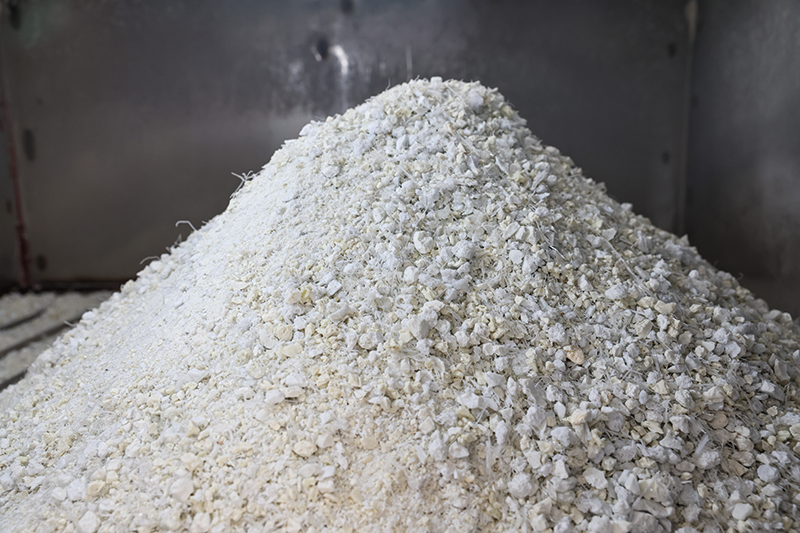
Polyester and elastane fabric scraps
© Hipotezyum/ShutterstockIncentivising investment
Guy de Sévaux, Invest-NL’s Bio-based and Circular Economy Lead, provided a Netherlands perspective.
Invest-NL found that '95% of what comes in is produced and designed somewhere else – we buy a lot of textiles and throw them away quickly [too]. [Although] we have very big sorting facilities and recycling facilities, both chemical and mechanical, these are in real danger of disappearing because of the financial context'.
Investment is needed to maintain these facilities, as well as to introduce and scale up new technologies and plants, but Crippa highlighted risk perception as a major barrier for investors.
He explained that significantly more investment is needed for scaling up ‘first-of-a-kind’ plants, and that investors may request 50% or more equity due to the higher risk involved. Additionally, loans from commercial banks typically require a long-term offtake agreement for the input and output, as well as guarantees from the European Investment Bank and its subsidiary European Investment Fund.
There is additional financial support from innovation funds, and Crippa pointed to this as one of Europe’s strong points for incentivising development of new technologies.
But Muller noted that working in recycling doesn’t receive the same plaudits it used to garner. 'Five to 10 years ago, I was applauded, and everybody wanted to…talk to me about the recycling market. [Recently], I was at an event where people gave me condolences that I’m in [this] market.'
Last year, Plastics Recyclers Europe voiced concerns about a sharp decline in domestic production, increased imports and rising economic pressures. The trade body stated, 'Besides the critical market trends, European recyclers are grappling with high energy costs and soaring input waste costs, which have increased operational expenses over the last few years.
'Meanwhile, they are being undercut by cheaper imported materials, which often come with fraudulent claims due to the lack of transparency in the origin of materials.'
Muller also cited reluctance in the textiles industry to invest in sorting and recycling technologies, and believes most consumers are not willing to pay a premium for recycled end-products.
'Five years ago…I would have said waste-to-commodity is the way forward. [But] unless regulations change, and we see clear demand and people willing to pay for it, I think in the next five to 10 years, we need to focus on niche markets [where] you’re converting an end-of-life [material] into a product that actually survives with a premium.
'You need to have the right quality, you need to have the right specification, but most importantly, you need to focus on the customers who want to change. [Also], if we can’t prove that PET-to-PET, PET-to-fabric, or fabric-to-fabric is a positive business model, then people will just not invest in it.'
De Sévaux also identified the potential to work with 'sorting companies to see how we can reduce their costs altogether'. Invest-NL is 'working with [and investing in] chemical recycling companies…and working together on repair and reselling of non-sold goods, which is quite a big part of the circular activities'.
He continued, 'We just started [working on] textiles EPR with three different companies…what we see is that step-by-step [they move] from a waste-oriented organisation to a circular one. We would like to see that go much further…and take all the steps necessary to [reach] a transparent and well-functioning business model where material comes back [into the business].
'One of the first things that we as investors would ask [is] do you have long-term offtake agreements, both for incoming and outgoing materials. That means we have to look at the whole value chain [and integrate it] to a much higher extent. We need a lot of conditions to be met before we can [fully] invest in these kinds of companies.'
Most European companies are currently obliged to use a minimum amount of recycled material in new products, but de Sevaux argued that this remains low, and 'we need to bring it up to a much higher level, and we cannot do it alone in one country'.
He emphasised that the EU needs to make 'a commitment on the development of a circular European textiles industry. Government needs to set boundary conditions…and oblige companies to make it happen'.
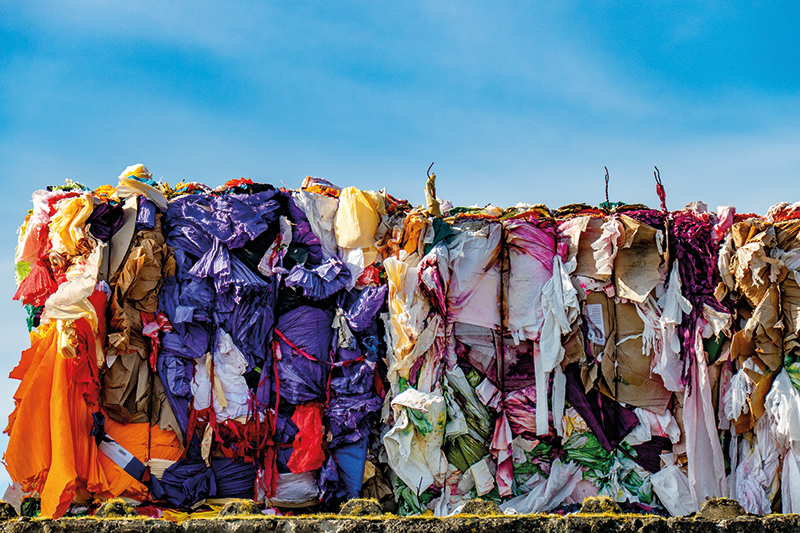
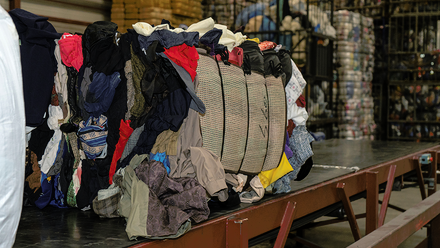
Fabrics that have been collected for recycling
© Dietrich Leppert/ShutterstockIn harmony
Recycling Europe Textiles has made proposals to the European Commission for mandatory recycled content and expressed support for the Ecodesign for Sustainable Products Regulation (ESPR) regulation as the vehicle to introduce such measures. In its paper, the body reports that 'mandatory ecodesign requirements for recycled content are essential to structurally shift the textile value chain towards circularity and to strengthen the recycling industry'.
It is calling on the Commission to adopt a narrow, targeted definition of ‘recycled content’, introduce progressive and mandatory recycled content requirements, set up a robust and credible verification system, and leverage Digital Product Passports for increased traceability and information for consumers.
It also highlights pressure on the European textile collecting, sorting and recycling industry due to an 'oversupply of low-quality textile waste, insufficient demand for recycled textile fibres and funding gaps', as well as rising clothing consumption driven by ultra-fast fashion paired with low market demand for recycled fibres.
Christian-Yves Crépet, Honorary Board Member and Ambassador for PETCORE Europe, asserted, 'How can we coordinate and synchronise the engagement of the value chain? That is the big issue we have…the idea is to harmonise EPR implementation', meaning that everyone follows the same guidelines.
To this end, the EU has developed a Textiles Ecosystem Platform to engage the textiles community and as a way to access funding, support and up-to-date policy information.
Carsten Wentink, Policy Officer at the European Commission, closed out the session with an update on ESPR and pointed to competing parameters for the sector to consider.
'There are trade-offs between these sustainability objectives and…other characteristics of the products like simple functionality. Sometimes you need certain additives or fibre compositions to make something very robust or comfortable from the perspective of the user. So we have to be mindful of these things.'
Recycling Europe Textiles suggests well-designed recycled content requirements can overcome these challenges while still sending strong signals to the market, creating demand for recycled fibres and unlocking investments for scaling up recycling technologies in Europe.