Breaking the mould
Ambitious and still only in her twenties, Georgina Frater MIMMM heads up the Innovation Services Division at Alloyed, a University of Oxford, UK, spin-out.
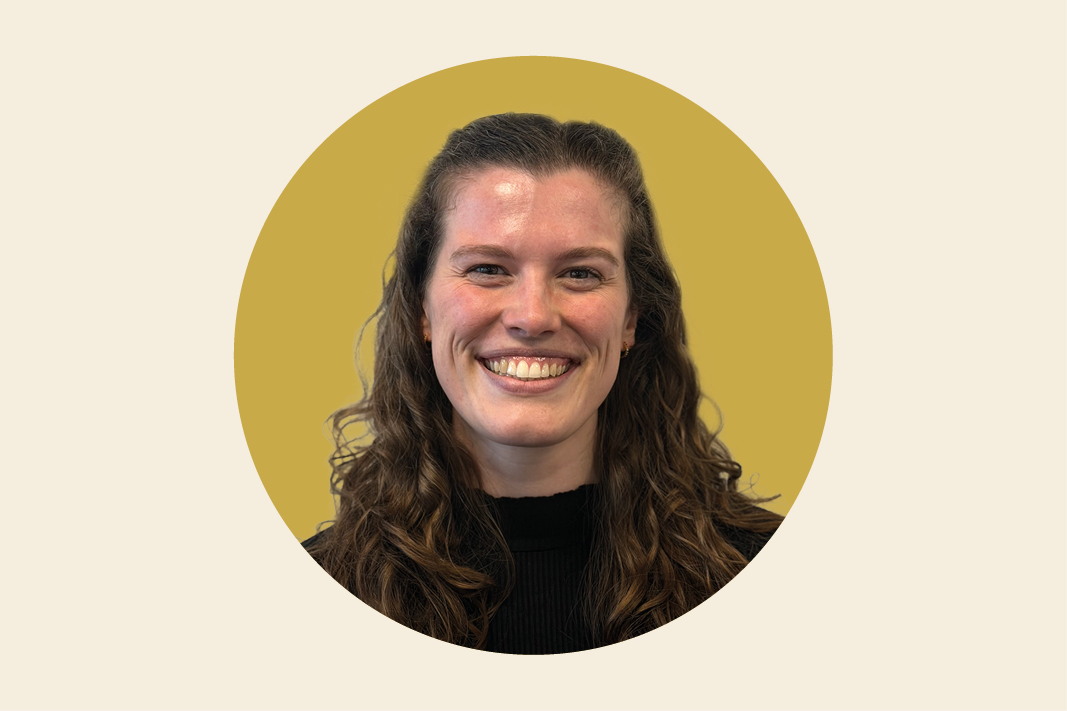
For someone who wasn’t aware of Materials Science as a subject until she changed degrees at the University of Cambridge, UK, in the mid-2010s, Georgina Frater MIMMM has quickly propelled herself with laser-like precision to a senior role. She leads a team of engineers at Oxford University spin-out Alloyed, which 3D prints metallic alloy components for the aerospace, consumer electronics and defence sectors.
At only 29 years old, the Northumberland native and daughter of a farming family runs one of four divisions at Alloyed, which provides digital metal alloy solutions, specialising in additive manufacturing (AM), alloy characterisation, rapid mechanical testing and computational alloy development.
An academic high-achiever, Frater describes her chosen career as one of organic development.
'My parents are retired farmers and didn’t go to university, so I didn’t have anyone to suggest what I might be interested in,' she confides.
Excelling in the sciences and Maths while studying for A-levels, she initially gained an engineering place at Cambridge, but frustration with her chosen subject soon set in.
'I wanted to understand a bit more about, ‘Where did this theory come from? And why do I need to trust it?’,' she explains. 'I wanted to understand the science behind where the equation came from.'
Discovering Materials Science
After realising she was more interested in science, Frater engineered an early switch to a Natural Sciences degree. This required her to choose four modules. Physics, Maths and Chemistry were no-brainers, but she admits it was the first time she had encountered Materials Science.
It became her favourite module, partly because she got to use the science and 'apply it to something that I could hold'. She also excelled at it, so much so that she achieved a first-class BA in Natural Sciences in 2018, replicating this top grade in a MSci in Natural Sciences a year later.
To add to her accolades, she won an Armourers and Brasiers Medal and Prize for the second highest score in her year. Her Master’s project investigated the degradation mechanisms of cathode materials in lithium-ion batteries for electric vehicles.
'The main goal was to make a battery that was so thin you could put it inside a transmission electron microscope, and charge and discharge the cell while it was being viewed,' she explains.
After leaving academia, Frater secured a Graduate Process Engineer position with Renishaw UK & Ireland in Gloucestershire. This was a short-tenured experience that she says was highly rewarding, and where she made the professional connections that helped her pivot to Alloyed.
Making Alloyed connections
'If you want to link together my career, Renishaw makes the metal 3D-printing machines that Alloyed uses for all its production,' she explains.
Frater spent around six months there, helping to develop process parameters for laser powder bed fusion and investigating materials behaviour. She was part of a team of around a dozen applications, materials and process engineers.
'I got to do some interesting technical things,' she says. 'One was to do with maraging steel, which is very useful for casting applications. If you 3D print the mould, you can integrate cooling channels into that. One challenge is that the material undergoes phase transformation while you are printing it…it can change the geometry.
'So, how can you control the process to make sure the geometrical changes are acceptable? I got to learn the basic methods of how you find the optimal power, speed and path for that laser to follow to achieve the densest and strongest results.'
Through former colleagues who had taken up posts at Alloyed, Frater was alerted to a Materials Engineer position and started in April 2020, just as the COVID-19 lockdown kicked in.
When she joined, there were around 40 engineers, but this has since grown to around 200 spread across four divisions – Innovation Services, Component Engineering, Serial Production and Argive.
In just five years, Frater was promoted to Managing Director of the Innovation Services Division. She works with customers on the data they need for the metal alloy components, as well as new materials and process optimisation and qualification for regulated industries.
In addition to designing and manufacturing advanced metallic components for a broad range of aerospace and defence clients, the firm works on two other important markets – energy generation and consumer electronics, particularly the structural components required for wearable electronic devices.
'The reason is 3D printing allows you to make very thin, very light and very stiff things,' she explains. 'These structural parts are what you need for applications like virtual reality and augmented reality headsets.'
Going platinum
Early on, Frater recalls undertaking a project on platinum casting for jewellery. One of the spin-out’s investors was Valterra Platinum, which saw an opportunity for Alloyed to unlock more markets for its materials.
Typically, alloys like platinum ruthenium are commonly used. Frater worked with colleagues on the computational side to create a superior, albeit more complex, platinum alloy, and designed experimental validation to test it.
She uses the example of a platinum wedding ring to illustrate some of the challenges. 'Platinum is extremely bright, shiny and white, but if you wear a ring for six months, it gets a patina on the surface. That means lots of tiny scratches that make it look almost like a brushed finish. Our brief was to make the soft material harder, so it’s more scratch resistant and stays shinier for longer.'
As platinum has an extremely high melting temperature, this presented a technical challenge when it came to casting it into a wedding band or an engagement ring.
'The material can react with the mould, melt the mould, or you can get lots of horrible pores inside. That means if you were polishing it to get this beautiful shiny finish and you encounter this massive pore, then you either have to repair it or start again.'
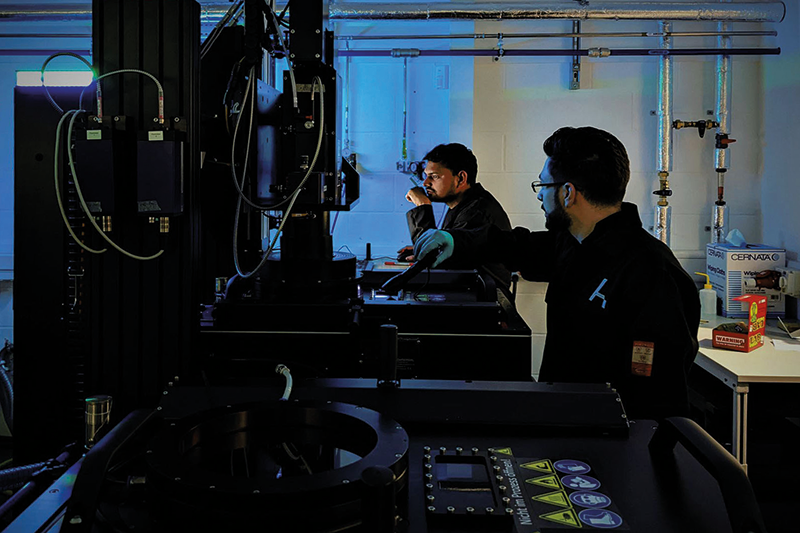
Alloyed team members operate an additive manufacturing machine for laser process parameter optimisation
© AlloyedLearning the ropes
Prior to Frater’s next role as Project Manager, Alloyed CEO Michael Holmes transferred her and two colleagues to Los Angeles, USA, for a year in late 2021. With many of the spin-out’s customers based on the US West Coast, he wanted to expand its presence in the heart of the aerospace and electronics sectors. While Frater kept her hand in technical projects back home, the experience taught her critical business skills, including being more customer-focused.
'It was a good opportunity for me to think, ‘How do we pitch the company? What are people’s actual problems?’ People don’t come to you saying, ‘I need a new alloy’. They say, ‘This doesn’t work, it breaks all the time’, and then we have to translate that into ‘What can we do for you?’
Back in Oxfordshire, she increasingly stepped away from a pure materials science role and began to oversee a series of ambitious projects, often involving parameter process optimisation.
The Project Manager role was her first brush with managing, and since then she’s been through a succession of promotions – from Programme Manager to Engineering Director and, finally, Managing Director of the Innovation Services Division.
Frater says the CEO passionately believes in helping young people who don’t necessarily have a degree in a relevant subject or A-levels to develop a career at Alloyed. The company employs a strong cohort of apprentices.
How has she found the experience of managing these individuals compared to the wider team? Strong communication is key, she reflects. 'We work in small teams where everyone is working very quickly and no one really has full sight of what others are doing.
'Most of the time it’s not hard, because they are so hungry to learn that they aren’t intimidated by not knowing the answer. It’s more about making sure that if you see someone who is a bit more in their shell that you make them feel safe enough to ask questions.'
Reflecting on the experience of managing people, Frater says her first assignment as Project Manager made her realise that her success was no longer about her individual contribution. She trusts her managers implicitly and is confident they will only sign off work on her behalf to a high standard.
'Having that stamp of approval at the end of the process is a really important one,' she continues. 'I want the team to have the freedom to do whatever they want to do, the way they want to do it. But ultimately, if rubbish work goes to the customer, then I’m going to be the one who apologises or tries to clean up the mess, so that means figuring out how to make sure there’s a tick before it gets sent off.
'If I sat down and tried to solve all the problems myself, then the team doesn’t get the opportunity to learn and we wouldn’t get as much done because I’d be the limiting factor,' she clarifies.
'Delegation is one of the most valuable things I learned. It requires investment upfront, more time and guidance than you might expect, but the development you see in the person you’re helping makes it worth it.'
Frater says the experience is 'super satisfying', adding that she didn’t anticipate how rewarding it would be to see someone else develop under her guidance. Seeing others flourish professionally made her lean more into a management role rather than further pursuing a technical route.
'I don’t have children, but I imagine it feels similar – when you see them struggle the first time,' she continues. 'Then, six months later, you see them dishing out the advice that you once dished out.'
Scrutinising the approach
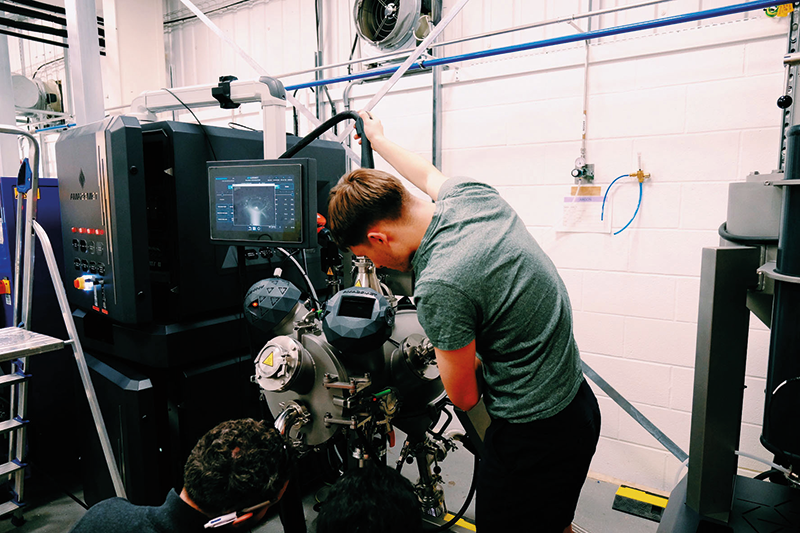
Part of Frater’s job is to check that her engineering team uses the correct methods when designing and 3D printing metal components. One is alloys by design (ABD), an approach informed by cost, thermodynamic calculations and machine learning models the team has developed.
'What I really want to check when engineers are using those methods is how much can we trust this strength model for aluminium alloys? Is it suitable for the particular alloy system we are looking at and can they provide evidence that it’s suitable?'
Frater will intentionally critique the methods and expects her engineers to be able to defend why it is technically robust.
When she first joined, the spin-out’s focus was 80-100% materials science. This is now about 20%. The rest is about making components, optimising AM and making systems like the Micro Turbine. All of it depends on AM, where the thermal history varies by the different locations in the machine.
Frater explains that much of the team’s time will be spent considering, 'What do we need to change about the process to make sure that the properties are going to match in those different locations? It’s a lot more about the algorithms that we use for the laser, and how we balance the material quality we are producing with productivity'.
She explains that many issues can be solved by slowing the process down, but this can raise a part’s cost by 50%. 'We have to be commercially savvy as materials engineers. We can’t sit in a corner and ignore that the way the business is growing is through component sales. I really like that we’re evolving and I get to keep challenging myself to learn more.'
Steps to manage cracking
One of the main technical issues that the team is confronted with when handling large and/or complex parts is the risk of cracking when 3D printing creates stress in a particularly brittle material.
One option is to change the alloy’s composition before fabrication. However, where this isn’t feasible, they can cut and polish the part post-fabrication and check for remaining cracks under the microscope. However, sometimes the cracks can be inches long.
'You see them straight away when you pull them out of the machine, but there are things we can do with the laser to change the thermal gradient during scanning, depending on what’s causing those cracks,' Frater explains. 'You can use multiple lasers at the same time, or create some rules about the maximum amount of time that you can wait before the laser comes back to that spot, or the minimum acceptable energy that can go in from the laser.'
She points out that some crack types – namely small ones in the middle of a part – are acceptable because the team can use hot isostatic pressing to close them.
This leads Frater onto the methods her team deploys for testing components. Since most parts use lighter metals like aluminium, magnesium and titanium, they use a CT scanner as it can spot holes in components.
'You can create scripts that allow you to look at your CT scans of multiple parts and compare them, and make sure that any systemic issues are being picked up,' she explains.
They also undertake heat exchange work, which involves filling parts with metal powder that must be removed before the parts can become functional.
'If you put the part in a CT scanner and do a quick scan, you can spot the areas of trapped powder and go back and remove it,' she continues.
'Our goal is to make sure that we test during development and that the process is the best it can be to avoid those issues before we get to making tens or hundreds or thousands of parts.'
Novel materials
Frater explains that around 30% of her projects involve developing a novel material or maturing a material novel to the AM process. While the remaining 70% use standard alloys, she suggests the process deployed will be novel.
'We have a nickel superalloy called ABD900 that is highly processable through 3D printing, but which has...higher capabilities in strength than equivalent alloys,' she says. 'At one point that was considered a very novel alloy, but now we treat it as a standard alloy because it processes so well.
'Our goal is to do enough work to mature the 3D-printing technology that people don’t think it’s novel anymore.'
Asked what’s next at Alloyed, Frater says her focus is to grow the business.
'As a division head, I’m responsible for a portion of our budget. But I really want to work in industries that we haven’t touched as much as I would have liked,' she explains, highlighting the semiconductor industry as one example.
'The machines that make semiconductor chips have to be very tightly controlled and there is a lot of thermal energy that goes into the process. AM can be really good for thermal management. If you can add more thermal control to the semiconductor-making machines, then that helps with the tolerances needed as the process gets more energetic, or if you’re trying to make it more efficient.'
Judging by the time Frater has spent at Alloyed and her achievements to date, she clearly loves her work and thrives in such a dynamic, fast-paced environment. The energy she brings and her desire to be challenged suggests she will continue to make her mark in advanced manufacturing.