Atlas points the way to rare-earth discoveries
A global map of igneous rocks bearing rare-earth elements (REE) could help guide future exploration.
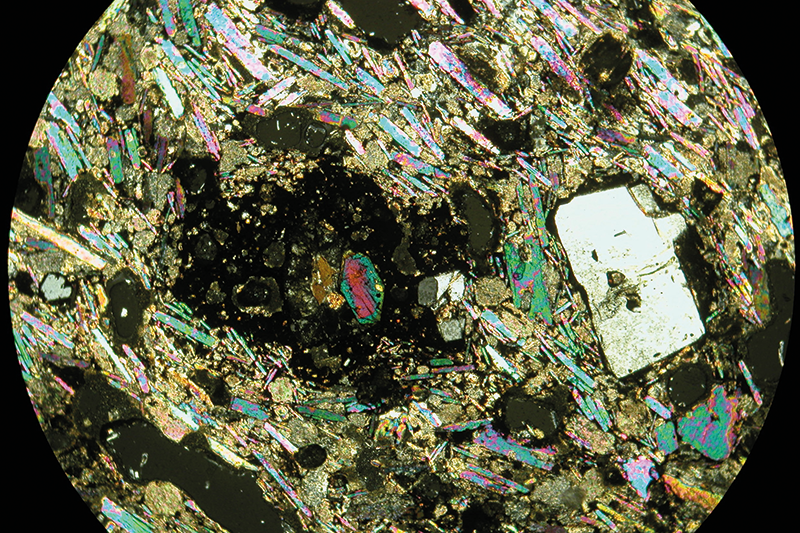
A rock rich with rare-earth elements under a microscope
© University of CambridgeResearchers from the University of Cambridge, UK, believe they have found a link between the distribution of REE-rich, CO2-bearing, igneous rocks and the thickness of the Earth’s lithosphere.
The analysis reveals that carbonatites and other CO2-rich igneous rocks, associated with rare-earth mineralisation, are concentrated around the margins of lithospheric regions around 170km in thickness.
The team has combined chemical data from around 9,000 igneous rock samples from across the world – all enriched in dissolved CO2, which increases the potential for REE concentration. This dataset has been compared to global models of lithospheric thickness derived from seismic waves generated by earthquakes.
The thicker lithosphere keeps mantle rocks at relatively high pressures and cool temperatures, suppressing melting. Under these conditions, only very small amounts of melt are produced. These melts form CO2-rich magmas that often become trapped at the lithosphere’s base, where they solidify into carbon-rich igneous rocks.
However, the researchers suggest that economically significant rare-earth deposits are not formed during this initial stage and, instead, the rocks must undergo a later episode of melting. This remelting effectively gives the metals a 'second stewing', further concentrating them until ore-grade deposits can develop.
While previous research has typically focused on individual sites or regions, this new study examines patterns on a global scale and investigates deeper geological processes that may control the distribution of REE-bearing rocks at the Earth’s surface.
Understanding the geological processes that concentrate these elements into mineable ore bodies is an important challenge for mineral exploration and future resource security.
The study focuses on rocks that are younger than 200 million years old and were formed after major episodes of continental break-up.
The team now plans to extend the map further back in geological time to older rocks that host most of the world’s economically significant rare-earth deposits and mines.
Although tectonic processes such as mountain building and rifting have altered many of these ancient rocks, the researchers hope that identifying similar large-scale geological patterns could help find undiscovered critical mineral resources.