At its core
How a core-shell design could enhance thermal barrier coatings for jet engines.

Modern gas turbines operate at extreme temperatures to achieve high efficiency, low fuel consumption and reduced emissions. In advanced jet engines, gas temperatures often exceed 1,500°C, well above the incipient melting point of the superalloys (around 1,200-1,300°C) used in most turbine components. Thermal barrier coatings (TBCs), together with advanced cooling technologies, are key enablers of this capability.
Thermal barrier coatings provide thermal insulation that reduces the metallic substrate temperature by several hundred degrees, allowing superalloy components to operate under the safe temperature limit and function properly under such extreme conditions. However, as turbines continue to run hotter, TBCs are facing a lifetime-limiting threat from our atmosphere.
In service, engines ingest airborne particulates such as sand, dust and volcanic ash. These deposits are primarily composed of calcia-magnesia-alumina-silicate (CMAS) and can melt on the hot coating surface to form a highly corrosive glass. Most CMAS deposits typically melt around 1,200°C, well within the operating temperature range of TBC surfaces.
Once molten, vitreous CMAS infiltrates into the porous TBC through microstructural defects such as pores and cracks, driven by capillary forces. The infiltrated melt fills the strain-tolerant features within the coating. Upon cooling, the CMAS solidifies within the coating microstructure, significantly stiffening the TBC and increasing the thermal stresses. This results in a substantial increase in the driving force for coating failure, ultimately reducing coating durability and component lifetime.
The CMAS challenge has become increasingly important for both current and future air transport. Aircraft operating in and around desert environments are particularly vulnerable because of the ingestion of airborne sand and dust, while volcanic eruptions can disrupt flights for days or even weeks. At the same time, future high-efficiency and hydrogen-fuelled engines are expected to operate at even higher temperatures, further exacerbating the CMAS problem.
The tough longstanding trade-off
For decades, yttria-stabilised zirconia (YSZ) has been the material of choice for TBCs because of its unique combination of low thermal conductivity (approximately 2.3W·m-¹·K-¹ at 1,000°C), high melting point (~2,700°C), good compatibility with superalloys in thermal expansion, excellent phase stability and relatively high fracture resistance (around 3MPa·m¹/²). However, YSZ TBCs perform poorly against CMAS attack. Molten CMAS can rapidly infiltrate through the porous coating structure, leading to premature coating failure.
Considerable research effort has therefore been devoted to developing CMAS-resistant coatings. To date, the primary approach in the aerospace industry is to replace YSZ with rare-earth zirconates, particularly gadolinium zirconate (Gd₂Zr₂O₇). These ceramics share many of the desirable thermophysical properties of YSZ – such as low thermal conductivity – but more importantly, they react with CMAS to form crystalline products that seal the coating surface against CMAS penetration.
While this strategy improves CMAS resistance, it suffers from a major limitation – the fracture toughness of Gd₂Zr₂O₇ (approximately 1MPa·m¹/²) is far lower than that of YSZ. This intrinsic brittleness makes Gd₂Zr₂O₇ coatings more susceptible to delamination and erosion during service. In practical terms, this means improving chemical durability comes at the expense of mechanical robustness.
This trade-off represents one of the central challenges in current and future TBC design. Ideally, a coating should be both chemically effective in mitigating CMAS attack and mechanically robust against physical damage, for example cracking and erosion. Achieving both simultaneously has proven extremely difficult. Resolving this longstanding conflict is a major focus of modern TBC R&D.
An architectural approach
Researchers from the Henry Royce Institute at the University of Manchester, UK, together with collaborators from Rolls-Royce and Cranfield University, UK, recently took on the challenge from a new perspective. They redesigned the coating microstructure rather than searching for an elusive all-round coating material.
Instead of replacing YSZ entirely, the team designed a new core-shell architecture for TBCs deposited by atmospheric plasma spray (APS). In this design, each building block of the coating is made up of a YSZ core and a thin CMAS-resistant shell.
The idea is relatively simple. Atmospheric plasma spray TBCs typically exhibit a lamellar structure formed by overlapping splats – flattened molten ceramic particles. Between these splats weaves an interconnected network of splat boundaries, microcracks and pores. These are microstructural features that provide coating strain tolerance, but also serve as the primary pathways for CMAS infiltration. The researchers propose engineering a thin layer of alumina – an established CMAS-resistant ceramic – precisely along these vulnerable infiltration pathways through the
core-shell design.
In principle, this approach would allow the coating to retain all the desirable properties of YSZ, particularly its high fracture resistance, yet simultaneously obtain the strong CMAS resistance of alumina – a combination that previous TBCs have not achieved.
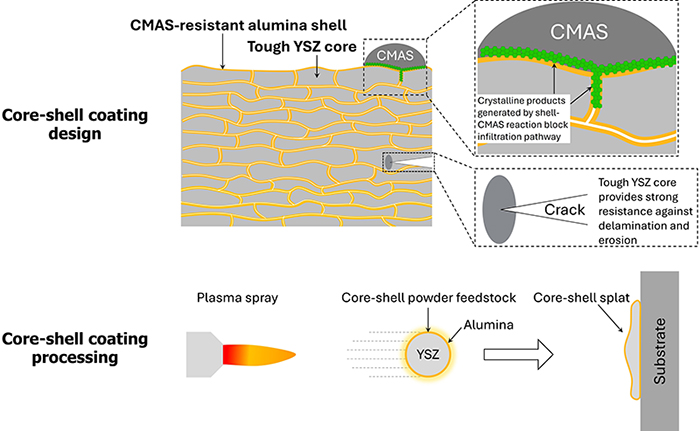
Top: Schematic illustration of the core-shell thermal barrier coating design and processing route. Cross-sectional microstructure of the coating. Each microstructural unit (splat) comprises a tough yttria-stabilised zirconia (YSZ) core and a thin calcia-magnesia–alumina–silicate (CMAS)-resistant alumina shell. Under CMAS attack, the shell, precisely engineered along the CMAS infiltration pathways, reacts with molten CMAS to block its penetration, while the tough YSZ core provides strong resistance against delamination and erosion.
Bottom: Manufacturing route of the coating, involving synthesis of core–shell powder feedstock followed by plasma spraying to form the core-shell coating
© Z. Li, G. Brewster, L. Isern, C. Chalk, J. Nicholls, P. Xiao, X. Zhang, Y. Chen, A core-shell thermal barrier coating with strong resistance to molten silicate attack and fracture. Acta Materialia, 2025. 288: p. 120870. https://doi.org/10.1016/j.actamat.2025.120870 https://creativecommons.org/licenses/by/4.0/
A coat of armour
Producing a ceramic coating with the core-shell microstructure is a significant challenge. The team came up with a two-step manufacturing process. A sol-gel process encapsulates commercial, spray-dried YSZ powder within a thin alumina shell, creating ‘core-shell’ feedstock particles. The particles are then deposited using APS to form the coatings.
The original design concept envisioned that each deposited splat would retain the distinct YSZ core and alumina shell structure in the feedstock powder. However, the result proved more complex and interesting.
During APS, the flame temperature can reach around 16,000°C. This extreme heat causes rapid melting of the core-shell particles. Under these conditions, alumina and YSZ near the core-shell interface partially mix in the liquid state. The mixture is then rapidly solidified and frozen to room temperature. As a result, each splat develops a compositionally graded core-shell microstructure without a sharp interface. The alumina-rich regions are concentrated near the splat boundaries and the zirconia-rich regions in the splat interiors.
Although the result deviates slightly from the original concept, this evolved microstructure has proved to be highly effective.
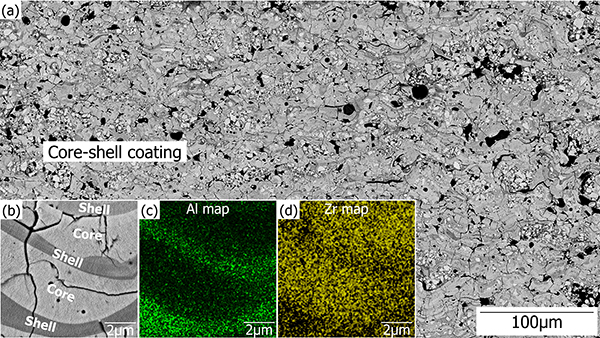
Cross-sectional scanning electron microscopy (SEM) images of the plasma-sprayed, core–shell, thermal barrier coating. (a) Overview of the coating microstructure, showing the characteristic layered architecture derived from the core–shell powder. (b) Higher-magnification SEM image of the core–shell splats. (c, d) Energy-dispersive X-ray spectroscopy maps of aluminium (Al) and zirconium (Zr) from the area highlighted in (b), confirming the presence of a Zr-rich core and an Al-rich shell within the splats
© Z. Li, G. Brewster, L. Isern, C. Chalk, J. Nicholls, P. Xiao, X. Zhang, Y. Chen, A core-shell thermal barrier coating with strong resistance to molten silicate attack and fracture. Acta Materialia, 2025. 288: p. 120870. https://doi.org/10.1016/j.actamat.2025.120870 https://creativecommons.org/licenses/by/4.0/
Resistance under attack
Testing evaluated the core-shell TBC’s resistance to CMAS attack. Two types of CMAS were used – a model composition of 35CaO-10MgO-7AlO1.5-48SiO2 supplied by Rolls-Royce, and a second composition of 27.8CaO-4MgO-5AlO1.5-61.6SiO2-0.6FeO-1KO0.5 designed to simulate real desert sand.
The CMAS was applied to the coating surface, followed by annealing at 1,250°C – above the CMAS melting point – to trigger infiltration into the coating.
The effectiveness of the core-shell design became immediately apparent. Industry benchmark YSZ TBCs suffered severe CMAS attack. The CMAS rapidly infiltrated through half of the coating thickness (400μm) within just 30 minutes. After 15 hours, CMAS invaded the full coating thickness and caused substantial structural damage in the form of delamination.
In contrast, the core-shell coating exhibited exceptionally strong resistance to CMAS attack. The infiltration depth was reduced by an order of magnitude compared with the YSZ coating during the initial 30-minute exposure and, even after
15 hours, CMAS infiltration remained limited to a shallow surface region, with 88% of the coating remaining intact.
The transformative improvement in CMAS resistance arises from the chemical reaction across multiple length scales, between the infiltrating CMAS and the alumina-rich shells along the infiltration paths. The reaction generates crystalline phases (anorthite and spinel) that precipitate directly within splat boundaries, pores, cracks and grain boundaries – effectively providing multiscale protection, blocking the infiltration pathways and preventing further CMAS penetration.
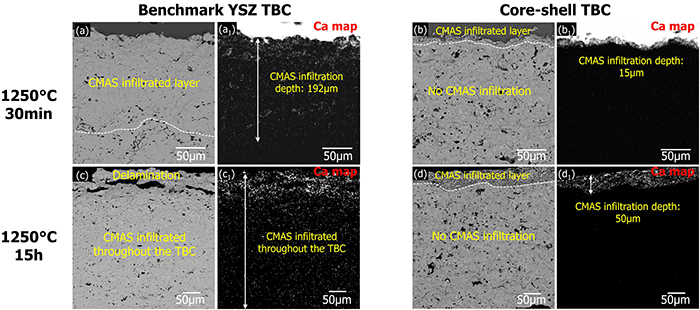
Comparison of calcia-magnesia-alumina-silicate (CMAS) resistance between the industry benchmark yttria-stabilised zirconia (YSZ) and core–shell thermal barrier coatings (TBCs). Cross-sectional SEM images (a–d) and corresponding energy-dispersive X-ray spectroscopy calcia (CaO) maps (a1–d1), where CaO is used as a tracer for CMAS infiltration, showing the microstructures of the YSZ and core–shell TBCs after CMAS exposure at 1,250°C for 30 minutes and 15 hours. The YSZ coating suffered rapid CMAS penetration, with infiltration extending through approximately half of the coating thickness after 30 minutes and through the entire coating after 15 hours. In contrast, CMAS infiltration in the core–shell coating remained confined to the near-surface region even after 15 hours of exposure
© Z. Li, G. Brewster, L. Isern, C. Chalk, J. Nicholls, P. Xiao, X. Zhang, Y. Chen, A core-shell thermal barrier coating with strong resistance to molten silicate attack and fracture. Acta Materialia, 2025. 288: p. 120870. https://doi.org/10.1016/j.actamat.2025.120870 https://creativecommons.org/licenses/by/4.0/
Resisting fracture without compromise
Improving CMAS resistance alone is not sufficient for turbine applications. What truly sets the core-shell TBC apart is that its greatly improved CMAS resistance does not come at the expense of fracture resistance – a balance that previous CMAS-resistant TBCs have largely failed to achieve.
To evaluate fracture resistance, the team first conducted high-velocity erosion testing at Cranfield University. In this test, angular alumina particles travel at approximately 140m/s perpendicular to the coating surface to simulate the severe particle impacts experienced during service.
Material loss from the coatings was continuously monitored until the underlying metallic bond coat became exposed. This helped assess the coating’s resistance to impact-induced fracture and material removal at the macroscale, with both material properties and microstructural effects included.
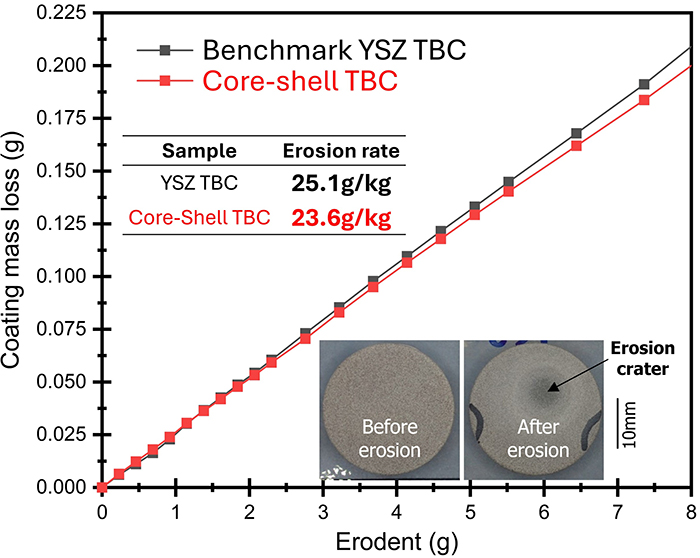
Comparison of erosion performance between the industry benchmark yttria-stabilised zirconia (YSZ) and core–shell thermal barrier coatings (TBCs). The graph shows the coating mass loss as a function of the amount of erodent used during high-velocity erosion testing. The inset images shows the top views of eroded coating samples after testing, while the table summarises the measured erosion rates, defined as the ratio of coating material loss to the mass of erodent used
© Z. Li, G. Brewster, L. Isern, C. Chalk, J. Nicholls, P. Xiao, X. Zhang, Y. Chen, A core-shell thermal barrier coating with strong resistance to molten silicate attack and fracture. Acta Materialia, 2025. 288: p. 120870. https://doi.org/10.1016/j.actamat.2025.120870 https://creativecommons.org/licenses/by/4.0/
To further probe the coating’s intrinsic fracture resistance, the researchers also performed bending tests on microcantilever beams machined directly from the coating using a focused ion beam.
In this approach, tiny cantilever beams – only a few micrometres in size – were fabricated from individual coating splats and fractured using a nanoindenter inside a high-resolution scanning electron microscope. This technique is particularly suitable for coatings because it enables site-specific measurements of fracture toughness in extremely small regions, often at the microscale.
It was initially expected that the lower-toughness alumina in the core-shell coating might reduce fracture resistance, but the results turned out to be quite the opposite. The erosion tests show that the core–shell design not only retains the erosion resistance of the benchmark YSZ coating, but slightly improves it, as indicated by its lower erosion rate. These findings are further supported by the microcantilever beam bending tests, which show that the fracture toughness is more than 30% higher than that of the benchmark YSZ coating.
The improved fracture resistance is attributed to two key mechanisms. Firstly, the addition of alumina lowers the melting point of the core-shell powder, allowing the molten splats to deform and spread more effectively upon impact with the substrate during APS deposition. This promotes stronger bonding between neighbouring splats and reduces the number of pre-existing microstructural defects, particularly vulnerable intersplat boundaries that often act as preferential crack propagation paths in conventional APS coatings. The resulting denser and better-bonded microstructure offers greater resistance to erosion and crack propagation.
Secondly, the coating enhances ferroelastic toughening. Conventional YSZ TBCs typically contain a tetragonal-prime (t’) phase with a domain structure. When a crack propagates, the local stress field near the crack tip causes small crystallographic domains to reorient – a mechanism known as ferroelastic domain switching. This process absorbs fracture energy and generates local strain fields that oppose crack propagation, thereby toughening the material.
For the core-shell coatings, the incorporation of alumina into the t’-YSZ lattice increases its tetragonality, thereby enhancing the ferroelastic switching strain generated during crack propagation. The contribution from ferroelastic toughening increases, enabling an improvement in fracture toughness.
Designing for the long term
The team believes this work highlights a possible new direction for how TBCs are designed in the future. Traditionally, TBC development has focused primarily on discovering new coating materials through compositional modifications and iterations. In contrast, the core-shell approach emphasises microstructural architecture, placing different materials precisely where they are most effective. Rather than relying on a single material to simultaneously deliver every required property, the coating distributes functionality across the microstructure itself.
Future gas turbines are expected to operate at even higher temperatures and under more aggressive environments. These demands will require coatings capable of resisting complex combinations of thermal, chemical and mechanical degradation, which may be extremely difficult to achieve using a single composition alone.
By combining the fracture resistance of YSZ with the CMAS resistance of alumina, the core-shell coating demonstrates that it is possible to overcome one of the most persistent trade-offs in conventional TBC design.
In addition, the concept appears highly versatile. Many other ceramics could potentially be combined and made into similar architectures depending on the application requirements. More broadly, the core-shell design represents a transferable idea that could be extended beyond TBCs to other advanced coating systems, such as environmental barrier coatings.
As advanced manufacturing and powder processing technologies continue to develop, architectured coatings may play an increasingly important role in enabling the next generation of high-efficiency turbine systems.
Thank you to all who made significant research contributions, including: Dr Zichen Li, Dr Xun Zhang and Professors Ping Xiao and Philip Withers from University of Manchester; Dr Luis Isern, Dr Christine Chalk and Professor John Nicholls from Cranfield University; and Dr Gyn Brewster from Rolls-Royce.
Recent events

EUROCORR 2026
The European Corrosion Conference, the flagship event of the international corrosion calendar, promises investment for the future by addressing the corrosion challenges of green technologies
Dublin
EUROCORR 2026
The European Corrosion Conference, the flagship event of the international corrosion calendar, promises investment for the future by addressing the corrosion challenges of green technologies
DublinMore like this...