Detecting corrosion under insulation
A patent for detecting corrosion in metal assets hidden by insulation or fireproofing materials.
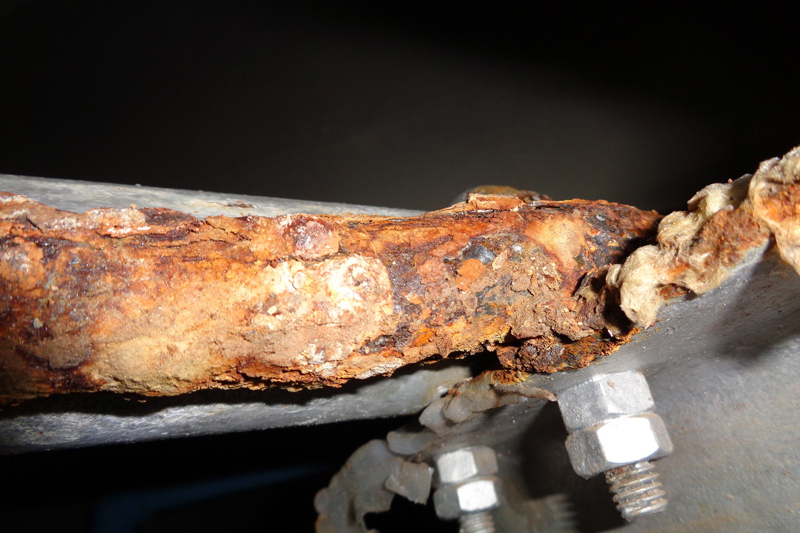
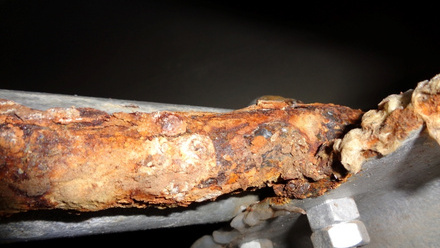
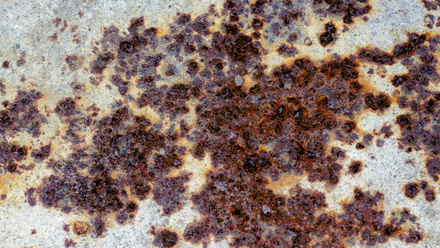
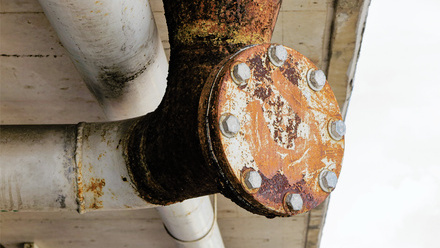
In industrial facilities, metal structures such as pipes and vessels are often wrapped in thick layers of thermal insulation or fireproofing materials to maintain process temperatures and ensure safety. However, such protective barriers can hide a destructive and silent threat known as corrosion under insulation (CUI), or corrosion under fireproofing (CUF). In particular, when water accumulates underneath the barrier – due to rain, water leaks or condensation – it can become trapped against the metal surface and initiate corrosion. This is worsened by any sources of chloride ions or acid.
As this occurs beneath the shielding layers, it cannot be observed during routine visual inspections. Instead, operators are often required to physically remove insulation sections to inspect the underlying metal in a random sampling approach. This process is labour-intensive and expensive, can require extensive scaffolding to enable access and, unfortunately, is found to be unreliable.
To address these challenges, European patent EP3894840B1, granted in January 2025 to the Saudi Arabian Oil Company, describes a non-destructive hybrid sensory system. It is designed to predict and detect CUF, without removing physical insulation and by combining complementary sensing technologies with advanced predictive computing.
In particular, by integrating thermography, electromagnetic scanning and real-time environmental monitoring, the system aims to provide a comprehensive, non-invasive assessment of an asset’s integrity.
According to the broadest claims of the patent, the system includes a first-detection apparatus, a second-detection apparatus, at least one ambient condition sensor, a communication device and a computing device.
The first-detection apparatus is adapted to capture thermal images of an infrastructure, while the second includes an emitter directing terahertz (THz) radiation towards the asset and a THz detector that receives the radiation from the asset. The ambient condition sensor is for detecting environmental conditions at an asset’s location. The communication device is coupled to all these devices to receive and relay data.
The computing device is coupled to the communication device and is configured to execute a machine learning algorithm from thermal images, as well as the THz and ambient condition data inputs. It then outputs a CUF prediction regarding the asset. This prediction distinguishes locations on the asset that have a high likelihood of CUF from those with a low likelihood.
The combination of different sensing devices, described as ‘sensor fusion’, is deemed necessary to ensure that the locations likely to experience CUF are accurately detected.
For instance, the thermal images show temperature gradients on the insulation’s outer surface, which can indicate locations vulnerable to CUF. However, temperature gradients are also sensitive to environmental factors, such as wind or sun exposure, or water intrusion not associated with actual metal corrosion. Therefore, relying on thermal imaging alone can lead to false positive results.
In contrast, THz radiation can pass cleanly through fireproof insulation made of fiberglass, mineral wool, or polystyrene foam. When the radiation reaches the concealed metal asset, it is partially absorbed and reflected back to the detector, forming a highly detailed 2D map of the metal-insulator interface. This provides additional information to corroborate thermal images, indicating whether corrosion has actually occurred. In turn, the thermal images can compensate for the typically lower resolution achieved using THz detection alone.
The use of real-time ambient sensors that measure temperature, humidity, or air pressure also enables results to be corrected for environmental variables, which can influence the corrosion rate and the insulation’s thermal signature.
A key part of the claimed system is the centralised computing device to generate a prediction. According to the patent, the algorithms it deploys can include deep learning techniques such as convolutional and recurrent neural networks.
Deep convolutional neural networks (CNNs) can be used to classify the complex spatial features of the thermal and THz images. Recurrent neural networks (RNNs) can be employed to analyse evolution of the thermal image and THz data over time, taking into account the ambient condition data.
According to the patent, prediction accuracy can be increased by executing boosting algorithms, such as AdaBoost. However, use of these algorithms is known to increase the amount of computational time required, and this is not normally necessary when using learning models like CNNs and RNNs. Nevertheless, the patent explains that increased accuracy at the expense of greater computational time is an acceptable trade-off, given that mistakes in corrosion detection can be very expensive.
Read the patent here.
Recent events

EUROCORR 2026
The European Corrosion Conference, the flagship event of the international corrosion calendar, promises investment for the future by addressing the corrosion challenges of green technologies
Dublin
EUROCORR 2026
The European Corrosion Conference, the flagship event of the international corrosion calendar, promises investment for the future by addressing the corrosion challenges of green technologies
DublinMore like this...