3D-printed surfaces enhance quantum sensors
Intricate textures bounce unwanted gas particles away in high-vacuum chambers.
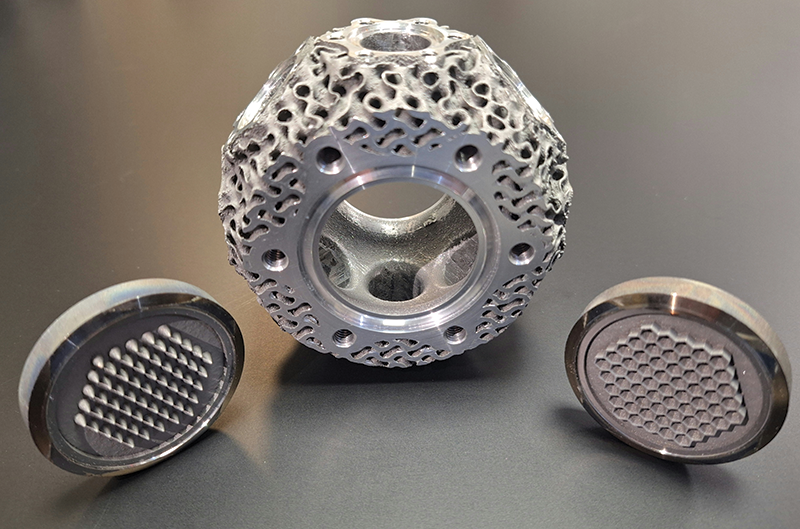
Examples of 3D-printed, textured, vacuum fittings to improve pumping performance when coated with particle-absorbing material
© Benjamin HoptonScientists at the University of Nottingham, UK, suggest this could allow useful particles to be delivered more efficiently, helping to improve measurement accuracy. The structures are made from titanium alloy Ti-6Al-4V Grade 5.
Quantum sensors use microscopic quantum objects to measure magnetism, gravity and other effects with unprecedented precision. The extreme sensitivity of these quantum objects means they only work under a vacuum.
Controlling the high-vacuum gas dynamics is therefore critical to ensure the accuracy of measurements. Although quantum sensors typically operate in highly controlled, strong vacuums, undesirable particles still occasionally get in and introduce ‘noise’.
To combat this, the team at Nottingham has created an ice hockey puck-sized system by 3D printing the titanium alloy with different patterned surfaces – hexagonal pockets and conical protrusions. These are designed to increase the frequency of contact between an incident atom and the surface, and preferentially bounce incident particles in particular directions. It is intended to fit into the ports of a commercial vacuum chamber.
Promising candidates include a hexagonal pattern like a honeycomb and an intricate 3D pattern derived from geometry-inspired artwork.
Nathan Cooper, Research Fellow at the university and lead author, says the design allows researchers to tailor gas flow dynamics in high vacuum without changing the large-scale structure of the apparatus.
They have tested how strongly the structured surfaces can enhance surface-based vacuum pumps, measuring up to 3.8 times the pumping rate per unit area tested. Simulations have found achievable surface patterns that may offer up to a 10-fold increase.
The researchers explain how particles scattering off a surface obey a known probability distribution for their angle of emission relative to the local surface normal. These improved outcomes are achieved by changing how a surface is inclined, to influence the output distribution for particles scattering off that surface.
'The improvements in outcomes come from using this ability to change particle output directions. In the case of the pumping application demonstrated, this is achieved by increasing the mean number of collisions a particle makes with a surface before it returns to the main volume of the vacuum system,' shares Cooper.
'On a flat surface, a particle can scatter only once and then leaves. On a structured surface, it can hit the surface multiple times. Because non-evaporable getter pumps have only a small probability of pumping most particles per time they hit the surface, these additional surface collisions substantially increase the pumping rate.'
Cooper expands, 'It could also likely be applied to make better collimation nozzles for particle beam generation, finely tune channel conductances for gas flow control, or direct particles from known sources towards or away from selected areas of an apparatus.'
A combination of vacuum science with effective 3D printing of materials compatible with ultra-high vacuum was required to realise the work and has only recently been demonstrated.
The team is currently working on the development of a compact, 3D-printed, quantum accelerometer, and will examine how the design freedom of 3D printing can be exploited to integrate other aspects of quantum technology. They are also exploring how localised heating of selected interior vacuum surfaces could activate the printed material itself as a passive vacuum pump.
Subject to funding, they intend to integrate passive pumping systems based on this technique into 3D-printed quantum sensors.
PhD student and co-author Ben Hopton says, 'What’s exciting about this work is that relatively simple surface engineering can have a surprisingly large effect.' This approach could 'significantly reduce, or even remove, the need for bulky pumps in some vacuum systems, allowing quantum technologies to be far more portable'.