Synthetic ice for a sustainable (and fun) skating experience
European researchers have developed an artificial solution with gliding properties similar to that of real ice.

Climate change, snowmelt and rising energy costs are putting pressure on ice rink operators. Skating on plastic sheets provides an economical and sustainable alternative, suggest Glice AG from Lucerne, Switzerland and Fraunhofer IWM in Freiburg, which have collaborated to develop synthetic ice with gliding properties that match those of frozen water.
The organisations developed a steel-plastic sliding contact model that took account of the need to start skating from a standing position, glideability, low friction, and hardness.
‘The first moment is particularly critical when ice skating. High initial resistance hinders the skater's safe start to gliding,’ explains project manager Professor Matthias Scherge from the Fraunhofer Institute for Mechanics of Materials IWM.
Therefore, the research initially focused on the first few seconds of movement. In addition to the frictional forces, the depth of immersion of the blade was also investigated.
‘Only when the blade ploughs with as little resistance as possible does the light and floating gliding sensation set in,’ adds the head of the Tribology business unit at Fraunhofer IWM.
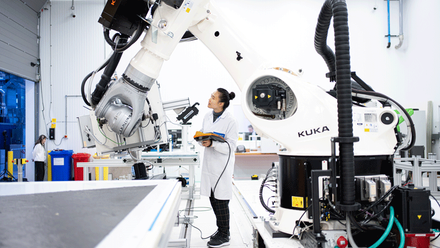
To clarify the interaction between skate blades and artificial ice, Fraunhofer IWM developed and constructed an ice gliding simulator. It was used to mimic the start-stop and gliding situations between different skate blades and synthetic ice variants and record the acting forces and other material characteristics.
Using the measured values for friction and abrasion, a tribological model was developed, from which recommendations for promising formulations were derived. The scientific and technological challenge was to create a mechanically durable surface that appeared white while offering ultra-low resistance to the skate blade.
After many iterations, laboratory results show friction coefficients of around 0.035, values that are slightly lower than those of ice at low sliding speeds. By way of comparison: with a friction coefficient of 1, sliding is impossible; at 0.5, it feels as if sand has been sprinkled on the surface. Only below 0.1 does sliding become possible.
The glide is based on a combination of materials consisting of a stable base made of refined polyethylene and a highly mobile surface layer whose polymer chains offer little resistance to the blade. Glice claims that the panels have a service life of 20 years, ten on each side.
The high tribological requirements met by the developed polyethylene may also be useful for applications in mechanical engineering, such as in slide rails, bearings, seals, and gears. It could also replace fluorinated polymers.