Seed coats inspire metamaterial for aircraft wings
A biomimetic metamaterial is made from a nickel-titanium (NiTi) shape-memory alloy.
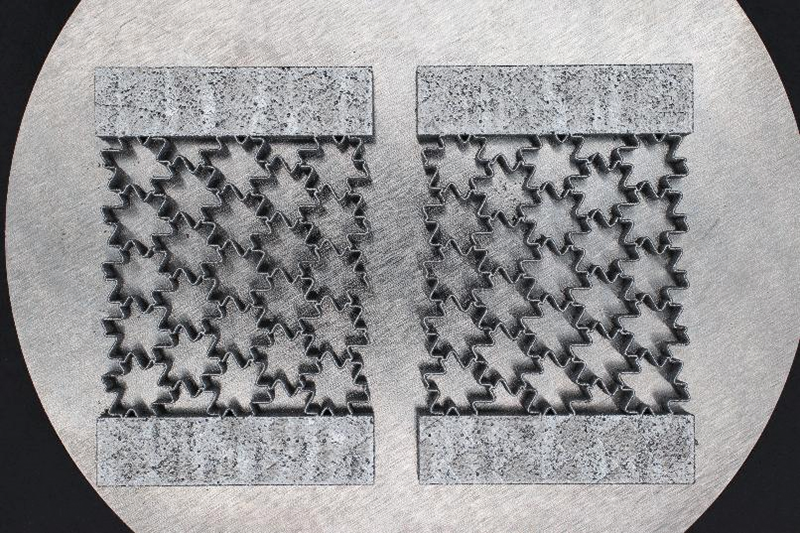
Samples of the seed-coat-inspired, nickel-titanium metamaterial prepared for testing
© Wenxin ChenThe alloy could enable aircraft wings that can morph smoothly while in flight.
Morphing wing designs often rely on passive structures that cannot shift shape in real time, soft polymer-based materials, or heavy mechanical actuators. However, this alloy structure is said to be active, strong and lightweight, capable of withstanding aerodynamic forces while reshaping itself.
It is inspired by the epidermal cell features in Portulaca oleracea seed coats. The seeds’ protective layer has embedded and wavy interfaces that spread out stress. The metamaterial is likewise said to be flexible and robust due to its honeycomb network pattern.
The research team at Nanjing University of Aeronautics and Astronautics (NUAA), China, use a near-spherical, Ni50.7-Ti49.3 alloy powder in laser powder bed fusion (LPBF) manufacturing.
A high-precision form of metal 3D printing, LPBF allows the team to create tiny, wavy structural features just 0.3mm wide – smaller and more controlled than what is typically possible in metal metamaterials.
The mechanical behaviour of the honeycomb structure can also be tuned by adjusting how many cell walls meet at each junction. This shifts the Poisson’s ratio across negative and positive values.
The team says a hexagonal iteration of the design performs better than other metal metamaterials with comparable strength. It can stretch up to 38% before fracturing and recover over 96% of its programmed shape when heated. It also exhibits good cyclic stability, which could extend a wing’s service life.
With this alloy structure, the team has built prototype wing sections, finding they were able to morph smoothly through an angle range of -25° to 25°, even at low temperatures similar to flight conditions.
Professor Dongdong Gu from NUAA says the prototypes show 'remarkable large-deformation recovery…achieving smooth and continuous deformation', with the shape-memory alloy providing its own actuation.
He adds that the 'mechanical properties of metamaterials are dependent on both intrinsic material characteristics and structural parameters'. Compared to conventional honeycombs, 'our evaluation reveals higher strength and stronger energy absorption capacity' in the proposed design.
'By incorporating ripples of varying amplitudes, the structure facilitated multi-stage tensile deformation, thereby improving in-plane mechanical properties.'
The core challenge, Gu notes, was 'how to reconcile the inherent conflict between the high strength of metallic materials and the flexibility required for achieving large deformations. It is necessary to effectively coordinate the architectural design of the mechanical metamaterial with the functional properties of the shape-memory alloy'.
He says the team’s wavy network structures amplify the intrinsic shape-memory effect of the NiTi alloy.
Due to their active deformation capability, superelasticity and biocompatibility, the metamaterial can also act as a driving component, or in flexible actuation systems and grippers.
With its improved structural design and energy-absorption capacity, it can also be incorporated into load-bearing and vibration-damping devices.
The team plans to add sensors and electronic components to future versions of the material so they can monitor and adjust their own shape, as well as develop it into modular, programmable, soft actuators that can be deformed in a controlled manner.
They believe this technology could lead to smarter, adaptive aircraft surfaces that respond to changes in flight conditions in real time.