Piece by piece
Examining the effects of micro and nanoplastics on health and the environment.

Stuart Patrick FIMMM MRSC (left) and Keith Barnes FIMMM FRSA (right) from the IOM3 Sustainable Development Group Leadership Team
© Stuart Patrick and Keith BarnesA Google AI search for scientific reviews of plastic pollution and microplastics indicates these particles are less than 5mm and are pervasive global pollutants found in oceans, soil, air and biota, originating mainly from the degradation of macroplastics (75%+).
The AI summary states that scientific evidence confirms their accumulation in human tissues such as the lungs, blood and placentas, potentially causing inflammation, reproductive toxicity and metabolic disruption. Key sources of these plastics include synthetic textiles, tyre wear and industrial pellets.
However, there is no mention of the assessment methods used to determine possible toxicity or the links to health conditions, highlighting the need to review the literature more closely and present that information more clearly.
While not excusing the amount of plastic pollution, and noting the many investigations underway and proposed into the presence of microplastics in many different environments, there is a need to agree on better collaboration and finalise central agreement on facts, testing criteria and risk evaluation.
Taking stock
The plastics sector seems to be a victim of its own success, built on cost-effective performance that is acceptable to all global economies of varying levels.
In 2024, the European Environment Agency (EEA) reported that 'Plastic is a relatively new invention in human history with some of the first examples dating back to the late 1800s, but its versatility and low production cost have made it one of the most widely used materials of modern times. In western Europe, the average annual plastic consumption is around 150kg per person – more than twice the global average of 60kg'.
The agency reports that the majority of plastic in Europe, about 74%, is used for non-packaging purposes, like construction, furniture, textiles and consumer electronics. Plastic production in Europe alone amounted to 57.2Mt in 2021.
Post-consumer recycled plastics and bio-based/bio-attributed plastics accounted for 10.1% and 2.3%, respectively, of European plastics production, according to Plastics Europe.
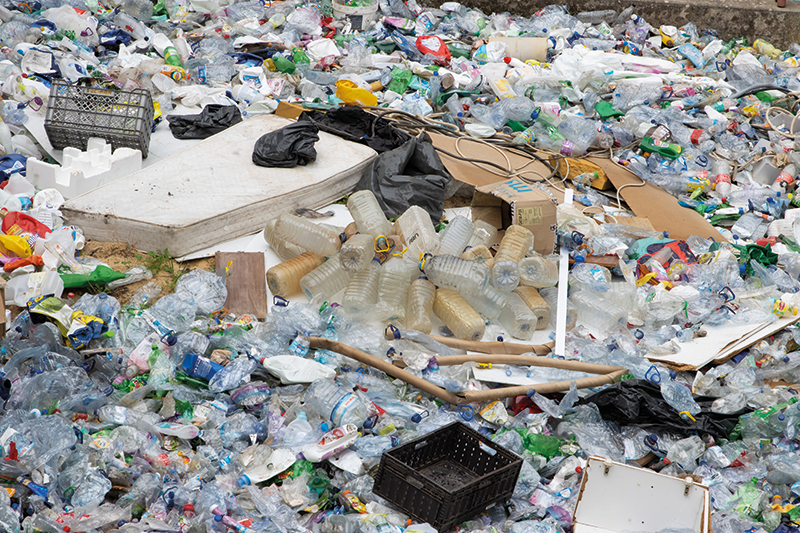
Meanwhile, the plastics waste pollution problem, known as ‘leakage into the environment’, translates to the indiscriminate littering and dumping of plastic waste, from single-use plastic packaging to discarded fishing nets.
The Scientists’ Coalition for an Effective Plastics Treaty reported in 2024 that globally, 'it is estimated 12.7Mt of plastics enter the environment as microplastics every year, the main sources being paint (37%), tyre particles (29%), pellets and textiles microfibres (8%) and personal care products (0.4%). There will also be substantial additional quantities from the fragmentation of larger items of plastic that have already entered the environment as debris.'
Furthermore, the EEA reports:
- 85% of marine litter from land-based sources is plastic.
- Ingestion of plastics by marine species is widespread in European seas. For example, 93% of fulmar birds assessed in the North-east Atlantic Ocean had ingested some plastic and 85% of turtles examined in the Mediterranean Sea had eaten the litter.
- About 8% of European microplastics released to oceans are from synthetic textiles – globally, this figure is estimated at 16-35%. Between 200,000-500,000t of microplastics from textiles enter the global marine environment each year.
The US Environmental Protection Agency (EPA) differentiates between primary and secondary sources of microplastics, with the former being intentionally manufactured in small sizes for consumer products, such as cosmetics or biomedical products, while the latter are broken down from larger plastic materials, such as food wrapping, tyres and synthetic textiles.
The EPA comments that 'microplastics have been found in every ecosystem on the planet, from the Antarctic tundra to tropical coral reefs, and have been found in food, beverages, and human and animal tissue.
'The wide range of particle sizes, densities and compositions pose a challenge for researchers because there is not a single method that can be used to characterise the wide variety of micro and nanoplastic particles.
'There is a pressing need to develop and standardise collection, extraction, quantification and identification methods for micro and nanoplastics to improve reliability, consistency and comparability across studies. These methods are needed across medias such as sediment, surface water and aquatic species.'
As of April 2026, the US EPA will include microplastics and pharmaceuticals on the sixth Contaminant Candidate List, which means testing and monitoring for these under the Safe Drinking Water Act and providing funding for research. It has been reported that this could be a precursor to future regulation if those particles are deemed a threat to public water systems.
Nonprofit organisation The Ocean Cleanup reports to have collected more than 50mln kg of plastic waste from aquatic ecosystems around the world as of March 2026. This was described by earth.com as '…the largest verified haul yet reported by a single global cleanup initiative. The milestone reframes the scale at which engineered cleanup systems can operate while exposing how much plastic still enters the sea each year'.
Yet while the primary focus is understandably on the potential health and environmental hazards, there seem to be no risk evaluations on the possible toxicity of microplastics.
Complex narrative
In his book, The Plastics Paradox, Dr Chris DeArmitt FIMMM from the Plastics Research Council talks about microplastics being a negligible proportion of the ‘recipe’ of air pollution.
A study in Environmental Science & Technology uses a probabilistic model to compare the mass intake of microplastics against the intake of other common microscopic particles found in the human diet and environment, such as titanium dioxide, sand, quartz and silicates.
In the paper on Lifetime accumulation of microplastic in children and adults, researchers found that for every single microplastic particle a person swallows, they ingest approximately 200,000 times more inorganic 'dust' particles.
While humans ingest about 40mg of these inorganic particles per day, the mass of microplastics consumed is so small, at just ~0.0000013g per week, that they represent only a negligible 0.001% fraction of the total particle intake.
The study emphasises that while public concern is focused on the 0.001% of particles that are non-toxic plastic, the remaining 99.999% of ingested particles consist of substances like crystalline silica (quartz dust), which are proven toxins and carcinogens that receive far less attention.
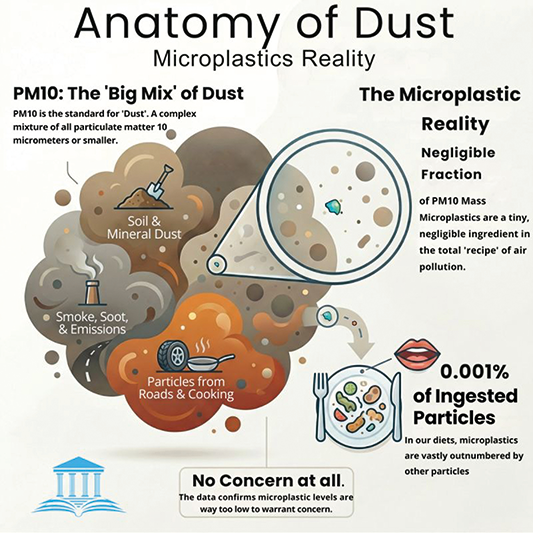
This research concludes that, 'Comparing our findings with the intake of other particles, microplastic mass intake rates are insignificant, as they make up for only 0.001% of these particles. However, this comparison does not imply that the toxicological profiles of these particles are similar'.
There has been research in the public domain to suggest that because such a high percentage of plastic, reportedly 99.7%, passes straight through the body, the total mass of microplastics retained in human tissue over a 70-year lifespan is calculated to be less than 0.005g. This is less than a single grain of sugar or salt, or a small raindrop.
Only the smallest fraction of particles, less than 10μm, are capable of translocation – moving through the body. Even then, the body uses biliary excretion to return these particles to the gut for expulsion.
Humans ingest roughly 200,000 times more inorganic dust particles than plastic, like sand and silica, yet they pass through the same digestive processes without the level of public concern reserved for non-toxic plastic.
Because of the efficiency of the pass-through effect, actual human exposure to microplastics remains hundreds of millions of times lower than the established No Observed Adverse Effect Level.
These levels were determined using ingestion of plastic pellets defined as microplastics. So, detecting a particle in the body is not the same as detecting a health problem. The body’s natural defences ensure that nearly all ingested microplastics pass harmlessly through the system.
The research study Comparison between in vitro toxicity of polymer and mineral dusts and their fibrogenicity, published in The Annals of Occupational Hygiene, further notes that plastic materials are 'non-toxic' and among the safest materials.
The EPA’s Toxic Substances Control Act even created the 'polymer exemption' in recognition of the exceptional safety of plastics compared to other classes of substances. Since polymer molecules are so large, they cannot migrate (move around), which makes them intrinsically safer than small molecules.
The Plastics Research Council notes that when animals ingest plastic, it passes right through without any effect, according to several studies, such as Virgin microplastics are not causing imminent harm to fish after dietary exposure in the Marine Pollution Bulletin, which is related to PVC, nylon, ultra-high-molecular-weight polyethylene, polystyrene and medium-density polyethylene.
In that study, the researchers concluded, 'The dietary exposure of the bacteria S. aurata to six common types of virgin microplastics did not induce stress, alter the growth rate, cause pathology, or cause the microplastics to accumulate in the gastrointestinal tract of the fish'.
Indeed, the US Food and Drug Administration (FDA) states that 'Current scientific evidence does not demonstrate that levels of microplastics or nanoplastics detected in foods pose a risk to human health. The FDA continues to monitor the research on microplastics and nanoplastics in foods and is taking steps to advance the science and ensure our food remains safe.'
Meanwhile, off the back of US research, the German Federal Institute for Risk Assessment, which advises German authorities on food and product safety, said in December 2012 that 'According to the current state of knowledge, there is no reliable toxicological evidence of health risks from the intake of microplastics via food. Current evidence does not permit any definitive conclusion about the effects of microplastics on health'.
In 2022, the World Health Organisation (WHO) released the report Dietary and inhalation exposure to nano- and microplastic particles and potential implications for human health. Using a group of international experts, the WHO reviewed the available published data up to December 2021 and assessed the risks to human health from exposure to microplastic particles from the environment. The report identified research needs and defined the scope of future work needed on microplastic particles to address current uncertainties.
The 2020 paper On the creation of risk: framing of microplastics risks in science and media, published by Harvard University, USA, included the following in the abstract. 'The public is concerned about plastic pollution, while clear-cut scientific evidence for an environmental risk of microplastics is absent. This contrast between incomplete scientific knowledge and public risk perception is an interesting case for investigating how ‘environmental risk’ is transformed in science communication.
'This study examines how microplastics risks are framed in peer-reviewed publications and online newspaper articles, respectively. It also analyses if the contents conveyed by the frames used in science and the media are consistent. The results show that most scientific studies (67%) frame microplastics risks as hypothetical or uncertain, while 24% present them as established.
'In contrast, most media articles reporting on microplastic impacts (93%) imply that risks of microplastics exist and harmful consequences are highly probable. The creation of simple narratives (journalists) and the emphasis on potentially negative impacts (scientists) contribute to this inconsistency.
'The transformation of an uncertain risk into an actual risk is further caused by two inconsistent risk conceptions, namely risk being the probability of a negative outcome (environmental scientists) or being the uncertainty of a negative outcome itself (public). Although the latter differs from the risks identified ‘objectively’ by scientific methods, it allows understanding [of] the risk perception of the public and decision-makers.'
Most recently, a Guardian newspaper article said that 'High-profile studies reporting the presence of microplastics throughout the human body have been thrown into doubt by scientists who say the discoveries are probably the result of contamination and false positives. One chemist called the concerns ‘a bombshell’.'
Taking things further, ENDS Europe, the environmental news operation, commented in March 2026 that 'As the European Parliament asks EFSA (the European Food Safety Authority) to assess the evidence on human exposure to microplastics, scientists warn that overstating either certainty or uncertainty of the harm they cause could undermine trust, delay action and weaken the case for upstream controls on plastic pollution'.
The issues revolving around studies that do claim harm has been shown by other scientists to be invalid because they:
- Use a million times more plastic than is in the environment.
- Use crosslinked polystyrene beads completely unlike plastic in the environment.
- Fail to use controls (i.e. comparing to other particles). When compared, plastic is as non-toxic as clay or cellulose.
- Use invalid methods like pyrolysis-gas chromatography-mass spectrometry that detect fat and confuse it with polyethylene.
Finding a consensus
The level of media and related online content on this issue is phenomenal and is often linked to possible harm with risk-averse connotations. Surely there should be collaboration and a central agreement on facts, testing criteria and proven healthcare problems.
While acknowledging the waste problem that needs tackling, there are of course plenty of benefits that come with plastics use, and a complete ban on plastic use or a move to being plastic-free would be unwise. In addition, the British Plastics Federation notes that throughout their lifecycle, plastics contribute significantly to keeping emissions down.
The Ellen MacArthur Foundation, in collaboration with UK NGO WRAP, released a 2024 report titled Scaling Impact: The Plastics Pact Network’s Six-Year Journey Towards Eliminating Plastic Pollution and Waste. It shares the impact and lessons learnt from the past six years of the Plastics Pact Network and highlights its ongoing role in driving local, collaborative action around the world to reduce waste, informing and complementing national policy and a Global Plastics Treaty.
The report says that, thanks to Plastics Pacts, tens of billions of problematic or unnecessary plastic items have been eliminated. Also, design for reusability, recyclability and compostability in practice and at scale has increased by 23%. Incorporation of recycled content back into packaging has increased by 44%.
In the UK, Extended Producer Responsibility will act as a tax on waste packaging, and a Deposit Return Scheme for mainly plastic and metal containers will come into force next year. It will be interesting to see the results of these in the next couple of years.
The other direction of plastics, apart from recycling, is reuse and refill – of which there have been numerous trials, but wider uptake will be down to public education and collaboration across sectors.
The EU has been more successful here, as most countries are covered by central waste control, not local authorities. Brand owners will need to provide information on their packaging about the correct bin in which to deposit the item, the deposit amount and maybe the plastic material used.
Ultimately, littering and dumping of waste is a global problem and there must be education, installation of better waste collection facilities, setting up of recycling/incineration plants, along with higher penalties to significantly reduce this problem.
The authors would like to thank Dr Chris DeArmitt FIMMM from The Plastics Research Council for his support and advice on generating some of the content, Daniel J. O’Kelly from Explainable Studio and our colleagues in the IOM3 Sustainable Development Group for their encouragement and advice.