Passing the baton
Mentors and mentees across different disciplines share their experiences.
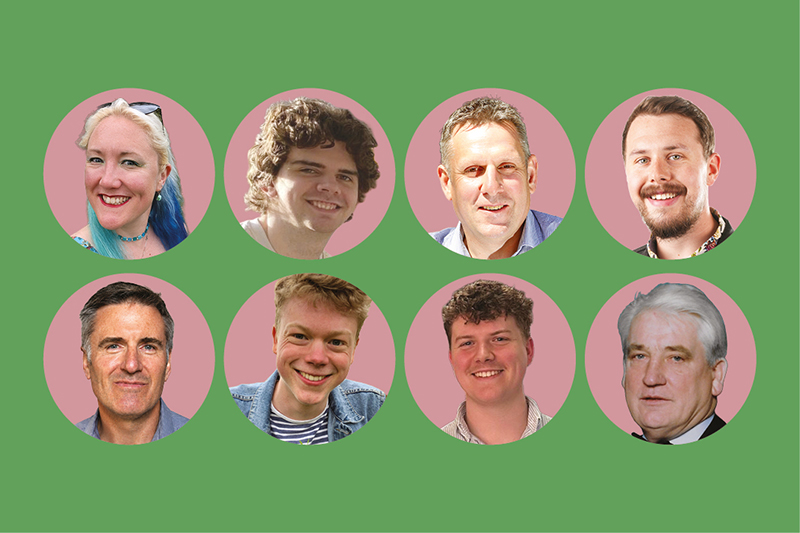
Bottom row L-R Andrew Fulton, Oliver Thomas, Samuel Jackson, Norman W Jackson © All headshots owned by individual contributors as above
Eleanor Grieveson CEng CSci MIMMM, Senior Metallurgist, Amentum
What place has mentoring had in your career?
After an undergraduate degree in Materials Science at the University of Oxford, UK, I stayed on to complete a DPhil in Structural Materials for Fusion Power, for which I received industrial sponsorship and mentoring from Rolls-Royce. This helped me get a job at Rolls-Royce in their materials department. There, I continued with a range of mentors who helped me achieve Chartered Engineer and Chartered Scientist registration. I now work as a Senior Metallurgist in Amentum’s Corrosion and Materials Science team. With my Chartered status, I was asked if I was interested in becoming a mentor on the graduate scheme, and have since supported three graduates through this scheme and onto the path towards Chartership.
How have you found the company mentorship scheme?
The Amentum graduate scheme is a great way of structuring career planning and progression for new employees straight out of university and is helpful for those new to mentoring. Allocating specific mentors to mentees provides a stable start for both sides. As I have progressed in my career, I have taken on other, more informal mentees, but I feel I would have been less confident had I not already been part of the graduate scheme.
What do you feel you can share with your mentees?
Having worked both in direct industry and consulting, on a wide range of technical topics and with a diverse set of co-workers and mentors, I have a point of comparison to make for most situations and there is always someone in my network who can support where I can’t. I was encouraged to try everything and I’ve tried to instil that in my mentees, particularly at the start of their careers. It’s good to get as much experience in different areas as possible for the best chance of finding what you really enjoy.
What is one challenge and one thing you’ve enjoyed?
My mentees have regularly challenged me when they come along with questions on topics I don’t know about, but these often prove good learning points for both of us as we can work through solutions together. It’s always enjoyable and satisfying to watch mentees come in as uncertain students and progress through technical, admin and business challenges, finding their feet in industry and becoming valued contributors to the workplace.
-----------------------------------------------------------------------------------------------------------------------------
Alex Gooddy AIMMM, Graduate Materials Scientist, Amentum
What is your experience of being a mentee?
Having completed my undergraduate degree in Materials Science at the University of Oxford, UK, in 2025, I joined Amentum as part of their graduate scheme, working within the Materials and Equipment Qualification Team. As part of the graduate scheme, I was assigned Eleanor Grieveson as a mentor to provide support and guidance about the nuclear industry, and help put me on the path towards Chartership.
Why and how did you seek out mentorship?
When I was looking for a materials-related job, I took an interest in programmes that offered strong support and development to build up my confidence and knowledge of the industry. The Amentum graduate scheme provided this, with a structured system of work supported by an assigned mentor. Thanks to this mentorship scheme, I have an outlet to discuss any new ideas that were introduced to me through the graduate scheme.
What skills or tools have you taken on board?
Through mentoring, I can get an insight into other operations within Amentum that I would not know of had I only gotten support from within my team. Thanks to Eleanor, I have been directed towards useful resources and groups that focus on interests and goals of mine within the company, but outside the orbit of the team I work in on a day-to-day basis.
What challenges have you encountered as a mentee?
On some occasions, I have run into roadblocks in parts of the business that are outside the expertise of my mentor, however, they have always been diligent at working through these problems with me or signposting people who could help more easily.
What have you enjoyed, and are you keen to become a mentor in the future?
I’ve most enjoyed the extra confidence my mentor has given me to continue striving for development as a young professional, with the goal of Chartership and beyond. In future, I would like to provide the support that has been given to me to a new set of engineers.
----------------------------------------------------------------------------------------------------------------------------
Mike Watkinson, Deputy Pro-Vice Chancellor for the Faculty of Science and Engineering at Manchester Metropolitan University, UK
What place has mentoring had in your career?
I was appointed to my first independent academic position in 1998 and worked my way to become a full professor in 2010. During that time, my department underwent a number of major changes, coinciding with the formation of a new multi-disciplinary school. As a result, I was thrust into a leadership position earlier than I might have been, which included being a mentor to more junior colleagues.
I moved into a faculty position involving PhD student development as well as mentoring their supervisors. I then became head of a multi-disciplinary school at a new institution, and undertook extensive informal and formal mentoring through the annual appraisal process. Most recently, I have moved to a substantive faculty leadership role, where I informally mentor an early-career academic as well as a research fellow in another academic discipline – not because I have to, but because I choose to.
How does mentoring compare to your regular interactions with students?
The mentoring relationship is very different and, I would contend, more significant. I don’t think I have ever told a mentee what to do, but I have always listened carefully to their plans, or read a draft manuscript or grant, and given constructive advice. People at this early-career stage are making decisions that can be career-shaping, and I am acutely aware that they need all the support and advice they can get.
Have you mentored anyone outside your subject area?
Yes, but not that often. One can provide valuable strategic advice here, rather than subject-specific ideas. I am also currently mentoring someone outside my institution, which is an interesting experience, as I’m getting to see different issues and institutional approaches in another part of the sector.
What are the most important skills or experiences to share with mentees?
Most of my mentees have been 90% there with their thinking around strategies and just need a gentle nudge here or there, or reassurance from someone independent that this was the right way to go. Sometimes they need help with grants and manuscripts, and a mentor can really make a difference in the written submissions, but just as importantly, in responses to referees and editors.
-----------------------------------------------------------------------------------------------------------------------------
Matthew Wadge MIMMM, Member of the IOM3 Student and Early Career Committee, Third Century Fellow in Surface Engineering at Manchester Metropolitan University, UK
What place has mentoring had in your career so far?
I have been privileged to have several mentors throughout my career, from early-career researchers to senior leadership figures who guided me through my PhD, postdoc and research fellow roles. These experiences have shaped my approach to research, collaboration and career development. In parallel, I have mentored several Master’s and PhD students, supporting them in both technical research challenges and broader professional development.
Have your mentors’ styles influenced your approach?
Absolutely. I have been extremely fortunate with my mentors, not only in their passion for research but also in their openness, inclusivity and honesty. A core aspect of our one-to-one meetings has been discussing not just my research and career progression, but also my personal wellbeing, including mental health challenges.
These conversations, particularly during periods of depression and anxiety, have encouraged me to be more open and honest, both with myself and others. They have also informed my approach to mentoring, allowing me to support mentees on a more personal, non-pressured level when they feel comfortable discussing such issues.
Also, experiencing a range of mentoring relationships, and recognising how my own goals changed from one meeting to the next, have highlighted the importance of flexibility. I adapt by listening carefully to mentees’ current priorities and challenges, without losing sight of longer-term career aspirations.
How does mentoring as part of an organised programme differ from an informal interaction?
From my experience in the Academic Development Programme at Manchester Metropolitan University, it tends to offer broader, more general guidance aligned with common milestones. It also benefits from a cohort element, enabling peer learning and shared discussion of core development areas. In contrast, independent mentoring is typically more tailored and flexible. It allows for focused support on specific goals, such as refining a research niche, preparing grant applications, developing publications and career progression.
What do mentors and mentees have in common and what are the points of difference?
Mentees sometimes focus on more specific, short-term objectives, whereas mentors often take a broader, long-term perspective. Additionally, mentors may come from different disciplines, so both field-specific and general experiences can vary. What remains consistent is the core purpose – effective mentoring provides guidance, encouragement and a space for reflection.
-----------------------------------------------------------------------------------------------------------------------------
EUR ING Norman W. Jackson CEng FIMMM FNEIMME, Consultant Mining Engineer and Member of the IOM3 Mining Technology Group Leadership Team
What place has mentoring had in your career?
I began as an ordinary miner. I was trained to work in mines safely, and had some good instruction and practical training for all the various jobs I did. I ultimately qualified as a Mining Surveyor and as a Mining Engineer. Right from the beginning, I was taught to transfer my knowledge in every task I had to undertake. I progressed through various junior and senior roles in the industry, and came across many good and some very poor mentors. In turn, I mentored other apprentices lower down the training scale.
Why is mentoring important?
It’s about passing knowledge to people in the correct manner to see progression. One thing I learnt at an early stage was to not concentrate on just one mentor, as that might guide you in the wrong direction.
Safety in the mining industry is extremely important, learning the lessons and passing them on. Early in my career, I began investigating accidents, many of them serious and occasionally with fatalities. Every accident has a lesson, but they aren’t always the same. It’s trying to transfer that knowledge to your junior and senior staff, and to your mentors above you, that those lessons must be taken on board so the same thing doesn’t happen again. Accountability, as far as mentorship is concerned, is key.
One of my senior roles was in privatising the industry. That was a fascinating process, because it involved dealing with things I’d never dealt with before – the legal and financial processes in the transfer of a business. I learnt lessons and have been able to pass them onto other people, showing them how a business could be remodelled to meet future demands.
Mentoring, in many ways, is about management of change. Change is vital. Recently, I ventured into the world of artificial intelligence. At my age, I found it a fascinating process and, in my future mentoring, I’ll be recommending that people take it on board. It doesn’t matter how old you are, you can always learn and pass on information.
What is it like transferring knowledge and skills overseas?
I have worked extensively overseas. Russia is a huge country with different local languages. Therefore, mentoring through interpreters was a challenge. That kind of mentoring is difficult, because you have to pass on the messages, translate them, then reverse the whole process. You have to use practical examples, or chalk and a blackboard. You have to be careful in the way you transfer that knowledge, and you are much more reliant on facial expressions. That’s a mentoring skill, getting through to people no matter the language barrier.
When you get underground, that’s also different because you’re in darkness. People can’t see as clearly, they can’t see your face. When you’re sitting with your piece of chalk and you gather them around you, it’s important not to exclude people.
What are the additional challenges with mentoring in the mining industry?
I spend a lot of time working with local universities and local authorities, for example. One problem is their lack of practical experience, yet mining is 3D. You need all your senses, because when you’re underground, you’re limited to the length of your light – how far you can see. The rest of it is your other senses. You’re looking at what’s happening to your head, what’s happening to your feet. Passing this on to those without the practical experience offsite is difficult.
You can do things with good visual backup instead. PowerPoint presentations are an excellent form of communication, particularly when working overseas – a picture tells a thousand stories, and that’s vital. But it’s becoming more and more difficult. The places people can be sent to for experience are limited.
What’s next for you in mentoring?
I’ve thoroughly enjoyed supporting others in mines and working underground. Latterly, I’ve been an expert witness in several High Court cases of all sorts. I’ve mentored people about being an expert witness. The lesson there is to only talk about what you’re an expert in, otherwise you will be found out.
-----------------------------------------------------------------------------------------------------------------------------
Rebecca CSci FIMMM, Principal Materials Scientist at the Defence, Science and Technology Laboratory
What place has mentoring had in your career so far?
I joined my current employer on the graduate scheme nearly 15 years ago, after being awarded an MChem in Chemistry at Durham University, UK. I quickly moved into working on materials projects, in particular additive manufacturing, and I’ve had the opportunity to work across a wide portfolio of research. My current mentoring experience is my first formal one, although I have had opportunities to undertake informal mentoring of graduates and other colleagues through the projects I’ve led and worked on.
Why were you drawn to becoming a mentor?
I was supported in Chartership mentoring, but due to work and life commitments it took me a long time to finally fill in the paperwork. I achieved Chartered status last year and was keen to pass on my experience, both technically and as someone who had recently gone through the process.
Which skills or experience are most important to pass onto your mentee?
Listening is a key part of the role, but also curiosity and interest in the mentee’s work, so you can ask the right questions. A key aspect of the Chartership mentor role is to help the mentee identify where their experience meets the requirements, and I have been able to work with my mentee Lisa on this. The process can feel overwhelming, so I drew on my own recent experience to break the application process into smaller chunks, so my mentee wasn’t looking at a blank page.
What challenges have you encountered and what have you most enjoyed?
There haven’t been many challenges, but it has been difficult to find time for us to chat with each other as we both have busy diaries. However, we have been supported by our line management to prioritise these discussions.
I have enjoyed discussing Lisa’s work with her. Although we work in the same capability area, we work on very different projects and it has been really interesting to hear more about her area of work.
By helping someone else develop their career, mentoring helps you take a step back and look at your own career. It has been useful to think about how I have got to this point, and how those decisions and opportunities can support others.
-----------------------------------------------------------------------------------------------------------------------------
Lisa MRSC MIMMM, Senior Scientist at the Defence, Science and Technology Laboratory
What were you looking for in a mentor?
After graduating with a First Class MChem degree and PhD in Chemistry, I took on a role as a Senior Scientist, specialising in materials characterisation. Chartership was always something I was eager to pursue, to develop my career and gain recognition and credibility within the scientific community. When I heard about the Chartership mentoring scheme at work, I immediately took advantage of the opportunity to accelerate my professional development.
It was important that I found someone who understood the processes and expectations, and who I felt comfortable openly communicating with. As Rebecca and I work in the same team and share a similar technical background, and she has recently become a Fellow of IOM3, it was natural that she would be a good mentor to support me along the path to Chartership.
How have you benefitted from mentoring?
In my experience, having a mentor is fantastic way to build a relationship, learn new skills and develop your career. Rebecca and I regularly meet to discuss my progress against IOM3 competencies. I come to each meeting prepared, with an outline of what I want to accomplish during each session, and we work together to set clear development goals.
The process of aligning my work to the Chartership framework has increased my self-awareness. It has encouraged me to reflect on my career, seek feedback and identify areas for improvement. I am also more conscious of staying current with industry trends, best practices and emerging technologies. In future, I will continue to reflect on my skillset, seek feedback and set structured goals to further my development.
What challenges have you encountered as a mentee?
I initially found it challenging to map my day-to-day work to some of the IOM3 competencies and demonstrate them effectively. However, through regular communication with my mentor and acting on feedback, I began to record key activities, things that had gone well, what hadn’t and the lessons I had learned. I now engage more critically with my work. This has enabled me to stay on track and progress through the application process much quicker.
What have you enjoyed about the experience and are you keen to become a mentor in the future?
The support I have received from Rebecca has strengthened not only my technical skills, but also my interpersonal skills, such as communication and leadership. This has helped me grow in confidence. I would be keen to lead by example and become a mentor in the future – sharing my own knowledge, skills and experiences to contribute positively to the professional development of others.
-----------------------------------------------------------------------------------------------------------------------------
Andrew Fulton FIMMM, Member of the IOM3 Mining Technology Group Leadership Team, CEO of Anglesey Mining and Immediate Past President of the Mining Association of the UK
What place has mentoring had in your career?
I would probably describe my experience as being shaped more by people, operational environments and personal principles than by any formal programme alone.
I have both received and provided mentorship throughout my career, from my earliest days as a young mining engineer underground, through operational leadership roles, and now into broader strategic and industry leadership positions across the UK and international mining sector.
What does mentoring offer and how does it compare to training?
Mining remains an industry in which experience transfer matters enormously. Many of the most important lessons relate to judgement, risk, communication, leadership under pressure and understanding people. These things are all difficult to fully capture in procedures or formal training alone. Good mentorship is often informal, continuous, and built on trust and shared experience.
Early in my career with Anglo American, mentoring was more structured and formalised. Experienced leaders invested time in developing younger engineers and managers, not simply through technical instruction, but by exposing them to decisionmaking, leadership behaviours, operational accountability and the realities of working in high-hazard environments. Some of the most valuable lessons were not taught in classrooms, but through observation, conversations after difficult shifts, reviews of failures and successes, and being challenged to think critically and independently.
As my own career developed, mentorship became something I viewed less as a programme and more as a professional responsibility. I have tried to support engineers, supervisors, managers and emerging leaders by creating opportunities, providing honest feedback, encouraging challenge, and helping people build confidence in both their technical and leadership capabilities.
I have also found that mentorship is never one-directional. Throughout my career, I have continued learning from colleagues, graduates, operators, technical specialists and peers across the sector. Some of the best mentors I encountered were those who remained curious themselves, sometimes making challenging statements to test the status quo. But they were also willing to listen as much as they advised.
What do you contribute in your own approach to mentoring?
Today, much of my involvement through the Mining Association of the UK, IOM3 Mining Technology Group, Materials Innovation Leadership Group, UK Mining Education Forum, Mineral Products Qualifications Council and wider sector engagement reflects that same philosophy. Helping to develop future capability, creating opportunities for younger professionals, and encouraging stronger links between operational experience, education and leadership development within the mining sector.
-----------------------------------------------------------------------------------------------------------------------------
Oliver Thomas, Member of IOM3 Student and Early Career Committee and PhD student at the University of Oxford, UK
What place has mentoring had in your career so far?
I have mentored through the Futures in STEM programme, which supports young people from underrepresented backgrounds, as well as through my work in the Department of Materials at Oxford, where I mentor Master’s and PhD students. I value these opportunities because they allow me to help someone gain confidence and direction at an important stage in their development. I have also benefitted from mentorship myself through professional societies, including IOM3, the International Union of Pure and Applied Chemistry and the Royal Society of Chemistry.
What have you gained from these experiences?
I’ve found that mentorship is fundamentally about learning from another’s experience and perspective. Being a mentor and mentee has made me more aware of how culture, background and career stage shape the way people engage with science. As a mentee, this has helped me approach international opportunities with more confidence. As a mentor, it has made me more inclusive and adaptable in how I support others.
What challenges have you found in mentoring?
ne of the challenges comes hand-in-hand with one of its greatest strengths – diversity of experience. Guidance is always shaped by someone else’s own experience, so as a mentor it’s important not to project my own path onto someone else. There is also a practical challenge in maintaining momentum – people have different schedules, priorities and time zones, and that can make it challenging to sustain regular and meaningful contact.
How has mentorship been valuable to you?
I have gained foresight. Mentorship has allowed me to benefit from other people’s hindsight before having to learn the same lessons myself. That has helped me feel better prepared in situations such as committee work, professional networking, building an online presence, and making the most of conferences and development opportunities. It has also given me a greater sense of confidence, because I know I am not navigating those experiences alone.
What have you enjoyed about being a mentor?
It is a genuinely two-way experience. I have learnt a great deal from mentees, colleagues and the wider international community. Hearing about different career paths and national contexts has broadened my own perspective on how science and industry operate. It has also made me more reflective about my own career and aware of how my experiences can be useful to others, which has been rewarding.
-----------------------------------------------------------------------------------------------------------------------------
Samuel Jackson AIMMM, Member of the IOM3 Student and Early Career Committee, Member of the IOM3 Non-Ferrous and Light Metals Committee, and PhD student at the University of Sheffield, UK
What place has mentoring had in your career so far?
I graduated from the University of Sheffield, UK, in 2025 with a bachelor’s degree in Materials Science and Engineering with a year in industry. I have since started an industrially sponsored PhD within the Sheffield Titanium Alloy Research group at the same university, having spent my placement year as a Materials and Processes Engineer at Airbus Defence and Space. This was followed by two summer internships at Rolls-Royce, the first as a Lifecycle Support Engineer and the second as a Safety and Reliability Engineer.
I was motivated to become a mentor because it gave me the opportunity to reciprocate the guidance and mentorship I received during my industrial internships and undergraduate degree, while also developing my own communication and leadership skills.
How have mentoring schemes been beneficial to the experience?
Being part of mentoring schemes has been really rewarding. For example, during my undergraduate degree I mentored under the Access to Sheffield scheme, providing one-to-one support for year 12 and 13 students with academic potential from underrepresented backgrounds. I particularly enjoyed this experience, as I could provide tailored guidance to students in a similar position to when I was applying for my undergraduate degree. Generally, I find mentoring schemes are well structured to provide support to both mentors and mentees.
What skills and experiences are most valuable to pass on to mentees?
I recognise that I’m very much in the early stages of my career, but I would say communication skills are always important to focus on and develop. Not only does this enhance the mentoring experience, but it is also a skill that mentees can carry forward into future roles and work.
What has been the main challenge in mentoring others?
I would say the main one has been that some mentees begin to disengage over time, either putting less effort into sessions or stopping attending them altogether. However, I don’t necessarily see this as an issue, because mentoring is a two-way exercise. Individuals might feel like they no longer require any support as they progress, while others might prefer more sporadic support.