Motoring on
Putting the spotlight on eliminating the use of rare-earths and copper in electric vehicle motors.

Ask most engineers where the critical materials risk lies in an electric vehicle (EV) and they will point you towards the battery. Lithium, cobalt, nickel – these have been extensively debated, mapped and subjected to strategies for diversification and recycling. The conversation is sophisticated, the data is good and the policy response, while imperfect, is at least engaged with the scale of the problem.
The traction motor sits quietly beside that debate, largely unexamined. This is a mistake. The neodymium-iron-boron (NdFeB) permanent magnet motor that powers the majority of battery electric vehicles today depends on a materials supply chain that is, in several respects, more concentrated and more immediately at risk than anything in the battery supply chain.
And unlike batteries, where the industry has been working on the problem for years, the motor has been treated as solved. An engineering choice made in the 1990s that nobody has seriously revisited until geopolitics forced the question.
Having spent the better part of two decades working on what happens when you take that assumption apart, it seems worth sharing the conclusion we reached at Advanced Electric Machines (AEM) – and have now validated across more than six million kilometres of commercial operation – that the alternative is not a compromise but an improvement.
Unwinding the system
The permanent magnet synchronous motor became the dominant EV drivetrain architecture for straightforward reasons. NdFeB magnets pack extraordinary magnetic energy into a small volume, thereby creating compact and lightweight motors with high torque output. At a time when major EV programmes were being designed, this was genuinely the best available option for the performance targets being set.
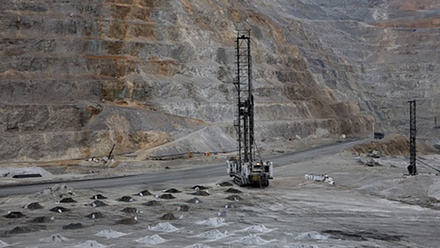
What those designs did not fully account for was the geography of neodymium, dysprosium and terbium. These elements exist in the Earth’s crust in reasonable quantities, but the infrastructure required to extract, separate and refine them into usable magnetic materials took decades to build and is concentrated almost entirely in a single country – China. Its share of refining and separation capacity is approximately 91%, while its share of sintered NdFeB magnet production exceeds 90%. For the heavy rare-earth elements (REEs), which are added to preserve magnetic properties at the temperatures generated inside a working motor, territorial concentration approaches 95%.
The concentration of rare-earth processing has been documented and discussed for well over a decade. What changed in 2025 was the transition from theoretical risk to operational reality. In April last year, China introduced export licensing requirements covering seven REEs essential to magnet production. Within weeks, Chinese exports of rare-earth magnets had halved.
European tier-one suppliers began curtailing output. Hildegard Müller, Head of the German automotive lobby VDA, stated publicly that production stoppages could 'no longer be ruled out'. Benjamin Krieger of the European Association of Automotive Suppliers confirmed that shutdowns in the supplier sector were already occurring.
Recognising the problem, some manufacturers have moved towards motor architectures that eliminate permanent magnets entirely. Induction motors and externally excited synchronous motors generate the rotor’s magnetic field electrically rather than through permanent magnets. Both approaches avoid rare-earths. Neither avoids copper.
Copper load of this
Copper carries its own set of constraints. Primary copper production is energy-intensive and geographically concentrated in ways that create procurement risk. Its price is volatile, moving with global economic cycles in ways that complicate long-term cost planning. And it creates a problem that rarely features in motor procurement discussions – end-of-life recyclability.
Copper and steel have similar melting points. A motor that combines copper windings with a steel lamination stack cannot be recycled as a combined unit in an electric arc furnace without contaminating the steel melt. The materials must be separated first, which adds cost and reduces the practical recovery rate.
In reality, most end-of-life motors containing copper today do not undergo that separation. The copper is either lost in the steel stream or the motor goes to landfill. A motor that cannot be cleanly returned to its constituent materials at end of life is not a sustainable component, regardless of what it does during operation.
Reluctant in principle
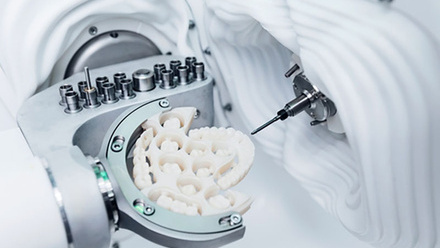
The motor technology AEM developed is based on reluctance principles. In a reluctance machine there are no permanent magnets and no rotor windings – the rotor is a precision-stamped steel lamination assembly with an internal geometry that creates pathways of varying magnetic permeability.
When the stator produces a rotating magnetic field, the rotor aligns with the path of lowest magnetic reluctance, and that tendency to align is what produces torque. There is no risk of demagnetisation at elevated temperatures, no need for dysprosium additions and no rare-earth content anywhere in the machine.
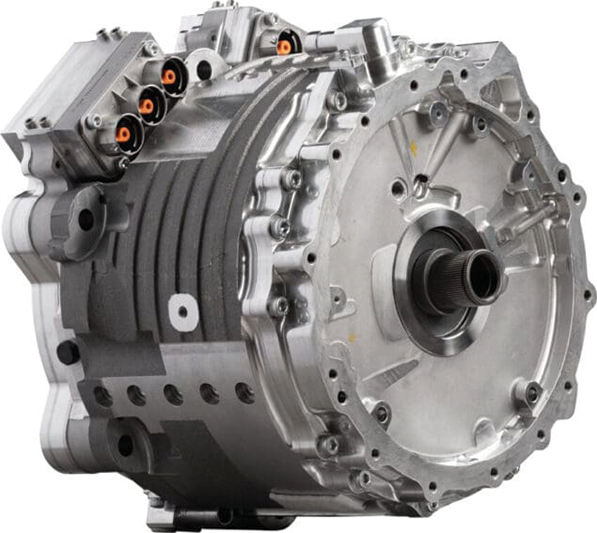
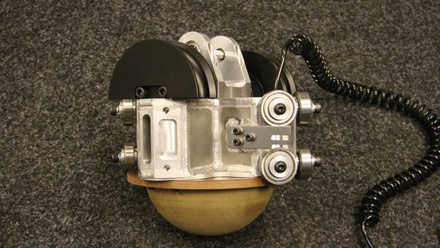
Super Speed Reluctance Drive is a rare-earth magnet-free motor being developed by Advanced Electric Machines with aluminium compressed coils, to offer a recyclable solution at the end of life
© Advanced Electric MachinesReplace the copper stator windings with compressed aluminium conductors and you have a motor built entirely from steel and aluminium, available from competitive and geographically diversified global markets.
Why did this architecture not dominate from the outset? Earlier switched reluctance designs produced significant torque ripple. This is the periodic variation in output torque that arises because reluctance torque is generated in discrete pulses as rotor poles align with stator poles. In a vehicle, torque ripple produces vibration and acoustic noise.
Early reluctance machines were also less efficient than permanent magnet alternatives across the operating range that automotive duty cycles require, particularly at light loads and part speed.
The resolution of those problems is what the past eight years of AEM’s engineering programme has been about. Advanced rotor geometries with carefully shaped flux barriers, real-time flux management through high-bandwidth control electronics, and precision manufacturing techniques have reduced torque ripple to levels that are imperceptible in normal operation.
The Super Speed Reluctance Drive (SSRD) demonstrators can operate at up to 30,000rpm, match equivalent permanent magnet machines on power density at representative automotive speed, and deliver competitive efficiency across the broad load range that the Worldwide Harmonised Light Vehicle Test Procedure demands.
The noise, vibration and harshness characteristics that once made reluctance machines unsuitable for passenger car applications have been engineered out.
Making traction
The end-of-life characteristics of a steel and aluminium motor are qualitatively different from those of its magnet-based or copper-wound equivalents. Both steel and aluminium are amenable to straightforward electric arc furnace processing. They separate cleanly. Their material properties are not degraded by the recycling process, so the recovered materials re-enter supply chains at full quality.
Secondary aluminium production uses approximately 95% less energy than primary production, according to the International Aluminium Institute. At the moment AEM does not use any recycled material to build its motors. This may change once supply chains catch up.
A lifecycle environmental analysis carried out by the Advanced Propulsion Centre quantifies the overall advantage.
The rare-earth-free motor technology achieves a 55% reduction in environmental impact compared to permanent magnet equivalents across the full product life, from raw material extraction through manufacturing, operation and end-of-life recovery. The rare-earth mining and processing phase is the single largest contributor to the permanent magnet motor’s environmental footprint, eliminating it entirely produces the most significant available improvement.
However, original equipment manufacturers and tier-one suppliers face a qualification timeline problem that is worth stating directly. Introducing a new motor architecture into a high-volume passenger car programme requires years of testing, validation and supplier qualification. The industry’s standard response to supply chain risk – waiting until the risk materialises and then reacting – does not work when the lead time for the solution exceeds the warning period for the crisis. April 2025 demonstrated that the warning period can be weeks.
The practical implication is that evaluation programmes need to start now, not after the next export restriction announcement. That does not mean committing to platform changes, it means acquiring the performance data and supply chain knowledge that would allow a decision to be made rapidly if circumstances required it. Organisations that have done that groundwork will have options. Those that have not will be managing a crisis.
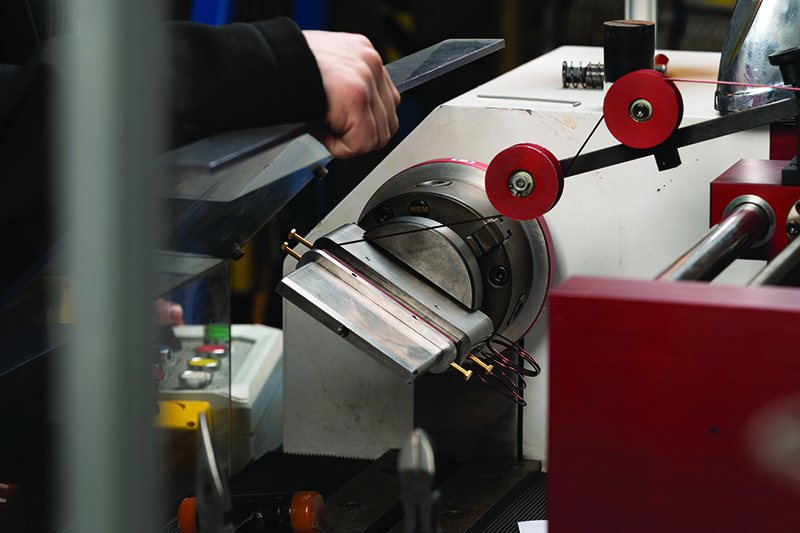
Advanced Electric Machines designs rare-earth-free motors
© Advanced Electric MachinesPulling the right lever?
For government, the relevant question is whether the UK’s Critical Minerals Strategy is focused on the right lever? The strategy was updated in November 2025 with a target that no single country should supply more than 60% of UK demand for any strategic material by 2035.
Diversifying the sources from which rare-earths are obtained is a legitimate objective. But where proven domestic technology already exists that eliminates the need for those materials in a key application, accelerating its adoption delivers resilience faster and at lower systemic cost than rerouting a supply chain.
The Automotive Transformation Fund and associated innovation support mechanisms should be calibrated to reflect that.
Finally, the question of what ‘sustainable electrification’ actually means deserves clearer treatment in the regulatory frameworks being developed.
Whole-life carbon accounting and Scope 3 emissions obligations are beginning to require manufacturers to account for the embedded impact of the materials used in their vehicles, not just what emerges from the exhaust pipe. A motor architecture with a supply chain that generates radioactive tailings, acidic effluent and significant CO₂ from coal-fired rare-earth processing carries a Scope 3 burden that will increasingly be measurable and, eventually, regulated. The architecture that eliminates those inputs does not.
The traction motor is not a solved problem. It is a problem that was set aside and has now been retrieved by a combination of geopolitical pressure and maturing alternative technology. The engineering work to make it genuinely solvable has been done. What remains is the window for mass adoption – which is already beginning to open.