High-entropy alloy design inspires material for energy infrastructure
Scientists from South Korea have developed corrosion-resistant, alumina-forming ferritic (AFF) alloys.
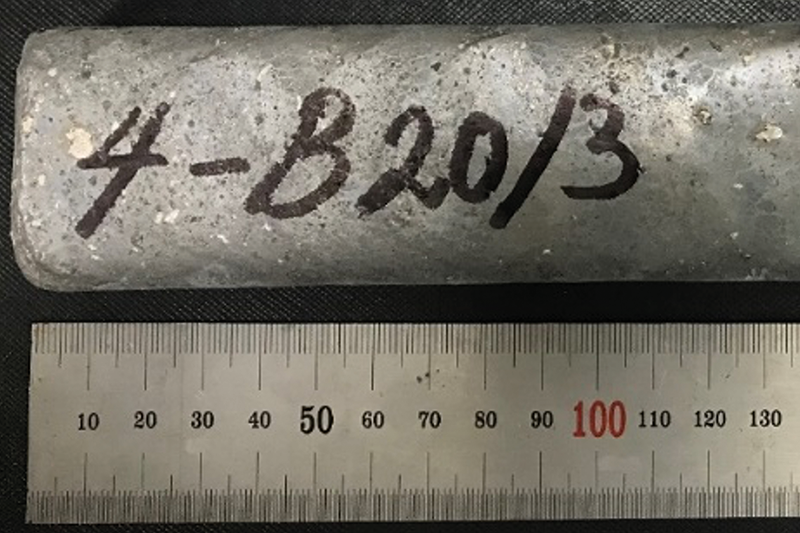
Photograph of a 1kg ingot produced by plasma arc melting
© JBNU–KIMSThey say the alloys could transform energy systems and nuclear reactors.
The material is developed using the concept of high-entropy alloys. It is an iron-chromium-aluminium-nickel-titanium-based alloy with a body-centred cubic (BCC) matrix.
Ka-Ram Lim of the Korea Institute of Materials Science explains that it is 'designed to deliver both excellent high-temperature corrosion resistance and high-temperature mechanical strength through the formation of a protective α-Al₂O₃ scale and coherent L2₁-type (Heusler) intermetallic precipitates'.
The aluminium content is approximately 16at.%, which Lim says is 'significantly higher than what is typically tolerated in austenitic (FCC) steels.
'The ferritic BCC structure can accommodate this aluminium level without phase instability, enabling reliable alumina-scale formation while maintaining mechanical integrity'.
The alloy is designed for extreme environments, such as high-temperature steam, 'where conventional chromia-forming alloys fail due to chromium volatilisation', shares Lim.
Key enabling qualities are reported as – the formation of a thermodynamically stable and slow-growing α-Al₂O₃ scale; resistance to scale volatilisation in steam; a BCC matrix that remains phase-stable at high temperatures; and the introduction of coherent L2₁ intermetallic precipitates that provide effective strengthening even at 700°C. The microstructure also balances oxidation resistance with high-temperature mechanical strength.
These features enable 'long-term operation in aggressive environments' relevant to next-generation energy systems, according to Lim.
The coherency between the aluminium-containing BCC matrix and the L2₁ precipitates is achieved through 'a high-entropy-alloy-inspired design concept'.
Under a steam-containing atmosphere (air-10% H₂O) at 700°C, the AFF alloys form a dense, continuous, α-Al₂O₃ scale, approximately 100nm thick.
This leads to oxidation-resistant features. 'This alumina layer effectively suppresses oxygen inward diffusion and prevents oxide spallation, resulting in almost negligible mass change (<0.06mg/cm² after 500h), significantly outperforming conventional austenitic stainless steels and many chromia-forming alloys,' Lim says.
The alloys maintain 'high yield and tensile strength up to 700°C due to precipitation strengthening by nanoscale, L2₁-type, Ni-Al-Ti intermetallics'.
Lim claims, 'The coherent interfaces between these precipitates and the BCC matrix provide excellent thermal stability and effectively suppress precipitate coarsening at elevated temperatures.
'Because the alloy is iron-based and incorporates a relatively high combined aluminium and titanium content of around 20at.%, the presence of these lightweight elements significantly reduces density, resulting in a high specific yield strength comparable to that of some nickel-based superalloys, but at substantially lower material cost.'
This work builds on prior studies of alumina-forming austenitic steels, FeCrAl alloys and aluminium-containing high-entropy alloys. Lim expands, 'It departs from conventional heat-resistant alloy design by using a high-entropy alloy-inspired concept to accommodate higher aluminium contents and achieve coherency between L2₁ precipitates and the BCC matrix.
'As a result, the alloy represents a convergence of earlier research directions enabled by more advanced compositional design.'
Relevant patents have been granted, and the team has confirmed that the alloy can be processed using conventional large-scale casting and rolling routes.
Their next steps focus on evaluating long-term creep resistance, formability and weldability, together with corrosion behaviour in molten salt environments.
Lim concludes, 'This work is intended to validate the alloy’s performance under service-relevant conditions and to support its transition toward practical engineering applications.'