Delving into the data
Correcting the imbalance in the charge to Materials 4.0.

Every few years, a technology narrative takes hold that is both genuinely accurate and quietly misleading. The artificial intelligence (AI) story in materials science is one of them.
Machine learning discovers the next battery cathode. A digital twin predicts structural failure before any crack is visible. An autonomous laboratory synthesises and tests hundreds of candidate electrolytes before a human researcher arrives in the morning. These stories are real. They describe things that are happening or are on the immediate horizon. And they are reshaping what materials science can do.
But each of those capabilities depends entirely on something far less glamorous – data. Specifically, characterisation data that is accurate, structured, described in machine-readable formats, generated to validated protocols and produced with quantified uncertainties. Data that a researcher who was not in the room when it was collected can trust, interrogate and combine with data from a different instrument in a different city.
Without that foundation, the AI model is training on noise. The digital twin is drifting from physical reality. The autonomous laboratory is generating output that no one else can verify or build on.
This is the central challenge of what the materials community is now calling Materials 4.0, and it is one that the UK is currently failing to address at the scale the ambition requires.
A different kind of materials innovation system
Materials 4.0 borrows its name from Industry 4.0, the fourth industrial revolution characterised by digitalisation, connectivity and intelligent automation. Applied to materials, it refers to the integration of digital technologies across the entire materials innovation lifecycle – from discovery and design through synthesis, processing, manufacturing, in-service monitoring and end-of-life.
But the important point is that Materials 4.0 is not simply about deploying new digital tools on top of existing workflows. It is about building a fundamentally different kind of materials innovation system, one in which the physical and digital are so tightly coupled that insight flows continuously between them.
The Henry Royce Institute’s National Framework for Materials 4.0 was published in late 2025 following extensive stakeholder engagement across academia, industry and national laboratories.
It describes this architecture as two interlocking dimensions. The vertical dimension represents the materials lifecycle, which are the stages that materials scientists and engineers have always navigated. The horizontal dimension represents the digital infrastructure layer that cuts across every stage – data standards, ontologies, AI and machine learning tools, measurement protocols, uncertainty frameworks, and shared data infrastructure (see image opposite). Both dimensions matter. But the horizontal layer is currently the weakest link in the UK’s chain.
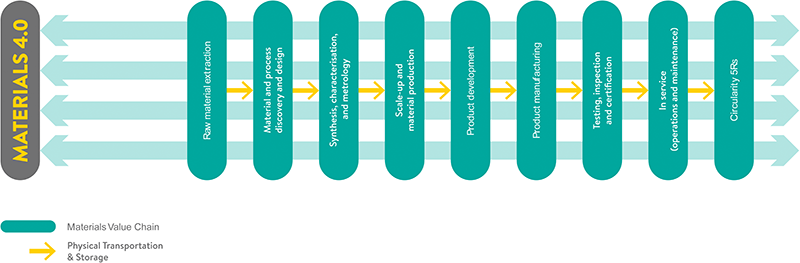
The Materials 4.0 Framework architecture. The digital infrastructure layer (horizontal) must connect to every stage of the materials value chain (vertical). Source: Henry Royce Institute, National Framework for Materials 4.0 (December 2025)
© Henry Royce InstituteA striking imbalance
The framework’s analysis of the UK’s existing Materials 4.0 activity landscape is where the numbers become uncomfortable. Across nearly 6,000 identified projects in academia, industry and national labs, more than 44% focus on algorithms and computational models, and more than 51% focus on digital tools and techniques like software platforms, machine learning pipelines and analysis environments. Barely 5% address data ontologies, data attributes and the shared digital infrastructure that makes everything else work.
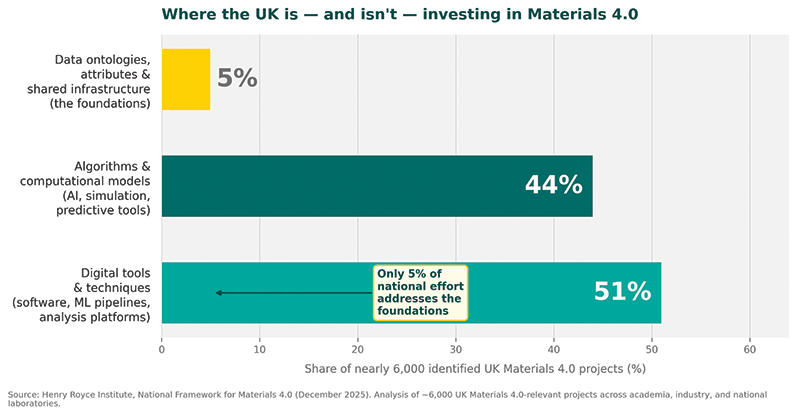
Share of nearly 6,000 UK Materials 4.0 projects by activity type. Source: Henry Royce Institute, National Framework for Materials 4.0 (December 2025)
© Henry Royce InstituteWhat this means in practice is that the UK is investing heavily at the top of the digital stack in the tools and models that produce insights, while systematically underinvesting in the foundations those tools depend on. The analogy is not flattering. It is roughly equivalent to building a network of motorways without agreeing which side of the road to drive on, what the speed limits mean, or how the junctions are signed. Each individual motorway might be excellently engineered, but as a system, it does not function.
The international context sharpens this. Other leading nations are not just building better tools, they are building standards, and those standards will shape international frameworks.
- The US – The Materials Genome Initiative is now well over a decade old. The National Institute of Standards and Technology is leading the development of shared materials data schemas and interoperability standards through the Materials Data Facility.
- Germany – NFDI-MatWerk, part of the National Research Data Infrastructure, is building standardised, FAIR-compliant (findable, accessible, interoperable, reusable) materials data repositories aligned with European ontology frameworks.
- Japan – the Materials DX Platform integrates high-throughput experimentation, digital twin development and AI-guided discovery at national scale.
The UK, with world-class science but underdeveloped data infrastructure, risks leading on discovery while following on interoperability.
The challenge is real
Nuclear power stations are designed to operate for 60-80 years. The materials in pressure vessels, pipework and structural components must maintain their integrity across that period and be demonstrably understood to maintain them, in a regulatory context where the consequences of a wrong answer are severe.
The Office for Nuclear Regulation’s performance-based approach to safety case demonstration creates specific requirements – every data point used to support a safety case must be metrologically traceable, uncertainty-quantified and independently verifiable. There is no tolerance for data of uncertain provenance or unknown quality.
It is fair to ask whether AI changes this calculus. Drawing on fleet-wide operational data across many reactors, machine learning can surface patterns and bound uncertainties in ways no single-site measurement programme could match. That is a genuine and growing capability. But it addresses statistical uncertainty, not systematic uncertainty.
If the data flowing into an AI model carries a consistent calibration bias, more of it produces a more precise wrong answer. Metrological traceability is the mechanism that catches and corrects systematic error, and volume alone cannot substitute for it.
The regulatory requirement is also categorical – a safety case must rest on traceable and independently verifiable evidence. An AI-derived confidence estimate does not satisfy that on its own. What AI genuinely offers is a more powerful way to exploit good data. The argument is not that AI is irrelevant to nuclear materials qualification. It is that AI makes high-quality and traceable measurement data more valuable, not less necessary.
This is where Materials 4.0 becomes genuinely transformative, rather than incrementally useful. The ability to build digital twins validated by decades of operational monitoring data, and to use machine learning to identify patterns that precede failure, is beginning to reshape how the industry qualifies materials and manages ageing assets.
Physics-based degradation models can be supplemented by AI analysis of operational data across entire fleets of reactors, finding correlations in microstructural evolution and mechanical property changes that no human analyst working through inspection reports could detect at that scale.
But the prerequisite for all of this is data that meets the nuclear standard – traceable, uncertainty-quantified and independently verifiable. In nuclear, the data quality requirements that Materials 4.0 demands are simply non-negotiable. This makes materials for nuclear not just a high-stakes exemplar, but the clearest demonstration of why measurement science is not a peripheral issue in this story. It is the foundational issue.
FAIR dealings
The National Physical Laboratory’s (NPL) review of the Materials 4.0 Framework, prepared from the perspective of the UK’s national metrology institute, makes a point that deserves to be stated more plainly than the policy documents usually manage – data standards and measurement standards must be developed together. You cannot have one without the other.
A data standard that specifies how to record a hardness measurement is only useful if the hardness measurement was made to a validated protocol, on a calibrated instrument, with a quantified uncertainty. Otherwise, you have a perfectly formatted record of an unreliable number.
Metrological traceability is the unbroken chain of calibrations that links a laboratory measurement to the SI unit system. It is not a bureaucratic formality but the foundation of comparability – the reason a tensile test result from one laboratory can meaningfully be combined with one from another, because both are traceable to the same fundamental standard.
In the Materials 4.0 context, this has a new urgency. When AI models are trained on materials characterisation data aggregated from dozens or hundreds of sources, the quality of those models depends directly on the comparability of the underlying data. A training dataset that mixes well-calibrated and traceable measurements with poorly calibrated and unverified ones cannot be distinguished by the model, and its predictions will reflect that mixture of quality.
This is not a hypothetical concern. In battery characterisation, for example, electrochemical measurement protocols vary significantly between laboratories, and data reported in the literature is frequently not comparable. The AI models trained on that literature inherit its inconsistencies.
The solution to this problem is not more sophisticated AI. It is better measurement science applied more consistently, documented more rigorously and shared more openly. The FAIR data principles provide the practical framework.
Making characterisation data truly FAIR is not primarily a software challenge. It requires a cultural shift in how data is generated from the first measurement. Capturing not just the result, but the conditions, the instrument settings, the calibration status, the sample provenance, the operator and the associated uncertainty. Data that is FAIR by design, not by retrofit.
Connecting the digital with the physical
The digital twin concept has attracted considerable attention and hype. Unlike a static simulation, it evolves as its physical counterpart evolves, and can be used to predict future behaviour, test hypothetical scenarios and optimise performance before interventions are made on the physical system.
The potential is genuine. A digital twin of a composite wind turbine blade can, in principle, predict damage before it is detectable by conventional inspection.
For the UK’s offshore wind sector – the largest in the world by installed capacity with ambitions to reach 50GW by 2030 – the economic and safety implications of reliable predictive maintenance are significant. Meanwhile, a digital twin of a nuclear pressure vessel can track radiation embrittlement over decades, updating the safety case as operational data accumulates.
But building a trustworthy digital twin requires three things – a physics-based model that is structurally sound, experimental data that validates the model’s predictions across the range of conditions it will face, and a continuous data stream from the real-world system that keeps the model current. All three requirements have a measurement science dimension that is rarely acknowledged in the technology narrative. The validation data must be traceable. The sensors that feed real-world data into the model must be calibrated. The uncertainty in the model’s predictions must be quantified and communicated, because a digital twin that cannot articulate its own confidence limits is not a safety tool. It is a liability.
The people who make it work
The Materials 4.0 skills narrative is frequently framed as a shortage of data scientists. This misses the point. The UK’s acute gap is in professionals who combine deep materials domain knowledge with computational and data literacy – people who design characterisation experiments to generate machine-readable data from the outset, apply measurement uncertainty frameworks to AI-generated predictions, and know from physical intuition when a model is extrapolating beyond its training data.
Research technical professionals, characterisation specialists, instrument scientists and measurement experts who operate the UK’s materials research facilities are not peripheral to the Materials 4.0 transition, but are central to it. The transformation towards FAIR data, validated protocols and metrologically traceable datasets happens at the point of measurement, not in algorithms. There are five roles that are uniquely positioned to drive it.
- Generators of trustworthy data: This means more than accuracy. It is about generating structured and described data so that people and systems who were not present when it was collected can trust and build on it, using shared metadata schemas rather than local conventions, as well as recording conditions, calibration status, provenance and uncertainty alongside the result. The cultural shift is from ‘I know what this means’ to ‘this must be meaningful to a model trained a decade from now’.
- Measurement experts: The AI models trained on characterisation data from many sources inherit the quality of those measurements. The professionals who maintain calibration chains, validate protocols and apply GUM (Guide to the Expression of Uncertainty in Measurement) uncertainty frameworks are the quality controllers of the entire Materials 4.0 data stack. This role deserves explicit recognition in how skills development programmes are designed.
- Integrators: Bridging characterisation and computation requires fluency in both – understanding what an AI model needs from experimental data, designing experiments to provide it and critically interpreting model outputs against physical measurement experience. Technical professionals who operate instruments and manage sensor networks are, in the most literal sense, the people who keep the digital twin connected to physical reality.
- Champions of data standards: Building shared ontologies and consistent measurement protocols is primarily a coordination problem. Technical professionals work across instruments, techniques and institutions, with established relationships with the International Organization for Standardization, American Society for Testing and Materials, British Standards Institution and the Versailles Project on Advanced Materials and Standards. They are natural interlocutors between the laboratory bench and the standards table.
- Innovators: Developing FAIR-compliant data capture workflows, building metadata schemas AI systems can interpret and creating validation datasets that benchmark models against physical reality is skilled, expert work. It requires institutional recognition that foundational infrastructure, even when it does not immediately produce a publication, is what makes everything else reliable. In the pre-digital era, this expertise was essential but invisible. In the Materials 4.0 era, it is strategic.
Getting the foundations right
The urgency is real. The EU Battery Passport Regulation comes into force in 2027, requiring every battery placed on the EU market to carry a digital record of its composition, performance and lifecycle data linked to traceable measurement standards. UK battery manufacturers and their supply chains need to be building that capability now.
Beyond batteries, there is a broader shift towards model-based qualification in aerospace, automotive and nuclear. This is where AI-generated property predictions and digital twin outputs will be used in regulatory submissions and creates an analogous requirement across multiple sectors, requiring trusted data, traceable measurements and independently verifiable results.
Initiatives such as the Royce Digital Materials Foundry, which combines open-access experimental databases, machine learning models and materials-domain language models, illustrate what is possible when that investment is made.
The Foundry’s value as a discovery and prediction platform depends entirely on the quality of the measurement-validated data flowing into it. That is the pattern that scales – every time an institution or programme embeds rigorous data quality practice at the point of measurement, it contributes to a shared infrastructure that the whole community benefits from. The Foundry is only as trustworthy as its inputs, and these are determined by the people generating characterisation data.
The UK has the scientific talent, industrial expertise and the institutional infrastructure of Royce, NPL, the Innovate UK Catapult Network, Research Technology Organisations, the Faraday Institution and universities to lead the Materials 4.0 transition. The framework is in place, the exemplar programmes are being designed and the governance structures are being built. What is needed now is a corresponding investment in the unglamorous foundations. Areas such as data ontologies, measurement protocols, reference datasets, uncertainty frameworks and the professional development of the people whose expertise makes all of it reliable.
Ultimately, Materials 4.0 is not the project of algorithms. It is the project of people who understand materials. People who know what good measurement looks like, what reliable data feels like, and what the difference between a good result and a misleading one actually means in practice. The AI comes later. The measurement comes first.