Ascending the critical path
Recovering rare-earth elements from volcanic rock.
It’s one of the most important natural resources questions of our time. How do you cost-effectively secure new supplies of critical minerals that aren’t prone to disruption by unfriendly actors, while treating the environment and local communities with respect?
Ascension is a young company, founded only two years ago, that is focused on recovering critical minerals from volcanic rocks, a widespread but previously unrecognised source.
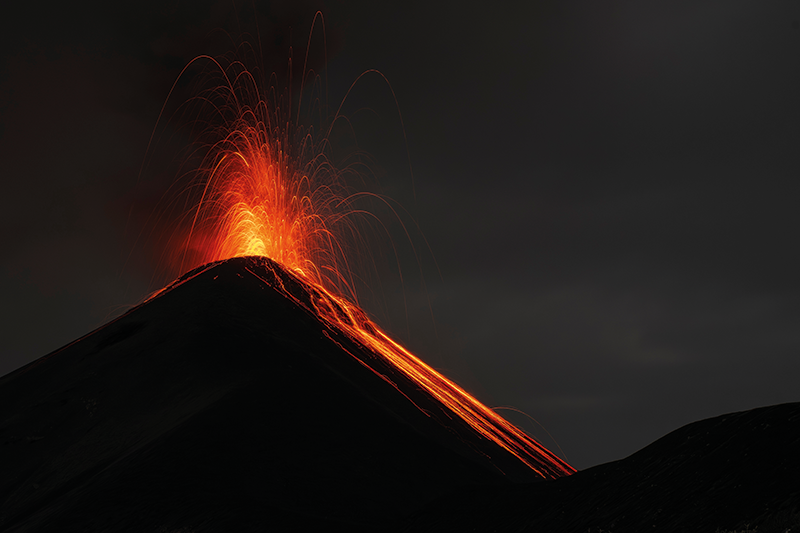
When volcanoes erupt explosively, they eject massive amounts of molten rock into the air, which cool quickly and are deposited over a wide area. This volcanic rock – known as tuff to geologists – can be rich in critical minerals, particularly rare earths.
The rare-earth elements tend to be distributed through the volcanic rock fairly evenly, but in relatively moderate concentrations, or grades. They are not concentrated in well-defined seams, like traditional ore bodies, which raises the question of how to extract them from the rock.
Miners will know that in situ recovery means sending liquid down a borehole into an underground mineral deposit. When the mineral is dissolved into the liquid – which we call an engineered geofluid – it is pumped back to the surface, and the minerals are extracted from the liquid. This is an alternative to traditional dig-crush-dissolve mining and is widely used today for uranium mining and, to an increasing extent, for copper.
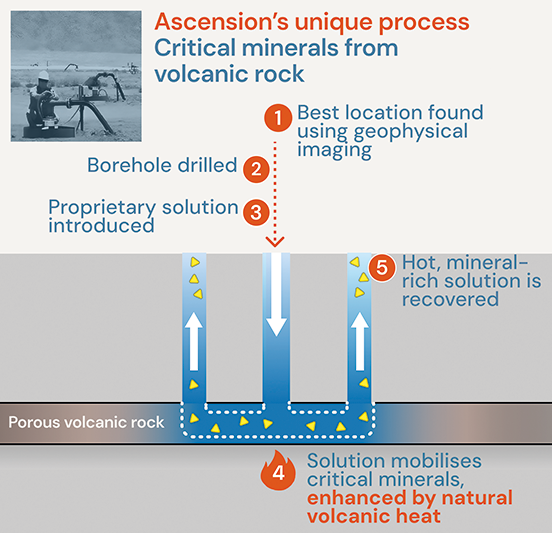
Ascension’s process also involves in situ recovery, with wellheads across a small area. One wellhead’s role is to push in the liquid by introducing proprietary solution, with the others ready to suck out the engineered geofluid containing the critical minerals.
The volcanic rock we are targeting is porous and permeable, and fluid control underground is a mature art. If you get it right – the right residence time, the right reaction time – you should be able to extract the rare earths in situ.
The process does not require tuff to be brought to the surface, so traditional mining techniques are not required (see image below).
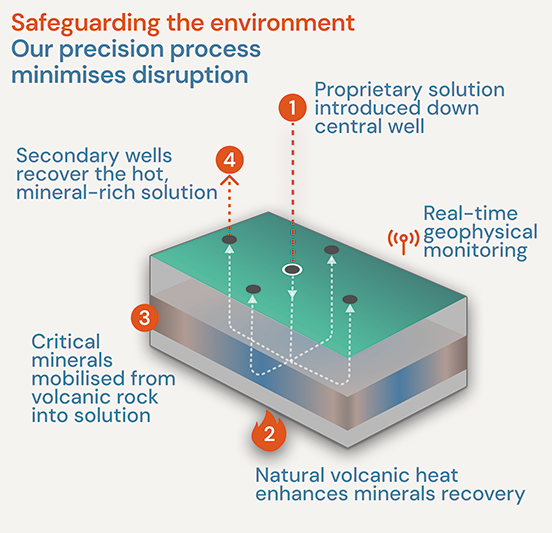
Unwanted material is left underground and the environmental impact on the surface is minimal. Indeed, some surface activities, such as farming, can continue during operations.
The invention is light on capital and operational expenditure, rapid to deploy and modular. A site can be used for two or three years and then returned to its previous state.
In doing so, volcanic rock found in large quantities all over the world becomes an easily-accessible resource, from which critical minerals can be recovered cost-effectively. The rock we are targeting is often especially rich in heavy rare earths, which are the scarcest and most valuable.
Hot stuff
While the focus on volcanoes often captures people’s imaginations, the research stems from decades of experience in the team in Geology, Geophysics and Chemistry.
The liquid, known as a lixiviant, has been developed in-house and tested in laboratories in Oxford.
A combination of in-house geological, volcanological, geochemical and geophysical expertise helps identify volcanic settings with the right physical and chemical properties. Machine learning is also used.
Volcanic rock is, of course, often co-located with areas of geothermal activity, especially where the volcanoes are relatively young. That is, there is plenty of heat below the surface, emanating ultimately from the Earth’s core. This heat is critical to the process, because its presence helps the rare earths dissolve into the lixiviant.
But while the lixiviant mobilises the rare earths deep below the surface, how do we ensure the wells extracting the resulting liquid – the engineered geofluid – are in the right place? And how do we make sure the liquids don’t flow away underground, either to never reappear or emerge somewhere unhelpful?
This is where geophysics comes in again to accurately predict and monitor where the fluids will flow, pool and be extracted by the wells – ensuring they do not end up where not required.
Geophysics combines Physics, Maths and Geology to study Earth’s processes, structures and forces. In recent years, the discipline has been radically transformed by important technological advances.
For instance, seismic nodes have become much smaller and more portable compared to old-fashioned instruments, while processing and modelling techniques have become much more advanced. These kinds of factors reduce turnaround times and lower costs. We have proprietary geophysical methods that relate to our process, for instance we use seismic and electrical resistivity surveys to characterise the subsurface.
The approach is modular and there is very limited surface expression – no hole in the ground.
Site selection is as much above ground as below. Not only do the rocks need to be the right type, with the right composition, but also, is it feasibly accessible and economical to work, and is the above-ground risk acceptable?
Going active
While Ascension is a young company, the thinking behind it has been many years in the making. Two of the co-founders, Professors Jon Blundy and Mike Kendall, first started collaborating a couple decades ago, having noticed that the volcanic areas they were both interested in often contained rocks rich in rare-earth elements.
Now, many years and academic papers later, Blundy is the Royal Society Research Professor at the Department of Earth Sciences at the University of Oxford, leading a programme called From Volcanoes to Green Mining. Kendall is Chair of Geophysics and Director of Oxford EARTH, the university’s new strategic research programme.
Ascension came together as a company in 2024, with support from Oxford University Innovation, the university’s technology transfer office.
Prior to joining Blundy and Kendall as the third co-founder, my experience was in entrepreneurial and management roles at Oxford Science Enterprises, Arrival, Bloom Energy and Mitsubishi Corporation. Ascension is now backed by investors, including Oxford Science Enterprises, East X Ventures, Global Brain, the UK Innovation & Science Seed Fund and the Grantham Foundation for the Protection of the Environment.
The team of 22 now includes James Fraser, who joined earlier this year as Chief Commercial Officer, bringing many years of experience from Rio Tinto and Euro Manganese. Other team members have experience from companies such McKinsey, bp and the UK Government, as well as academia.
Commercially, momentum is building. Ascension has so far raised £6.2mln of capital, including £1.2mln from two Innovate UK grants, with one of those grants receiving matched funding through the Investor Partnership.
The Ascension team, while still based in Oxford with close links to the Department of Earth Sciences, is already out in the field in global locations, conducting studies and building relationships in parts of the world with the right conditions for our process. The first well is planned for next year.
In Kenya, the company has a collaborative research agreement with the state-owned Geothermal Development Company (GDC).
The country straddles the active tectonic fault of the East African Rift System, making it rich in volcanoes, volcanic rock and geothermal energy. It could be a suitable location to set up operations, so continuing to refine knowledge of the geology and geophysics is a priority.
Moving to an operational phase is not just about understanding rocks and geophysics, it’s also about relationships, like the one with GDC. It’s also important to work with a broad range of local people and companies, and understand how the work can benefit local communities. For instance, geophysics surveys can help point to new sources of water.
As Ascension looks to roll out pilot projects, we are keen for local people to see that our precise and efficient process causes minimal disruption to the environment. With no need to dig a big hole and an expected operational life of only two or three years, surface changes are small and temporary, with things rapidly returning to how they were before.
Did you know?

The company name Ascension comes from Ascension Island, the British Overseas Territory in the South Atlantic Ocean. Ascension Island is a dormant volcano and studies carried out there have played a crucial role in the company’s journey.
Alongside our technical work, we are also busy talking to stakeholders about what the company offers. Mining is a complex market with many stakeholders, and so, for a young company, driving growth means making sure that the many relevant people and organisations understand what it can do.
For instance, we are keen for Western-aligned governments to consider this as a scaleable solution to the shortage of critical minerals – including rare earths – required to support key industries. China enjoys a near-monopoly on rare earths needed for defence, so diversifying supply chains is strategically vital.
The team is pleased to have recently been elected as a member of the Rare Earth Industry Association, and has joined the UK’s Critical Minerals Association. Both organisations are supporting engagement with key stakeholders and regular attendance at industry and investor conferences around the world.
The outreach is important as Ascension looks to become an important part of global supply chains. Potential customers include companies that would separate the liquid derived from the ground, before feeding into supply chains for the various manufacturing companies that require critical minerals.
The economics are notoriously complicated and hard to predict, but the company believes that original equipment manufacturers will be pleased to know that, for instance, the rare earths they require can be sourced in a safe, cost-effective and sustainable manner which won’t be compromised by international political manoeuvring.
Other market forces may play a role in supporting future growth. For instance, for many metals, the grade of deposits being brought to the surface by traditional mining is decreasing. As this increases costs, the team believes it may drive attention towards new processes like this one.
With global tensions rising and the need for critical minerals, including rare earths, ramping up, this seems like the right time to review opportunities to secure new supplies. It’s also true that in a world ever-more concerned about climate, environment and community issues, mining processes that can operate with smaller ecological footprints while benefiting local economies are going to be welcome. Ascension believes its approach can help with that too.