Thorium-229 enables ultra-precise nuclear clock
Researchers at the University of Manchester have developed a simple method for probing the natural ‘ticking’ of the thorium nucleus.
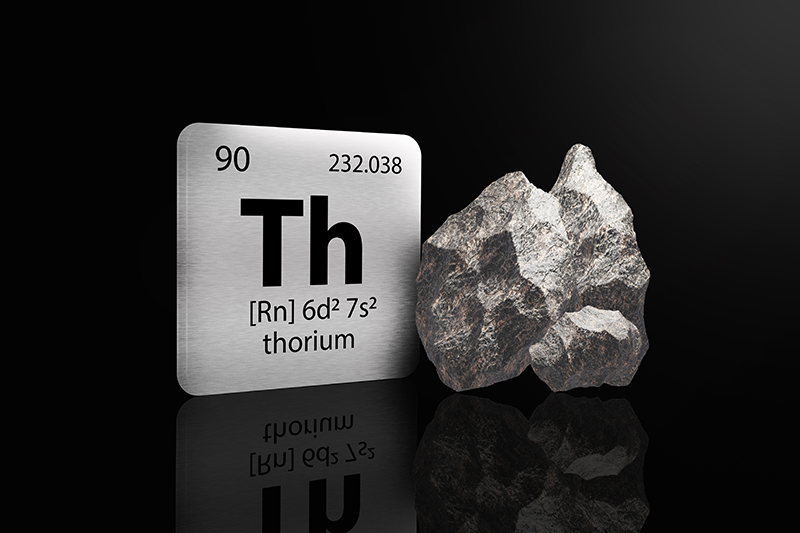
The team was able to excite a thorium-229 nucleus inside a microscopic thin film of thorium oxide using a laser, in a method known as conversion electron Mössbauer spectroscopy.
After a few microseconds, the energy absorbed from the laser is transferred to nearby electrons, so it can be measured directly as an electric current.
The simplicity of this method brings precise nuclear clocks closer to reality.
Nuclear clocks rely on atoms’ natural ‘ticking’, like atomic clocks, but use oscillations within the nucleus itself rather than electrons. This makes them less sensitive to external disturbances, with the potential to be significantly more accurate.
The thorium oxide film was made by electroplating a minute amount of thorium onto a stainless-steel disc, similar to gold-plating jewellery.
This is simpler and cheaper than the previous method devised by the team in 2024, which required the thorium-229 to be inside a specialised transparent crystal.
Mössbauer spectroscopy also typically requires high-energy gamma rays at special facilities, but the team was able to perform it with a laser in an ordinary lab.
The technique shows that thorium-229 can be studied inside more common materials than previously thought, as well as offering insight into its behaviour and decay.
Nuclear clocks can perform precise timekeeping that could transform navigation, communications, earthquake and volcano prediction, and deep-space exploration.
Since nuclear clocks should be sensitive to small changes in the Earth’s gravity caused by the movement of magma and rock deep underground, placing them across earthquake zones like Japan, Indonesia, or Pakistan could allow us to observe the Earth’s movements in real time and predict tectonic events before they happen.