Solar thermal energy turns up the heat
A UK company claims to have produced 800°C solar-heated air and used the stored heat to dry mineral rock in a field trial.
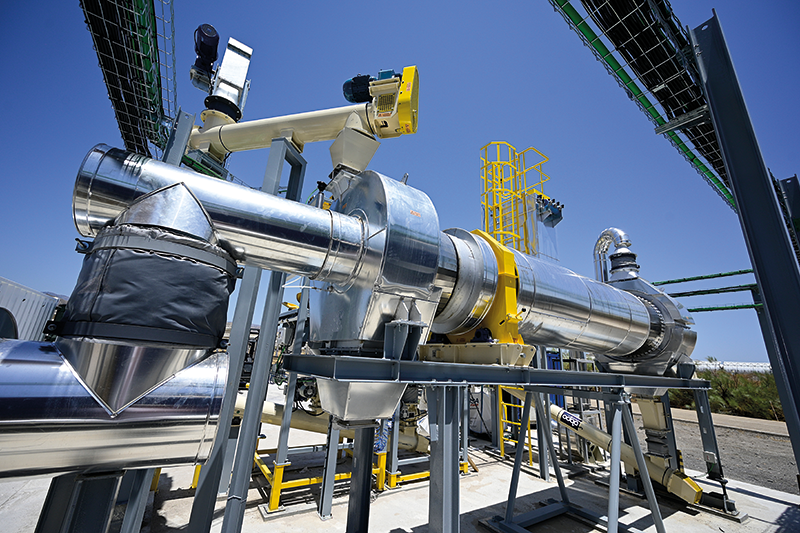
The rotary dryer at the Plataforma Solar de Almería in Spain. In trials, the stored solar heat reduced the minerals’ moisture content from around 10% to below 1%
© OdqaThis could potentially reduce industry reliance on fossil fuels for this and other high-temperature processes.
Oxford University, UK, spin-out Odqa tested its system at the Plataforma Solar de Almería (PSA) in Spain. In trials, the solar heat reduced the moisture content of minerals in a rotary dryer from around 10% to below 1%.
High-temperature industrial heat remains one of the hardest parts of manufacturing to decarbonise. Processes such as drying, calcination, kiln firing and metal melting often require temperatures of 400-1,000°C and are still largely dependent on fossil fuels.
Odqa’s founding idea was to apply heat-transfer principles from gas turbine engines to solar thermal energy. Dr Helen Webber, Head of Engineering at Odqa, explains how the firm, with expertise from the Oxford Thermofluids Institute, adapted the design into a rotating air-based receiver that heats ambient air using concentrated sunlight.
In the receiver, ambient air is drawn through tubular passages heated by concentrated solar radiation – a direct adaptation of turbine-blade cooling geometry designed to maximise convective heat transfer into the air stream. Earlier testing at Odqa’s Oxford facility and DLR Synlight in Germany saw the receiver reach outlet air at 820°C and 120kW output under calibrated simulator conditions.
At PSA, the company tested a demonstrator comprising a heliostat field, a solar tower, the air-based receiver, ceramic rock thermal storage and an industrial rotary dryer. PSA’s CESA-1 heliostat field reflected concentrated sunlight onto the receiver, which was installed at 54m above ground on an 80m tower, achieving 800°C outlet air and 120kW maximum recorded output under real sunlight.
Webber says the result is significant because it shows the receiver can operate under real field conditions, including fluctuating irradiance, cloud transients, wind loading and shifting sun angles. It also reaches the temperature range needed for processes such as calcination, metal pre-heating and drying.
The system is intended as a hybrid retrofit, delivering clean, hot air through a single pipe interface while retaining existing gas infrastructure as backup.
Webber explains that unlike molten salt or thermal oils, 'air has no upper temperature limit imposed by fluid degradation…the temperature ceiling is set by the receiver tube materials, not the working fluid'.
At PSA, the heated air travelled down an insulated pipe to ground-level equipment, where it was directed either to the rotary dryer or to a 1.8MWh, packed-bed, thermal store filled with high-density rock materials.
Drying was also demonstrated using direct solar heat and electric heaters, showing the system could switch between heat sources without interrupting production.
'This validated 24-hour, fossil-free operation,' Webber explains. 'We could deliver process-grade heat from solar, from storage, or from electric backup – seamlessly switching between them without interrupting production.'
Back in Oxford, Odqa used its solar simulator to melt 500g of scrap aluminium from room temperature with 700°C superheated air. The bench-scale proof-of-concept is said to prove technical viability for the metals sector, with laboratory temperatures exceeding 1,000°C.
Odqa’s CEO, Chris Kimmett, says this validates the company’s thermal modelling tools against real-world results and underlines the potential for retrofitting into existing industrial equipment, as many fossil-fuel-fired processes already use combustion gases as the heat delivery medium.
While the PSA receiver demonstrates 120kW output, 'our next step is commercial pilots in the 1-10MW range, which is representative of a single commercial installation for a rotary dryer or kiln', adds Kimmett. 'Operating with air means no corrosion, no freezing, no exotic fluids and no pressure systems,' he adds. 'It’s just simple, robust engineering – and that simplicity is key to scaling.'
Deployment will depend on geography. Odqa’s system requires high direct normal irradiance, ideally above 1,800kWh/m2/yr. The technology has the strongest case in southern Europe, the Middle East, North Africa, Australia, Chile and southwestern USA.