Fungi-based material gears up for firefighting
A prototype jacket crafted from mycelium leather is being tested for personal protective equipment for firefighters.
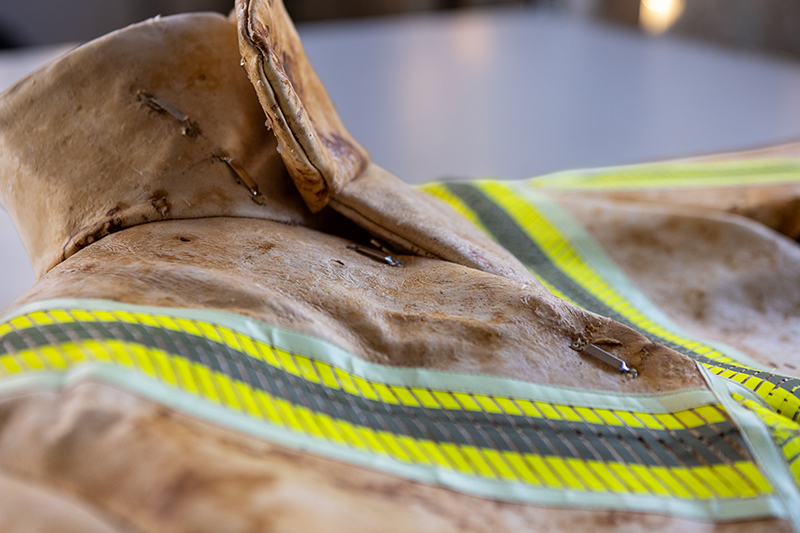
The material grown from agricultural waste has reportedly already achieved international safety certification.
The mycelium clothing, which is on display at the National Gallery of Victoria in Australia, is a collaboration between departments at the country’s RMIT University. They seek to highlight the fungi-based material’s durability, fire resistance, thermal insulation and ability to self-extinguish as important attributes for firefighting personal protective equipment (PPE).
Shocked by the increasing severity of Australian bushfires and recognising a market for better firefighting PPE, the fungal leather (fleather) is fabricated using liquid-state fermentation and draws on frontline firefighter’s insights.
Dr Tien Huynh in RMIT’s School of Science explains that her research group has tested more than 50 different fungal species over the past decade to assess each one’s feasibility for a wide range of applications, narrowing the focus to three that consistently demonstrate rapid growth and maintain excellent material properties. Previous published research includes a fire-retardant cladding that uses solid-state fermentation to convert dry agricultural biomass into a lightweight construction material.
Huynh shares that by selecting the right fungal species they have then refined and optimised it – in this case mycelium containing chitin, the same tough material found in crab and lobster shells. This was critical as each fungal species has its own unique characteristics.
‘Fungi do some of the hardest recycling work on the planet with minimal input from us, and we wanted to harness that ability to create sustainable solutions from abundant agricultural waste,’ Huynh says, adding that as they grow, ‘the fungi feeds on natural waste and forms a dense, web-like network (mycelium) that naturally binds materials together’.
Dr Judith Glover from RMIT’s School of Design describes mycelium as an extraordinary, biodegradable material as it has the potential to replace ‘materials with bigger ecological rucksacks and forever chemicals’.
The choice of feedstock and the chemical additives that enhance the fungi’s fire retardant properties, as well as the development of effective post-growth processing techniques, are additional considerations, Huynh adds.
To evaluate its mechanical, thermal and fire-performance properties, she collaborated with RMIT’s School of Engineering. For durability and structural performance, they undertook compressive and tensile strength tests to measure how well the material can withstand squeezing, pulling and long-term use, and therefore, suitability in real-world conditions.
Fire performance and thermal insulation are assessed using cone calorimetry, Fourier Transform Infrared analysis and controlled flame testing to ensure they comply with both Australian and international standards.
‘These methods allow us to measure key characteristics such as ignition behaviour, flame spread, heat release, smoke production and charring rates,’ she explains. ‘Together, these tests provide a detailed picture of how the material responds to fire and enables us to benchmark its performance against existing conventional materials used in protective clothing and construction.’
Huynh adds that the prototype jacket has already achieved OEKO-TEX STANDARD 100 Product Class II certification. This global textile safety certification confirms the material has been independently tested and verified for not having harmful levels of more than 1,000 substances, making it safe for prolonged contact with human skin.
Before its field deployment, Huynh says several hurdles must be overcome, namely large-scale manufacturing, long-term durability testing, certification and ultimately regulatory approval.
‘We [also] want to work closely with manufacturers, designers and firefighters through a co-design process to ensure the final product meets operational needs,’ she concludes. ‘The goal is not just to create a novel material, but to develop PPE that is practical, comfortable and easy to adopt.’
More like this...