Photonic computer solves complex problems faster
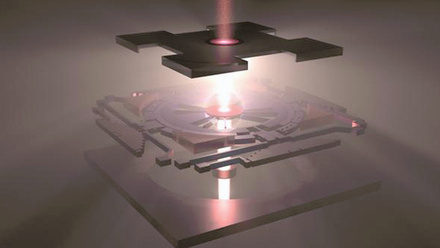
Researchers in Canada have built a light-powered, room-temperature Ising machine.

A joint team between McGill and Queen’s Universities in Canada created the Ising computer to solve difficult, non-deterministic polynomial (NP) problems more quickly and at a larger scale than existing machines.
They claim this could accelerate drug discovery, improve vaccine development, and reduce costs and emissions in logistics and transportation.
As more variables or scenarios are added to NP problems, the number of possible solutions – and time required to solve them – increases exponentially.
The researchers say this is a bottleneck for progress in several fields.
Ising machines model complex problems using light and at room temperature, unlike other non-traditional computing approaches that struggle with scaling up and stability, and require cryogenic cooling.
Previous digital Ising solvers have reportedly relied on computing clusters to emulate the Ising model for performing calculations, demanding substantial resources and energy
The team’s computer comprises more than 20 ultra-sensitive optical components, and they reportedly developed new control algorithms and signal-processing methods to accelerate computation and keep the system stable.
It is claimed to be the largest-scale and most stable photonic Ising machine in operation, with the highest computational speed of any photonic system – up to 212 giga-operations per second for a single computation core.
The researchers demonstrated its use for protein folding, important for understanding diseases and designing drugs, as well as showing it exceeds the performance of quantum annealers, one of the main competing technologies for solving complex optimisation problems.
Quantum annealers are expensive, hard to scale and need cryogenic cooling.
The team says their high-speed Ising computer is cheaper, consumes less power and scales to problem sizes that were previously out of reach.