Gold platform reveals binding forces behind 'nature's glue'
Researchers in Sweden have devised a method to study the hidden forces that bind the universe’s smallest particles.

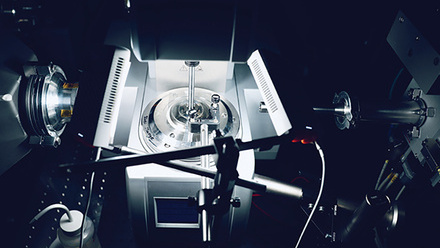
A researcher demonstrates the platform that uses gold, salt water and light to display fundamental binding forces, developed at Chalmers’ Nanofabrication Laboratory, Myfab Chalmers, and the Chalmers Materials Analysis Laboratory (CMAL)
© Mia Halleröd Palmgren/Chalmers University of TechnologyA drop of salt solution filled with millions of micrometre-sized gold flakes is placed on a gold-coated glass plate, then covered by another plate, where the flakes are attracted to the substrate with nanometre-sized optical spaces left between them.
By viewing this interaction through an optical microscope, researchers at Chalmers University of Technology, Sweden were able to observe these cavities acting as resonators, bouncing light back and forth to produce colours.
'Through these tiny cavities, we can now measure and study the [fundamental] forces we call ‘nature’s glue’... We don’t need to intervene in what is happening, we just observe the natural movements of the flakes,' says Michaela Hošková, a doctoral student at Chalmers University of Technology and first author of the scientific article, published in Proceedings of the National Academy of Sciences (PNAS).
To identify the wavelengths of the different colours, they can be separated by a spectrometer when illuminated by the microscope’s halogen lamp.
Two forces can be observed – a joining force called the Casimir effect that pulls the gold flakes together, and an electrostatic force in the salt solution that prevents the flakes from sticking to the substrate. The process of the two forces balancing each other out is known as self-assembly.
'Forces at the nanoscale affect how different materials or structures are assembled, but we still do not fully understand all the principles that govern this complex self-assembly. If we [did]…we could learn to control self-assembly at the nanoscale. At the same time, we can gain insights into how the same principles govern nature on much larger scales, even how galaxies form,' says Hošková.
'The method allows us to study the charge of individual particles and the forces acting between them. Other methods for studying these forces often require sophisticated instruments which cannot provide information down to the particle level,' says research leader Timur Shegai.
This platform stems from the work of Professor Timur Shegai’s Department of Physics research group, and their discovery that a pair of gold flakes creates a self-assembled resonator.
The researchers believe the method could be useful in many different fields, but particularly for technologies that require an understanding of how individual particles interact in liquids and either remain stable or stick together.
For example, this could provide new insights into the pathways of medicines through the body, or how to make effective biosensors or water filters, as well as for preventing products such as cosmetics from clumping together.