Conscious about composite consumables consumption
Weighing in on mixed plastics waste from composites manufacture.

The UK composites sector, valued at over £14bln, continues to grow rapidly, driven by demand in key markets such as aerospace and renewable energy. As turbine sizes increase and next-generation aircraft programmes accelerate, the use of composites is set to expand significantly, supported by investment in advanced manufacturing and clean energy.
However, this growth brings an often overlooked challenge. While composites are associated with lightweight, high-performance structures, their manufacture generates significant volumes of waste. In particular, large quantities of single-use plastic consumables. These materials are essential for production but do not form part of the final component, creating a hidden environmental impact.
Currently, once a composite part is manufactured, the associated consumables are removed and disposed of as a single mixed waste stream. In most cases, this material is sent to landfill or energy recovery, with little segregation or recovery of value. This prevents effective recycling and represents a significant, yet largely unaddressed, source of environmental impact.
As manufacturers respond to pressure to meet waste reduction and net-zero targets, attention is shifting towards overlooked waste streams. Alongside resin, fibre offcuts and machining waste, consumables form a significant share of production waste but have received limited focus. Beyond environmental impact, they represent a hidden economic cost, with materials used once and discarded without value recovery, which affects efficiency, cost competitiveness and market access.
The UK’s national centre of excellence for composite technologies (NCC) estimates that at least 50,000t of consumables waste are generated annually across European composite manufacturing, which represents just 15-20% of the global composites market.
The Sustainable Consumables programme at NCC is among the first to assess the scale of the challenge and identify viable solutions. Part of the NCC Core Research programme, it takes a supply chain-led approach, engaging manufacturers, users and waste organisations to define a circular supply chain.
While manufacturing approaches vary, the challenge of consumables waste is fundamentally shared. This enables cross-sector learning – the Sustainable Consumables consortium brings together manufacturers from aerospace, wind and defence to address the issue collectively.
To identify where the greatest value could be captured, many consumable concepts from across the waste hierarchy were explored, from reduction to reuse and recycling. These concepts were then prioritised based on their relative impact and feasibility.
High-impact hotspots
Targeted intervention requires a clear understanding of which consumables drive the greatest material use and environmental impact. An audit of NCC’s consumable use tracked the mass of materials purchased over a three-year period, identifying the dominant contributors, including breather fabrics, single-use personal protective equipment such as gloves, and various types of tapes.
While waste volume remains a primary concern, many organisations are also focused on reducing wider environmental impacts in line with net-zero targets.
To reflect this, the consumables inventory was assessed using a cradle-to-grave Life Cycle Assessment (LCA). The resulting hotspot analysis, shown in the image below, provides a clear, data-driven basis for prioritising interventions across multiple environmental indicators, while also highlighting opportunities to reduce costs and support compliance with increasingly stringent environmental requirements. For example, the global warming potential (GWP) data, a key metric for net-zero targets, identifies breather, tapes and bagging films as the highest contributors.
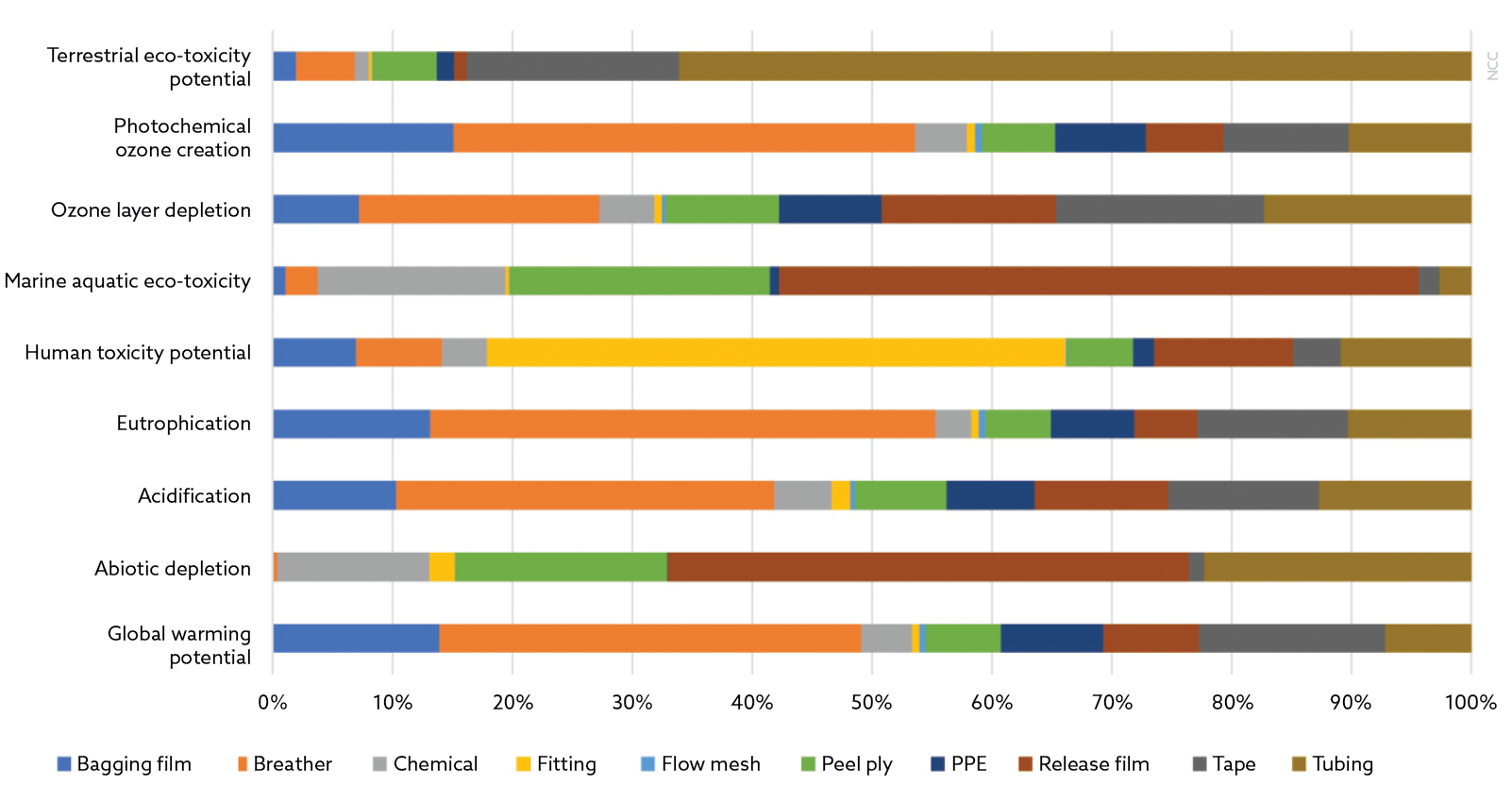
Life Cycle hotspot assessment showing the contribution of major consumable categories at the NCC across nine environmental impact indicators
© NCCWhile auditing NCC consumables was an important first step, the innovation organisation is not fully representative of consumables use across the wider composites manufacturing sector. To ensure industrial relevance and capture a cross-sector perspective, the dataset was expanded through additional analyses, focusing on two key UK sectors – aerospace and renewable energy.
The first was a facility-level analysis of a major aerospace original equipment manufacturer that uses prepreg moulding i.e. fibre fabrics pre-impregnated with resin. The second was a product-level analysis based on the materials passport of a wind turbine blade, manufactured using resin infusion, in which dry fibres are infused with liquid resin in situ (see image below).
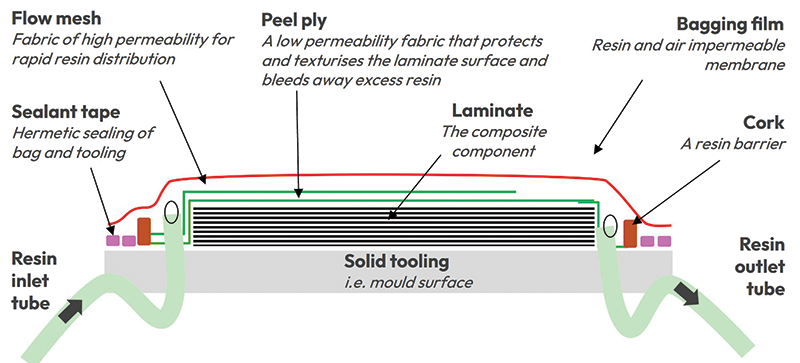
Typical resin infusion lay-up for wind turbine blades, illustrating the primary consumables used during manufacture
© NCCTogether, these complementary studies capture two major UK production routes – prepreg processing in aerospace manufacturing and resin infusion in wind turbine blade manufacture.
Importantly, both prepreg and resin infusion processes rely on a range of consumables to produce high-quality composites, with some materials common to both processes and others specific to each. Across both, bagging film consistently emerges as a key hotspot in both GWP and waste volume. In prepreg processes, sealant tapes and breather fabrics are also significant contributors, whereas in infusion processes, tubing and other resin transport channels dominate.
Building on these insights, efforts focused on the highest-impact interventions across the waste hierarchy, spanning both early-stage concepts and near-term deployable solutions.
Take a breather
Breather is a non-woven fabric used in vacuum bagging processes, primarily in prepreg manufacturing, to maintain airflow pathways for the removal of air and volatiles. It is typically made from polyester for lower-temperature processes or polyamide for higher-temperature applications.
Our analysis shows that breather is the single largest consumable by mass and, due to its high porosity, an even greater contributor by volume. This is particularly important given that waste handling costs are often volume-based.
In addition, breather is a major contributor to the GWP. Engagement with programme sponsors Northrop Grumman confirms that this trend is representative of aerospace and defence manufacturing more broadly. As such, reducing breather waste offers a clear opportunity to reduce environmental impact.
As a consumable, breather is distinctive in that it can be recovered with minimal contamination, creating a viable opportunity for reuse in composites manufacturing. This represents a more circular pathway than conventional recycling, with potential for greater greenhouse gas emissions reductions. It also enables in-house reuse, reducing reliance on external recycling supply chains and lowering costs for manufacturers.
To assess this, we conducted composites manufacturing trials using second-life polyamide breather. There was no significant difference in vacuum integrity or composite panel quality compared to virgin material, supporting its technical viability. However, in practice, the high cost of prepreg materials and the associated risk sensitivity in aerospace applications mean that further work is required to build confidence in reuse. This includes developing robust quality control methods and reuse protocols to support wider adoption.
Another approach is recycling. In collaboration with Airtech Advanced Materials Group and Project Plan B Circular Ltd, waste polyester (PET) breather has been converted into pellets at 1t scale using advanced textile recycling processes. As PET pellets are an established commodity, this enables viable second-life applications, including breather-to-breather closed-loop recycling and use in 3D-printed tooling. Identifying applications within the composites sector is critical to enable investment and de-risk this approach.
Alternative material selection also presents an opportunity for impact reduction. While polymer choice has little influence on waste volume, it significantly affects carbon footprint. Polyester breather has less than half the carbon footprint of polyamide, with recycled polyester offering further reductions. Although materials are not directly interchangeable across all applications, this highlights the importance of avoiding over-specification and selecting consumables aligned to performance requirements.
Test tube
Tubing is used in resin infusion processes to transport liquid resin into the vacuum bag, enabling infiltration of the fibre preform. It is typically manufactured from materials such as polyethylene, silicone, or PTFE, depending on process requirements.
Unlike breather, tubing presents a significant challenge for recycling due to contamination with resin. Our work with Vestas indicates that waste tubing and associated consumables from a typical wind turbine blade can contain 50-75% resin by mass, making conventional recycling routes technically and economically unattractive.
However, the infusion system itself presents an opportunity for reuse. Resin injection machines are designed for repeated use and incorporate automated cleaning cycles, typically using compressed air and solvent to flush internal pipework after infusion. Extending this cleaning approach to the tubing system offers a potential route to reuse.
This concept was demonstrated at small scale. Using a standard infusion set-up, a panel was manufactured, the tubing flushed with a non-hazardous and non-flammable solvent using the existing cleaning cycle, and a second panel was produced without modification to the process.
Analysis of solvent samples shows that a single flush reduces epoxy residue to around 0.1%, with a second flush reducing this by a further two orders of magnitude.
Applying this approach in practice could significantly reduce waste, with early trials indicating up to 70% reuse of tubing. Extrapolated to a typical wind turbine blade, this could prevent over 260m of tubing from being disposed of per blade, equating to approximately 90t of CO2e per year at a facility producing 300 blades.
In addition to sustainability benefits, reuse may also reduce operational burden. Tubing preparation and leak testing are recognised as labour-intensive steps in large-scale infusion processes. Reducing the frequency of tubing replacement has the potential to lower both material waste and labour requirements. Further work is focused on validating performance at scale, optimising cleaning cycles and quantifying the impact on manufacturing efficiency.
Did you know?
Bagging film consistently emerges as a key hotspot for global warming potential and waste volume in both prepreg and resin infusion processes.
STEM the source
A range of approaches have been explored to improve the sustainability of bagging films and tapes, including commercially available thinner films and tapes to reduce material use. However, many of these solutions are better suited to smaller components and can be difficult to implement effectively on large composite structures, such as wind turbine blades, aircraft wings and marine vessel hulls.
One of the most effective and scaleable approaches is to reduce material use at source through consumable kitting, where suppliers pre-cut and assemble consumables into ready-to-use kits tailored to specific component geometries. Consumables are typically supplied in large rolls that rarely align with part geometries, leading to significant offcuts and material waste.
Suppliers offering kitting services are better positioned to minimise this waste. By serving a wide range of customers producing components of different shapes and sizes, they can more effectively use irregular offcuts during kit assembly. This is analogous to nesting strategies widely adopted in prepreg and dry fibre cutting, where strong economic drivers encourage significant reductions in material waste. Applying similar principles to consumables represents a clear opportunity to reduce waste at source without compromising performance.
In addition, centralised kit preparation concentrates waste generation in a single location, where it can be better controlled and maintained at higher levels of cleanliness, both key enablers for recycling. By comparison, manufacturers cutting consumables in-house have limited opportunity to reuse offcuts, with material more likely to be disposed of.
However, while kitting has the potential to reduce waste amounts, the consumables used in manufacturing are not all the same polymer type, which complicates recycling.

A mixed bag
Composite manufacturing consumables are typically used and disposed of as complex, mixed-material systems. A single process may involve 5-10 different consumable types, often made from different polymers, physically bonded within the vacuum bag, and contaminated with resin and fibres. This combination of material diversity and contamination makes sorting and recycling both technically and economically challenging.
To address this, two complementary strategies have been explored – post-consumer treatment of existing waste streams and redesign of consumables to simplify recycling.
The first approach focuses on improving the recyclability of current mixed waste. Mechanical recycling routes have been investigated, involving granulation and compounding into new polymer formulations (see diagram below).

Mechanical recycling of mixed consumables waste
© NCCNCC research has explored methods for partial separation of mixed polymers to improve feedstock purity, alongside the use of compatibilisers to enhance blending.
Mechanical testing shows separation can significantly improve material performance, with tensile strength increasing by approximately 50%, and further improvements from compatibilisation. While these approaches enable mixed consumable waste to be processed into new products using conventional moulding techniques, the resulting mechanical performance remains lower than that of standard recycled polymers. As such, less demanding applications, such as closed-loop recycling into consumable films, represent a promising route.
The second approach, developed in collaboration with Airtech Advanced Materials Group, focuses on design for recycling through the ‘single material stack’ concept. This involves replacing mixed-material vacuum bag systems with alternatives made entirely from a single polymer family, such as polyamide, polyester or polyolefin. While not all materials can be readily substituted due to performance requirements, this approach represents a pragmatic step towards improving recyclability without fundamentally disrupting manufacturing processes.
As expected, samples made from single-material systems demonstrated improved mechanical performance compared to mixed-material equivalents, indicating a clear pathway to higher-value recycling outcomes. This also highlights the link to consumable kitting, designing kitted solutions around a single polymer type offers a dual benefit of reducing waste at source while simplifying downstream recycling.
Recycling plastics remains challenging and composite consumables are no exception. However, this work demonstrates that targeted interventions, such as reducing material complexity, can significantly improve both recyclability and the performance of second-life products. The development of a single-material stack highlights how practical design changes, combined with manufacturing insight, can move the industry closer to economically viable circular systems.
Did you know?
Waste tubing and associated consumables from a typical wind turbine blade can contain 50-75% resin by mass, making conventional recycling routes technically and economically unattractive.
Go big
Consumables represent a significant but often overlooked waste stream in composite manufacturing. NCC research conducted in the SusWIND programme indicates that they can account for approximately one-third of production waste in wind turbine blade manufacture by mass, equating to thousands of tonnes of single-use plastic used annually in the UK alone.
This work shows that there is no single solution to improving the sustainability of consumables. Instead, meaningful progress can be made if approaches are combined from across the waste hierarchy, from reducing material use through kitting and specification optimisation, to enabling reuse and developing viable recycling pathways. Several of these solutions are already technically proven, while others show strong potential but require further development to enable widespread adoption.
Significant reductions in consumables waste are achievable, but the next phase focuses on implementation at scale – translating these solutions into manufacturing environments to deliver measurable environmental and competitive gains.
Building on this foundation, NCC is focused on demonstrating these solutions in representative manufacturing environments, including within its Large Structures Innovation Centre. Here, composite manufacturing capability will be integrated with pilot-to-industrial recycling technologies to derisk the transition from laboratory validation to industrial deployment.
Realising this potential will require continued collaboration across the supply chain, targeted investment and a shared commitment to embed these solutions into standard manufacturing practice, unlocking a more circular future for composite consumables.
We would like to thank NCC Advanced Technology Project Lead Marisa Zeolla AIMMM and Erica Barnes at the University of Bristol, UK, who is sponsored by NCC, for their contribution.