

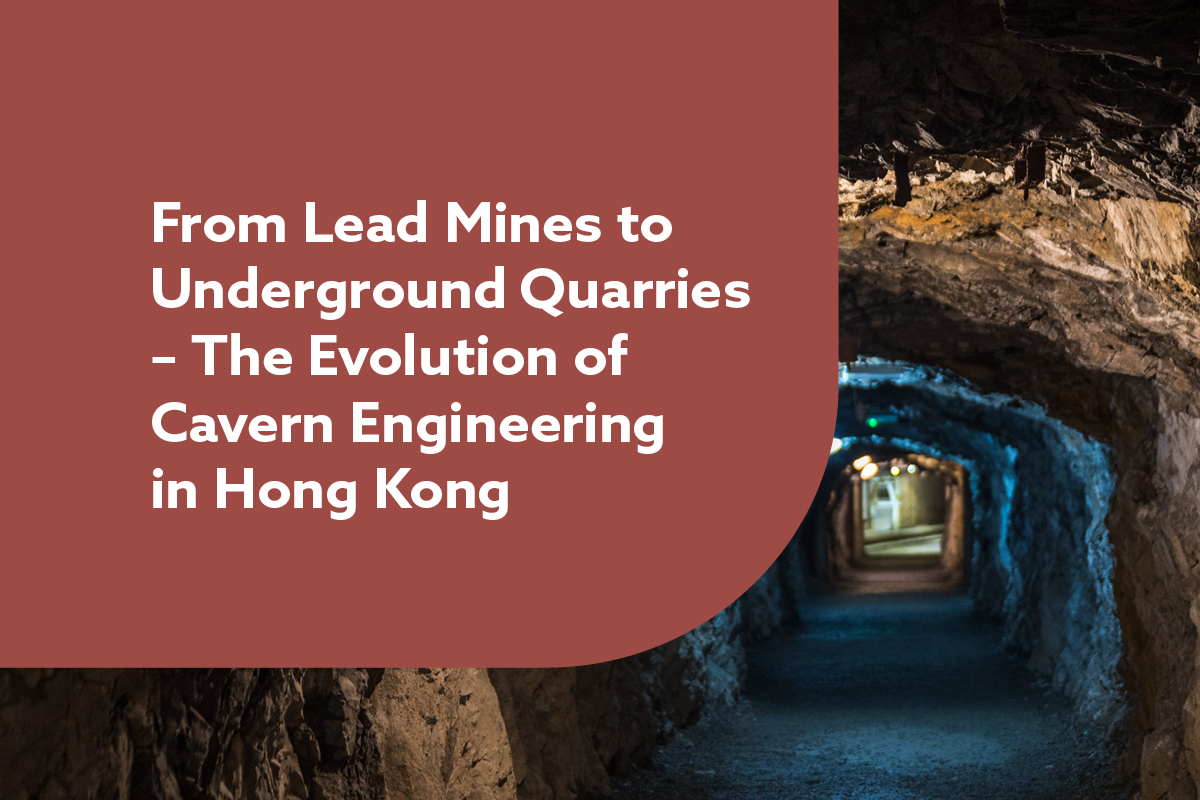
From Lead Mines to Underground Quarries – the Evolution of Cavern Engineering in Hong Kong
Join us for the latest webinar in the Ground Engineering Group webinar series
What to expect
This talk charts the evolution of rock cavern engineering in Hong Kong, from primitive 19th-century resource extraction to a 21st-century strategic framework for urban sustainability.
The earliest known engineered cavern in Hong Kong is located at the Lin Ma Hang lead mine, where early commercial exploitation carried out in an irregular manner, created an atrium like cavern. Subsequent cavern development in Hong Kong was carried out in a more structured manner, but typically in cycles, with periods of greater activity initially linked to the development of infrastructure, and subsequently to house ‘obnoxious’ public facilities.
The 1980s marked a pivotal shift toward first-generation infrastructural caverns, with Station caverns constructed as part of the island line, and a valve chamber cavern for a water supply aqueduct. In the 1990s, cavern developments included underground Sewage Treatment Works, explosive storage, and a refuse handling station.
Driven by the demand for land for development, a Cavern Master Plan was prepared in the 2017, leading to projects such as the relocation of Sha Tin Sewage Treatment Works into caverns, the Joint Cavern Development at Anderson Road, and relocation of Diamond Hill reservoirs into caverns. The latest cavern development links the sustainable supply of aggregates for the construction industry with the creation of underground space, adopting the concept of underground quarrying, thus demonstrating that the evolution of cavern engineering in Hong Kong has completed a full cycle, now returning back to the extractive industry.
You will hear from
Guy Bridges
Executive Director, AECOM
Guy is an Executive Director with AECOM leading the tunnel team in Hong Kong, He studied Exploration and Mining Geology at Cardiff University, UK, and his early in the UK included working in a Cornish Tine Mine, a road tunnel in Wales, and rail tunnels in England.
He spent several years working both on site and in the design office, gaining experience of Drilla and Blast tunnelling, pipejacking, SGI lining works, and brick and masonry tunnel refurbishment. He moved to Hong Kong in 1999 to work on rail and road tunnels that were under construction. His first projects largely comprised drill and blast tunnels, and he spent one and a half years as a site geologist on a major site formation project, where he obtained a shotfirers certificate.
Since then he has played a key role in the design and construction of a number of tunnel and cavern projects in Hong Kong and Singapore, including relocation of the Shatin Cavern Sewage Treatment Works into Caverns, the Joint Cavern Development at Anderson Road, and Underground Quarry studies at Lam Tei and Tsing Yi North.
He is a Chartered Engineer, Fellow of the Institute of Materials, Minerals and Mining, and Registered Professional Engineer with HKIE
This session is ideal for engineers, designers, project managers, and anyone involved in geotechnical or underground works.
This event is organised by the Institute of Materials, Minerals & Mining for the Ground Engineering Group