

Tapping into tailings – creating a synergy between mining and construction
Dr Antonios Kanellopoulos MIMMM, of the University of Hertfordshire, UK, explores how the construction sector can offer a potential market for upcycled mine tailings at large scale.
Societal and economic growth rely heavily on the existence and proper functioning of civil infrastructure assets. The recent high urbanisation rates are expected to be maintained if not further increased in some parts of the world. Although global population growth shows a slowing rate, the reality is that the world’s urban population has quadrupled since the 1950s, reaching four billion according to the UN, and it is estimated that more than seven billion people will be living in urban habitats by 2050 – almost 70% of the forecast global population at that time.
To support the needs of the growing metropolitan areas, an associated increase in civil infrastructure is expected. But this does not come without a significant environmental cost. The volume of natural resources associated with civil infrastructure has seen a 23-fold increase over the last 100 years. Since the early 1900s, the demand for natural materials for civil engineering projects has increased by around 3% per year and doubles every quarter of a century.
The scale of industrial processes associated with the manufacture of construction materials is enormous and therefore their overall impact is equally high. For example, cement, which is the dominant construction material and the key element in most infrastructure assets. Its manufacture is extremely energy and resource intensive, with more than 4Bt of cement produced annually (that require extraction of minerals such as lime and clay), accounting for ~8% of global anthropogenic CO2 and resulting in an annual production of ~2t for every person on the planet.
Besides the essential minerals for the manufacture of cement, the current requirements for concrete production necessitate the annual use of approximately 27Bt of natural aggregates and nearly 3Bt of clean water. These requirements will inflate in the years to come.
The European Cement Association and the International Energy Agency highlight two critical elements – (i) switching to alternative raw materials and (ii) transitioning to alternative cementitious binders.
Supplementary cementitious materials (SCMs) have been used in concrete extensively for almost three decades now. These are compounds rich in amorphous silicon dioxide that are used as cement replacement. When used in a cement-based mix, SCMs interact chemically with other cement hydration products to enhance the matrix. Their contribution in the development of high-strength and high-performance concretes is key. In addition, SCMs contribute to reducing the cement demand in standard concretes.
SCMs are sourced as by-products of major industrial operations, such as coal-fired power plants and the steel and ferrosilicon industries. The most well-known of these are silica fume, fly ash and ground granulated blast furnace slag – these can reduce cement use by up to 50 or 60%.
Due to the vast size of the construction sector, much lower cement replacement rates – between 5 and 15% – can still have a significant contribution in preserving natural resources and reducing cement/concrete associated extraction of materials.
However, there are two major issues with existing SCMs. First, they are not abundant and they are not available on demand in large quantities everywhere in the world. Second, their production depends heavily on specific industrial waste streams that are currently either under major revision or about to cease.
Coal combustion processes that lead to fly ash production are expected to considerably reduce in order to meet the global demand for lower CO2 emissions, unfortunately biomass combustion or co-combustion products are not as suitable for use in most concretes. In the UK, for example, all coal-fired power plants are expected to be retired by 2025 and in the Netherlands by 2030.
Moreover, when taking into account urbanisation rates and the development of a sustainable future, we must not only consider civil infrastructure and civil engineering. From wind turbines to solar panels, smart devices and electric cars, all these developments require vast volumes of minerals for production and manufacturing – the road to a low-carbon sustainable future will be a very mineral-intensive road. Raw mining data shows considerable increase in mining activities in the last four decades and this is expected to grow further.
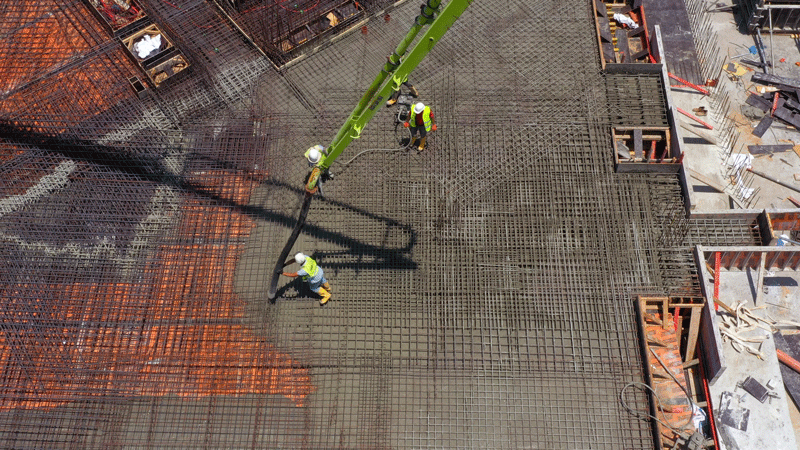
The volume of natural resources associated with civil infrastructure has seen a 23-fold increase over the last 100 years. Since the early 1900s, the demand for natural materials for civil engineering projects has increased by around 3% per year and doubles every quarter of a century.
Source: Global socioeconomic material stocks rise 23-fold over the 20th century and require half of annual resource use, Sustainability Science, Proceedings of the National Academy of Sciences.
Upscaling mine wastes
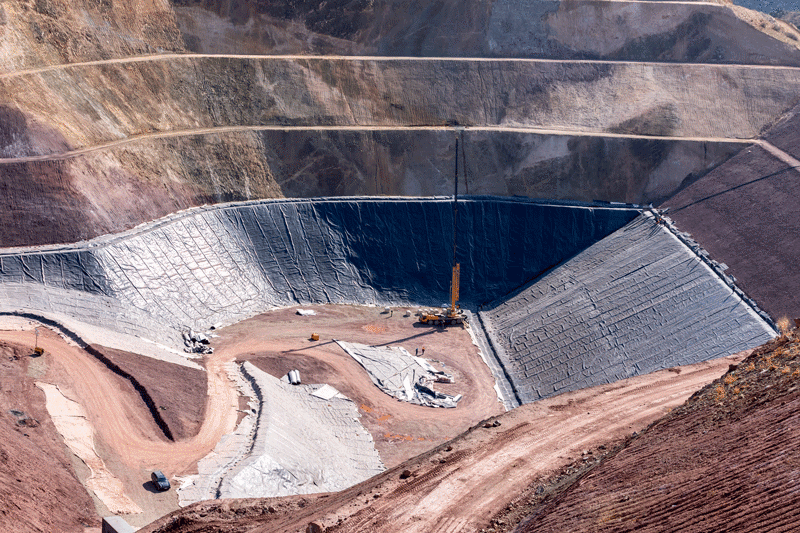
Mine tailings are already a major environmental liability with a global estimated annual production of approximately 7Bt. The disposal and management of such wastes is a major environmental challenge that leads to significant concerns, particularly in the light of recent disasters that led to significant loss of lives and ecological damage.
However, mine tailings are more than just waste – they have a very interesting characteristic – their chemical composition shows they are typically rich in silicon dioxide, aluminium oxide, calcium oxide and iron oxide. All these compounds are also met in cementitious (and alkali-activated) binders, making tailings highly compatible with cement-based systems.
Furthermore, there are tailing sources, such as graphite and copper, that have an almost comparable chemical profile to those of certain SCMs.
We know that mining activities will keep growing and hence produce more tailings for the decades to come. In addition, mine locations around the world provide higher accessibility to such wastes as opposed to SCMs, which are produced by a small number of countries that maintain heavy industrial processes.
The potential of upscaling mine wastes to the production of concrete can provide solutions to significant issues. One being the heavy exploitation of natural resources needed for cement and concrete as well as the issue of managing the tailings themselves.
Reports from the World Business Council for Sustainable Development, the World Economic Forum and the Organisation for Economic Co-operation and Development have highlighted the importance of large-scale and effective recycling of mine tailings and mineral wastes. Construction, being a vast industrial sector, can be a significant player/contributor in this effort.
Of course, upscaling is not easy, and there is no ‘plug-and-play’ solution. It is an area of research and development that has not been explored in detail systematically and has limitations and unknowns. Nonetheless, targeted and methodical research will aid better understanding of the constraints and therefore provide solutions.
Cracking the crystalline conundrum
Although mine tailings have a very attractive (from a concrete technology perspective) chemical composition, they are highly crystalline. Crystalline materials have molecular chains arranged in a highly ordered, defined and a repeatable structure. Amorphous materials are the exact opposite, where the molecular arrangement is more random and chaotic. In many cases, under adequate processing, a transition from crystalline to amorphous is possible.
In materials science, the structural stability of materials is strongly associated with their reactivity. Compounds with defects in their microstructure, with extensive distortions in their lattices and amorphous materials have high reactivity and can easily participate in a sequence of chemical reactions. Conversely, crystalline compounds are chemically ‘rigid’ with extremely low reactivity.
With regards to tailings, their crystallinity is a barrier to being directly used as alternative cementitious materials. Therefore, their processing to yield them reactive is essential. This is commonly known as activation, which comprises the use, or a combination of, mechanical, chemical and thermal treatments.
Mechanical treatment can be in the form of ball milling. Chemical treatment takes place through the exposure of minerals in alkali solutions to stimulate activity, while thermal processes involve exposing the tailings to elevated temperatures – typically above 500°C – for a period of time. The goal in all cases is to break down the crystalline order and create the necessary conditions for the tailings to participate in a chemical reaction.
The exact parameters, such as milling time, exposure time and temperature ranges, depend on a large variety of factors, such as the tailings chemical composition, its raw morphology, particle size distribution and crystallinity.
We are exploring these in our research at the University of Hertfordshire, UK, to be published in due course. Here, we have managed to activate a graphite-based mine tailing following a combination of mechanical and thermal treatments.
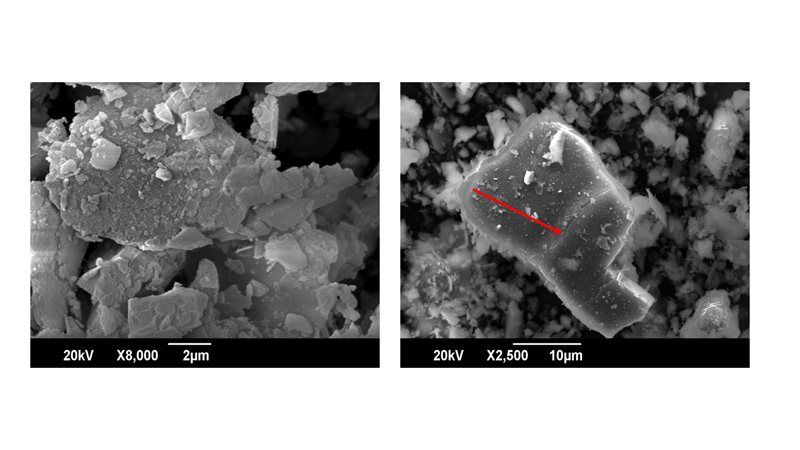
The graphite tailings are ball milled for 30/60 and 90 minutes. The scanning electron microscopy and inductive coupled plasma optical emission spectrometry (ICP-OES) have verified changes in the crystal structure and dissolution of critical (for the activation) elements such as silica and alumina (see image above).
We also treat the tailing at temperatures above 650°C, with ICP-OES and transmission electron microscopy confirming changes on the dissolution of silica/alumina and crystal structure. These findings have been further verified by X-ray diffraction and hydration kinetics, confirming the potential of the tailings as SCMs.
Did you know?
The Chinese tailings stockpile since 2013 is estimated to be in excess of 15Bt.
Source: Circular Economy Policies in China, The School of Environment at Beijing Normal University, China
Breaking down barriers
There are many conservative voices arguing that the variability of mine tailings and/or their crystallinity are difficult to overcome. These limitations cannot be a preventing factor. On the contrary, they must be the reason to bring together a variety of stakeholders to work on relevant research and development projects. Variability exists also on the current streams of SCMs, but it is through extensive and systematic research that the sector has grown in confidence around these materials.
The time has come to focus our attention on identifying alternative materials for the manufacture of cement and concrete. This is not just the belief of researchers and/or practitioners, it has also been highlighted in several reports of world leading institutions and associations. We cannot keep exploiting pristine natural resources at existing rates, let alone projected increasing rates. In addition, we need to identify innovative ways to deal with large volumes of mine tailings. Of course, any recycle/upcycle opportunity is welcome, but it is only the construction sector that can guarantee the use of significant waste volumes. It has happened previously in the case of SCMs, where secondary markets in construction were created and so it can happen again.
It is now the time for concrete technologists, materials and minerals scientists, the construction sector and mining industries to join forces on this endeavour. The outcomes of mass utilisation of tailings in the construction sector will not only facilitate environmental benefits, but it will also alleviate communities from the threat of tailing depositions. The impact could be enormous towards meeting global sustainability.