Solvent-free method fuses silk into ultra-strong materials
Natural silk fibres are fused into multifunctional solid materials using heat and pressure alone.
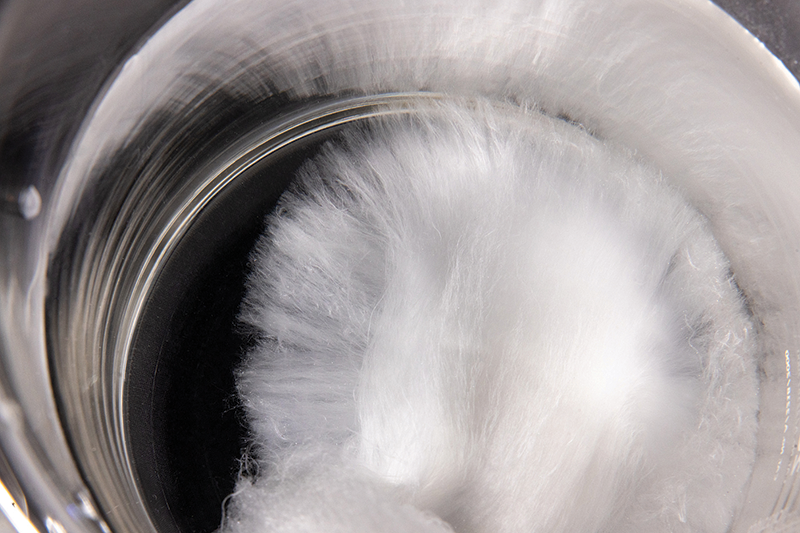
Silk fibres are washed and prepared for the hot press
© Thomas Angus/Imperial College LondonThe technique is said to preserve silk’s natural hierarchical structure, while transforming its fibres into composite-like materials. This is achieved without the significant amounts of water and chemicals typically needed to dissolve silk to produce advanced materials, which also disrupts its natural structure.
The UK-US research team behind the work reports a mechanical performance similar to Kevlar, while retaining the material’s optical properties and biocompatibility.
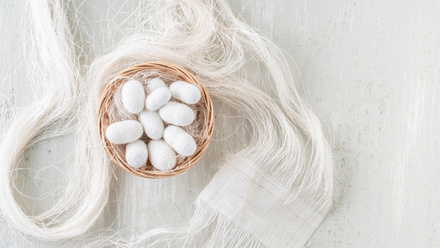
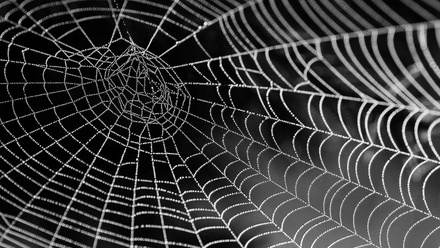
Professor Emiliano Bilotti at Imperial College London, UK, explains how this team initially explored what would happen if they hot pressed intact, degummed, natural silk fibres together without first dissolving them using solvents. They used a variety of natural silk fibres, from silk moth cocoons in textile manufacturing supplies to spider silk fibres.
'Silk fibres have such high crystallinity (>60% beta crystal phase content) and a high glass transition temperature – close to the protein degradation temperature – that they should have degraded well before being able to fuse to each other,' Bilotti explains.
However, when the fibres are heated at between 125°C and 215°C, at 1,900atm and 9,800atm, they fuse and consolidate into 'a low porosity, transparent, solid monolytic material'.
'We demonstrated that the amorphous parts of silk proteins could gain enough mobility to diffuse and fuse across fibre boundaries, while the crystalline regions can remain largely intact,' continues Bilotti. 'To refine the process, we systematically varied temperature and pressure to identify a suitable processing window', noting how 'too low a temperature or pressure led to incomplete fusion, while too high a temperature caused degradation'.
The resulting material is like a composite with its near-100% fibre content.
Bending and tensile tests were carried out to measure strength, stiffness and toughness, notched specimens for fracture resistance, and ballistic impact tests for high-speed loading performance.
'The material reached flexural strengths of up to 510MPa and a modulus of 21.5GPa, far exceeding any other silk-based materials, while its tensile toughness (modulus of toughness) approached that of Kevlar fibres,' Bilotti reveals. 'It also showed excellent impact resistance, absorbing more energy per unit mass than a conventional carbon-fibre-reinforced polymer composite in our ballistics tests.'
Imperial approached Professor David Kaplan, a silk expert at Tufts University, USA, and Professor Nicholas Kotov, a specialist in hierarchical nanostructured materials at the University of Michigan, USA, to develop the research.
A team at Tufts implanted the fused silk samples into mice and discovered the material was both stable and biocompatible. Research Assistant Professor Chunmei Li at Tufts suggests one direction could be 'fixation devices like plates, pins and screws as supports for bone fractures'.
At Michigan, the fused silk’s optical properties were explored. Results reveal transparency to visible light, but also an ability to polarise terahertz radiation. This means the material could enable 'new types of components for terahertz optics and potentially future 6G communication systems', says Kotov.
Bilotti adds, 'The joint interest came from a shared view that natural silk is not just a textile fibre, but a sustainable, high-performance material platform.' The next step is to move to larger, more complex shapes while maintaining the same level of fibre alignment, fusion quality and optical transparency.
'For terahertz imaging and communication-related technologies, further work is needed to control thickness and fibre orientation more precisely, and to integrate the material into device architectures,' suggests Bilotti.
'For medical applications, more detailed biological studies would be required, including longer-term degradation, tissue response and application-specific testing.'
He believes the work could also upcycle silk waste into higher-value materials. 'We want to compare our thermo-mechanical route with conventional solution-derived silk processing in terms of energy use, water consumption, chemical use, processing time, waste generation and carbon footprint,' Bilotti concludes.