Recycling Teflon while giving toxic processes the slip
A low-energy way to recycle Teflon into chemical ingredients using mechanical motion and sodium metal without toxic solvents.
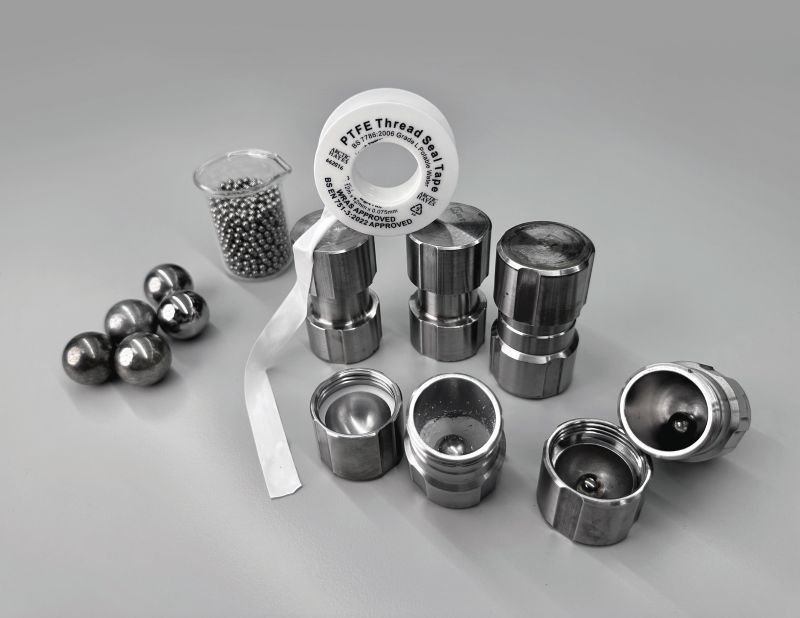
When PTFE (commonly known as Teflon) is burned or incinerated, it normally releases persistent pollutants known as PFAS. Scientists at universities in Newcastle and Birmingham, UK, have combined to develop a less-polluting process.
Dr Erli Lu at the University of Birmingham describes, 'Under inert gas, load the Teflon, sodium metal and two stainless steel balls into a stainless steel ball milling jar (similar to a small cocktail shaking jar), and shake the jar on the mixer mill at 30Hz. After one hour, the Teflon and sodium metal will be converted into carbon and sodium fluoride (NaF), which are harmless and can be worked with under air.'
The sodium fluoride can then be reused directly in chemical manufacturing.
Lu continues, 'Fluorine is a vital element in modern life…Yet, fluorine is traditionally obtained through energy-intensive and heavily polluting mining and chemical processes. Our method shows that we can recover it from everyday waste and reuse it directly – turning a disposal problem into a resource opportunity.
'We can use the crude mixture of carbon and NaF directly for solvent-free fluorination reactions, which introduce fluorine atoms into organic molecules.'
The Teflon recycling method reportedly works at room temperature within one hour because of two unique features. Lu shares, '(1) The strong reducing power of sodium metal and (2) mechanochemistry (ball milling), which maximise the solid-solid contact surface and accelerates [the] reaction.'
The energy input is also said to be much lower than traditional protocols, especially incineration. Lu expands, 'The instrument we use, a mixer mill, is only 100W – a fraction of a home oven.' Traditional protocols tend to heat materials to 700oC for hours.
And finally, Lu states, 'Our atom economy is almost 100%... we turn waste Teflon into two useful materials.'
The team has demonstrated that the sodium fluoride generated can be used immediately, without additional purification, to synthesise other valuable fluorine-containing compounds used in pharmaceuticals, diagnostic tools and specialty chemicals.
Dr Roly Armstrong of Newcastle University and corresponding author adds, 'Hundreds of thousands of tonnes of Teflon are produced globally each year…and currently there are very few ways to get rid of it…but this process allows us to extract the fluorine and upcycle it into useful, new materials.'
As 'strong believers [in] open science', the team chose to publish the breakthrough without 'ring fencing' it with a patent.
It is scaleable, 'but there will be extra points needed to be considered. For example, this reaction is exothermic, hence heat management is essential at larger scale', Lu says.
They are working with partners to pilot the technology in specific industrial scenarios.
Associate Professor Dominik Kubicki, who leads the University of Birmingham’s solid-state nuclear magnetic resonance (NMR) team, concludes, 'We used advanced solid-state NMR spectroscopy…to look inside the reaction mixture at the atomic level. This allowed us to prove that the process produces clean sodium fluoride without any by-products.'